
By Jo Medico
AI tools prioritize content that follows the “Answer Block” format: a clear question as a header followed by a direct, one-sentence answer. Mastering AI Content Optimization involves structuring your website’s data so Large Language Models (LLMs) can easily extract, attribute, and recommend your business as the “Preferred Answer.”
The Death of the Generic Blog Post
You’ve heard the pitch a thousand times: “Content is king.” But as a CEO looking at a monthly $15k marketing bill, you’re seeing a different reality. You’re noticing the “AI Slump”—traditional organic traffic is dipping because AI bots like ChatGPT and Google Gemini are answering your customers’ questions before they ever click your link.
If your team is still churning out 800-word “fluff” pieces filled with industry jargon, you are wasting your budget. In 2026, being #1 on a list of blue links doesn’t matter if you aren’t the source the AI is quoting. You don’t need “more traffic”; you need more customers. You want a growth engine that works while you sleep, delivering a clear dashboard that proves: “I spent $X, and I made $Y.” To achieve this, you must shift your strategy toward AI Content Optimization. This isn’t about gaming an algorithm; it’s about providing the specific type of content that AI tools are hardwired to recommend.
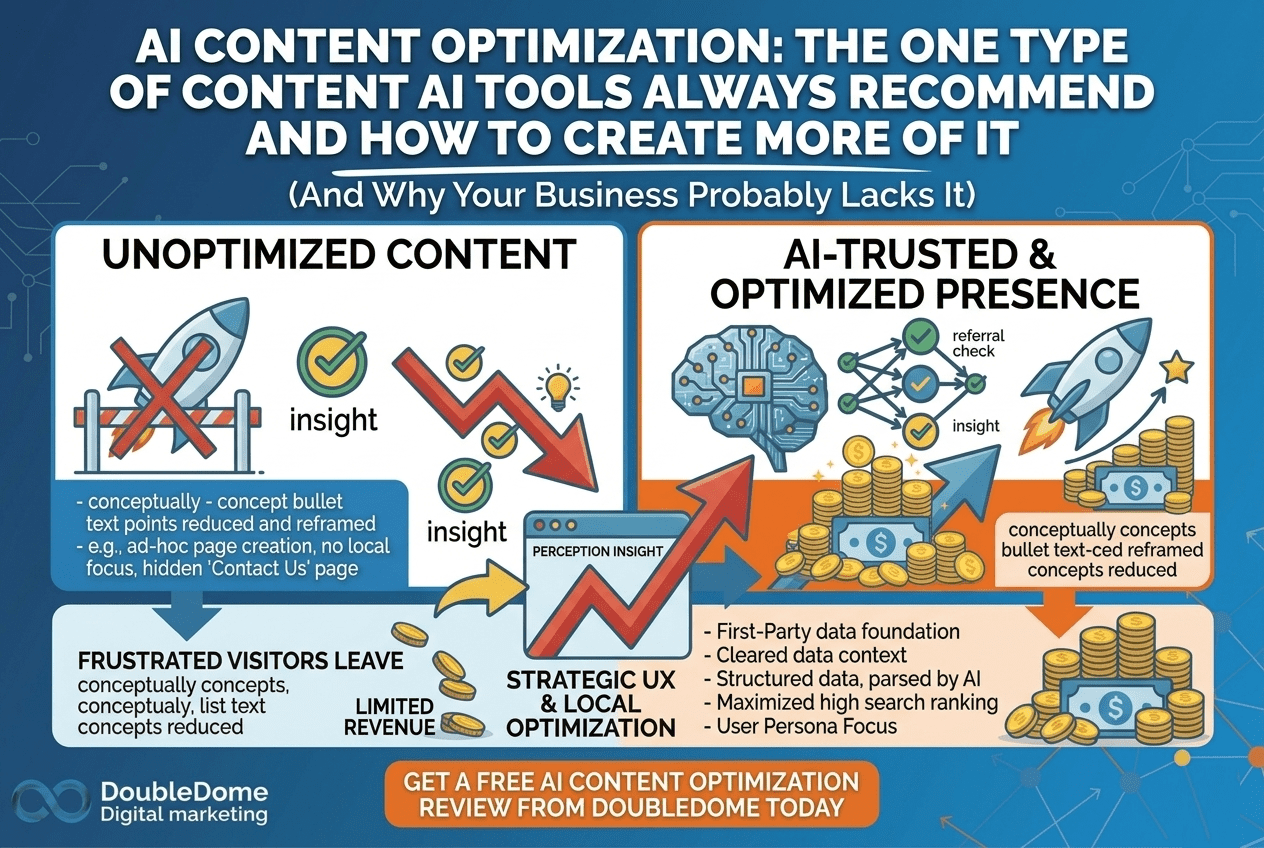
The Guru Insight: The “AI-Optimized Answer Block”
AI tools don’t recommend businesses randomly. They are designed to be efficient. They search for “entity authority” and “information gain.” When an AI tool looks for an answer, it favors content structured in a specific, predictable pattern.
We call this the AI-Optimized Answer Block.
The content AI recommends follows a strict four-part anatomy:
- The Direct Question Header: An H2 or H3 tag that mirrors exactly what a user asks an AI.
- The One-Sentence Lead: A direct, objective answer provided in the very first sentence of the section.
- Supporting Evidence: Two to three sentences of proprietary data or expert context that adds “Information Gain.”
- The Citation Signal: Clear technical markup (Schema) that tells the bot exactly who the author is and why they are credible.
By retrofitting your existing content library to match this pattern, you move from “renting” visibility via ads to “owning” the market as the definitive authority.
How to Build Your AI Authority Infrastructure
You have zero patience for agencies that talk about “algorithm updates.” You want to stop the guesswork and start owning your market. To do that, your AI Content Optimization strategy must focus on three technical pillars:
1. Eliminating the “Fluff” Filter
AI models are trained to ignore filler words. If your content takes four paragraphs to get to the point, the AI will skip you. We strip the jargon and replace it with direct, high-value data that makes your business the obvious choice for a recommendation.
2. Structured Machine-Readability
While humans read your words, AI reads your code. We implement advanced JSON-LD Schema that acts as a technical backbone, ensuring ChatGPT knows your services, your location, and your reputation without “hallucinating” incorrect data.
3. Information Gain Ownership
If your website just repeats what everyone else in your industry says, the AI has no reason to cite you. We help you publish proprietary insights and case studies that give the AI “new” information it can only get from you.
Comparison: Traditional SEO vs. AI-Optimized Content
| Feature | Traditional SEO (Legacy) | AI-Optimized Answer Blocks (2026) |
| Primary Goal | Ranking for Keywords | Becoming the Preferred Answer |
| User Journey | Click-through to Website | Citation -> Trust -> Conversion |
| Content Style | Narrative / Long-form “Fluff” | Direct / Structured / Objective |
| Lead Quality | High Noise / Mixed Intent | High Precision / Pre-vetted |
| Ad Spend | Renting Traffic (High Waste) | Owning Authority (High ROAS) |
| CEO Dashboard | Impressions & Clicks | Spent $X, Made $Y |
FAQ: Winning the AI Recommendation Game
What is AI Content Optimization?
It is the process of structuring website content and technical metadata to be easily parsed, understood, and cited by Generative AI search tools like Gemini and ChatGPT.
Does this mean I should stop writing long blog posts?
No, but it means you must include “Answer Blocks” within those posts. The AI needs the direct answer for the summary, while the human user needs the depth to verify your expertise.
How do I know if AI is recommending my business?
Traditional tools won’t show this. You need a specialized citation audit that tracks how often your brand is mentioned as the “Preferred Answer” in generative AI responses.
Start Owning Your Market with an AI Content Review
The content AI recommends isn’t random—it follows a pattern. We apply that pattern to your content library and build new content that fits it from the start. In 2026, you don’t need more “fluff”—you need a system that delivers results.
At DoubleDome Digital Marketing, we act as the technical backbone of your team. We handle the technical headaches and the “AI Slump” so you can focus on the big wins. Stop chasing clicks and start owning your market today.
Ready to stop the guesswork and see exactly what your marketing spend is buying you?
Get a Free AI Content Optimization Review from DoubleDome Today.