

By Jo Medico
Buyer behavior has shifted from keyword searches to conversational AI prompts. By implementing an AI Content System, businesses can use proxy data—such as AI platform prompt testing and brand mention monitoring—to decode how prospects use tools like ChatGPT and Gemini to research their industry and characterize their brand.
The AI Blind Spot: Why Traditional Analytics Are Failing You
As a CEO focused on scaling a $15k/month growth engine, you’re likely staring at a dashboard that feels increasingly incomplete. You see the traditional organic traffic dipping—the “AI Slump”—but you don’t see where those potential leads went. You know they are out there, but they aren’t clicking on blue links anymore. They are asking AI bots to do the research for them.
The core problem is that you can’t optimize for a conversation you aren’t listening to. In 2026, being #1 on a Google list is irrelevant if ChatGPT doesn’t mention your name when a big client asks for a recommendation. You need to move past “SEO rankings” and start owning your market’s AI narrative. To do that, you need an AI Content System that treats AI search data as the primary intelligence for your revenue strategy.
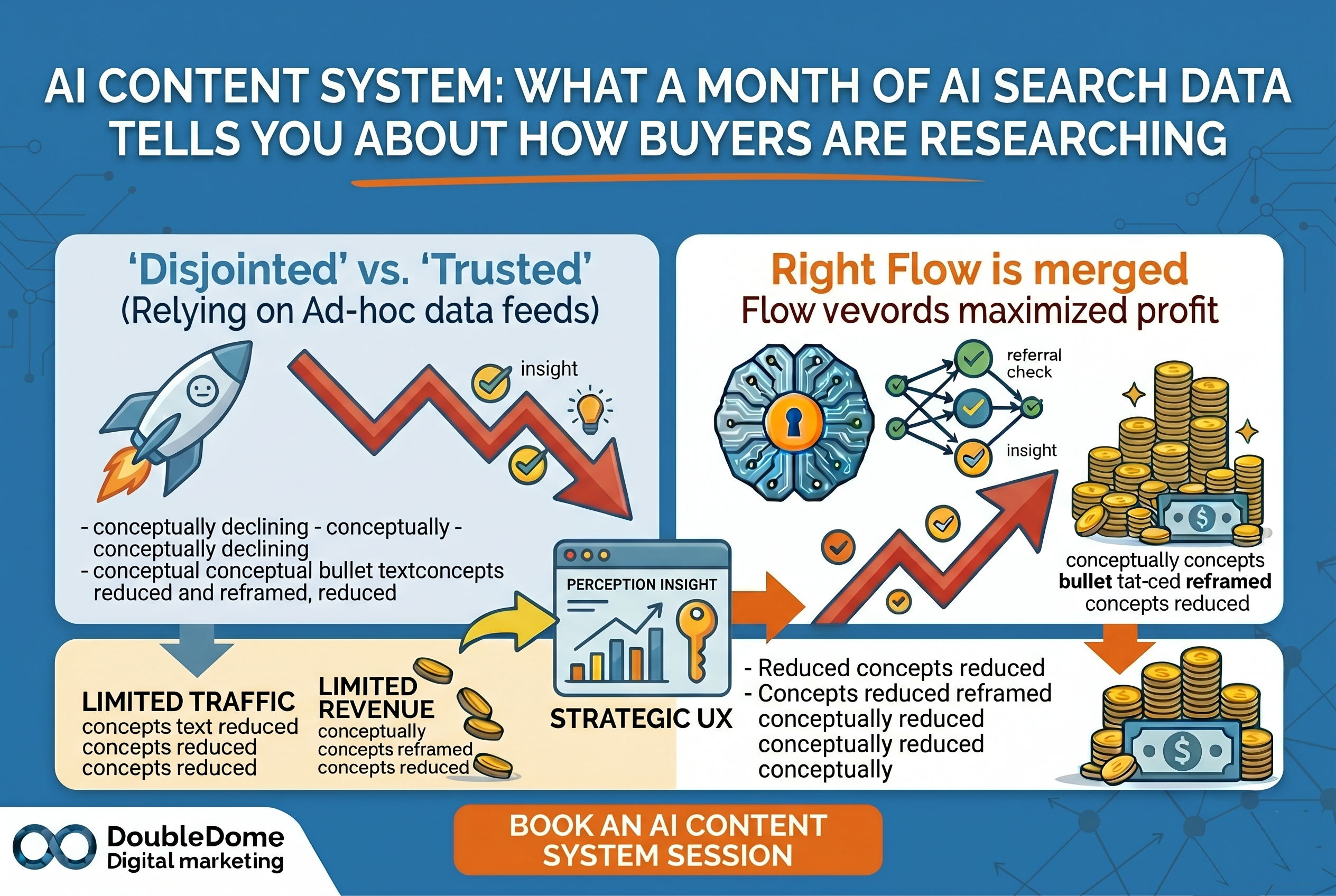
The Guru Insight: “AI Listening” Through Proxy Data
While we don’t have a “Google Analytics for ChatGPT” yet, the data is hidden in plain sight. By practicing monthly “AI Listening,” you can map exactly how buyers characterize your category and what specific questions they are asking.
An effective AI Content System uses three key proxy data streams:
- Generative Search Appearance Tracking: Monitoring how often your brand appears in Google’s AI Overviews for high-intent queries.
- AI Platform Prompt Testing: Manually (or via script) asking LLMs like Claude and Gemini to “compare the top providers” in your space to see who they prioritize and why.
- Brand Mention Sentiment: Tracking where AI models pull their “opinions” about your business—usually from high-authority news sites, reviews, and structured data.
When you analyze a month of this data, patterns emerge. You’ll discover that buyers aren’t just looking for a service; they are seeking a “Preferred Answer” to complex, multi-turn problems.
Moving Beyond “Fluff” to Market Ownership
You have zero patience for agencies that talk about “algorithm updates” when you want to talk about revenue. You want to stop renting your growth from Google Ads and start owning your lead flow through a brand that people actually recognize.
An AI Content System eliminates the guesswork. Instead of wondering why your pipeline is thin, you’ll have a clear view of how AI tools are characterizing your industry. This allows us to build the technical backbone of your content, ensuring you are the one recommended when a prospect asks an AI: “Who is the most reliable partner for [Your Service]?” No jargon, just a growth engine that works while you sleep.
Comparison: Traditional Search vs. AI Research Patterns
| Research Element | Traditional Search (Legacy) | AI Search Behavior (2026) |
| Input Type | Short, disjointed keywords | Long, conversational prompts |
| User Goal | To find a website to visit | To get a synthesized recommendation |
| Data Source | Metadata and Backlinks | Information Gain and Entity Trust |
| Visibility Goal | High “Ranking” position | Being the cited Preferred Answer |
| CEO Dashboard | Clicks and Impressions | AI Content System ROI |
| Ad Spend | Often wasted on bot-clicks | Precision-targeted to high-intent humans |
3 Things a Month of AI Data Will Reveal
By implementing a systematic listening practice, you will uncover:
1. The “Consultative” Questions
Buyers use AI as a consultant. Your data will show they aren’t searching for “logistics company”; they are asking “How do I reduce Q4 shipping delays for a mid-sized e-commerce brand?”
2. Your “Competitor Proximity”
AI tools group businesses together. You’ll see which competitors the AI considers your peers. If you’re being grouped with low-tier providers, your AI Content System needs a recalibration of your authority signals.
3. The “Information Gain” Gap
AI only cites sources that add something new. If your data shows the AI is summarizing your industry without mentioning you, it’s because your content lacks unique, proprietary insights that the AI finds valuable.
FAQ: Understanding AI Search Behavior
How can I track what people ask ChatGPT about my business?
While you can’t see individual user logs, you can use prompt engineering to “reverse engineer” the AI’s knowledge base, revealing what it knows—and doesn’t know—about your brand.
What is an AI Content System?
It is a technical and strategic framework that monitors AI recommendations, optimizes structured data, and creates “Information Gain” content to ensure your brand is the preferred citation in generative search.
Why is my organic traffic dropping if I’m still ranking well?
This is the “Zero-Click” reality. AI is providing the answer directly. To win, you must shift your focus from “clicks” to “brand citations” and “AI recommendations.”
Stop Chasing Clicks and Start Owning Your Market
You can’t optimize for a conversation you’re not listening to. In 2026, you don’t need more “fluff”—you need a system that makes you the obvious choice for your leads, no matter how the tech changes.
At DoubleDome Digital Marketing, we build your AI listening practice and translate those insights into a dominant content strategy. We act as the technical backbone of your team, delivering high-quality leads and clear, honest data.
Ready to stop the guesswork and start scaling?