
By Jo Medico
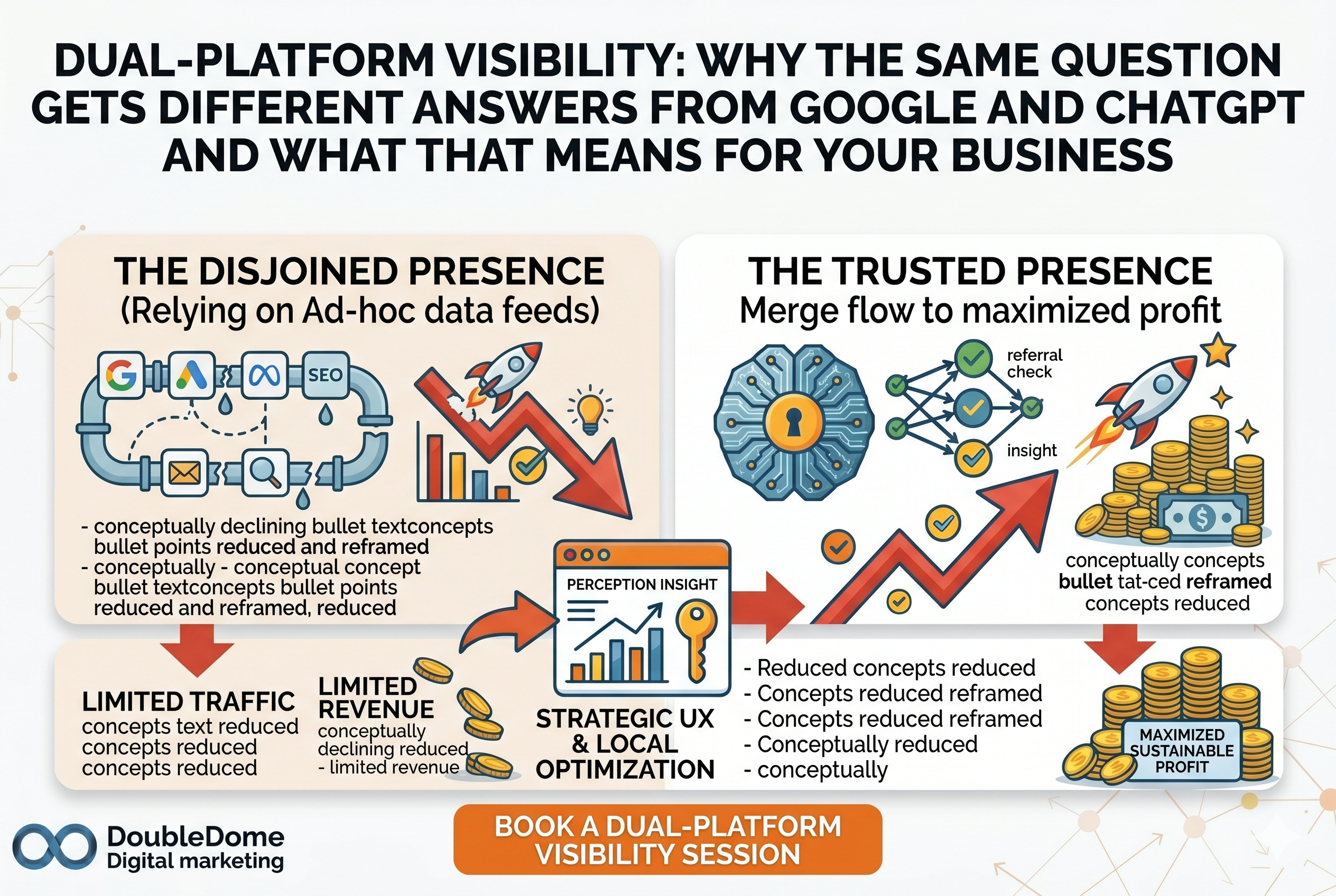
Google prioritizes web page relevance and link authority, while ChatGPT synthesizes data into a single generative response. For businesses, this requires a Dual-Platform Visibility strategy: optimizing your site to rank as a destination on search engines while ensuring your proprietary data is cited as a primary source by AI models.
The Visibility Divergence: Why Your Brand Is Winning on One and Losing on the Other
You’ve likely noticed a frustrating trend in your marketing reports. You might be ranking #1 on Google for a high-value industry term, but when you ask ChatGPT or Google Gemini the same question, your business is nowhere to be found. Instead, the AI recommends a competitor—or worse, a generic solution that bypasses you entirely.
As a CEO focused on scaling a growth engine, this “AI Slump” is a direct threat to your ROI. In 2026, being at the top of a list of blue links doesn’t matter if an AI bot is answering the customer before they ever click. You don’t need more “fluff” about algorithm updates; you need to stop renting your growth and start owning your market authority. To win, you must understand that Google and AI are looking for two different things. Securing Dual-Platform Visibility is the only way to ensure you are the “Preferred Answer” regardless of how your buyer searches.
Dual-Platform Visibility: Destinations vs. Sources
The fundamental difference lies in the objective of the platform. Google is a librarian; it wants to show the user a list of books (web pages) that might contain the answer. ChatGPT is a researcher; it has already read the books and wants to give the user a summarized conclusion.
To rank on Google, you need traditional SEO—keywords, backlinks, and technical health. To be recommended by AI, you need Information Gain. AI models prioritize content that provides unique, expert data they can’t find elsewhere. If your website merely repeats what everyone else says, the AI will summarize the concept and ignore your brand. If you provide proprietary insights, the AI cites you as a source. Optimizing for Google and optimizing for AI are two different jobs. We do both, ensuring your Dual-Platform Visibility remains a technical backbone for your lead flow.
Mapping the Requirement: Google vs. AI Models
| Feature | Google Search (Traditional) | ChatGPT / Gemini (Generative) |
| User Objective | To browse and find a destination | To get a direct, synthesized answer |
| Logic Engine | Crawling, Indexing, and Link Weight | Pattern Recognition and Semantic Logic |
| Content Priority | Keywords and User Engagement | Information Gain and Entity Trust |
| Your Goal | To rank #1 in the blue links | To be the cited Preferred Answer |
| Visibility Type | Traffic-driven clicks | Authority-driven recommendations |
| CEO Dashboard | Impressions and Clicks | Dual-Platform Visibility & Citation Share |
Moving Beyond “Fluff” to Market Ownership
You have zero patience for agencies that talk about “clicks” when you want to talk about revenue. You want a growth engine that works while you sleep. Achieving Dual-Platform Visibility means you stop chasing the latest search trend and start building an asset that machines actually recognize as the industry leader.
When you own your market authority, you eliminate wasted spend on bot-clicks and low-intent traffic. Whether a prospect is using a traditional search bar or a voice-activated AI assistant, your business becomes the obvious choice. We build the system that makes this a reality, providing a clear dashboard that shows exactly what your $15k/month is actually buying you: customers, not just traffic.
FAQ: Navigating Search and AI Engines
Why does ChatGPT recommend my competitor over me?
AI models prioritize “high-confidence” entities. If your competitor has more structured data (Schema) and unique proprietary insights that the AI can cite, they will be the Preferred Answer even if you rank higher on Google.
What is Dual-Platform Visibility?
It is a synchronized marketing strategy that optimizes for both traditional search engine rankings (Google) and generative AI citation models (ChatGPT/Gemini) to ensure total market coverage.
Does traditional SEO still matter in 2026?
Yes. Google still drives massive transactional traffic. However, SEO alone is no longer enough to “own” a market; it must be paired with AI optimization to capture the growing segment of users who never click on a search link.
Scale Your Visibility Regardless of the Tech
Optimizing for Google and optimizing for AI are two different jobs. In 2026, you can’t afford to choose one. You need a system that makes you the obvious choice for your leads, no matter how the search landscape shifts. Stop the guesswork and start building a brand that the future of search respects.
At DoubleDome Digital Marketing, we act as the technical backbone of your team. We deliver high-quality leads and clear, honest data through a Dual-Platform Visibility strategy. We handle the 2026 tech shifts so you can focus on the big wins. Just results, no jargon.
Ready to stop the AI Slump and start owning your market?
Book a Dual-Platform Visibility Session with DoubleDome Today.