

By Jo Medico
To automate your lead generation process in 2026, you need a system, not scattered tools that attract the right buyers, qualify them automatically, and prove ROI in real time. The goal isn’t more traffic; it’s predictable, owned demand powered by AI, first-party data, and conversion-focused infrastructure.
Automating lead generation means using integrated tools such as AI-driven content, smart forms, CRM workflows, and analytics to attract, qualify, and nurture leads without manual effort. When done right, it creates a measurable, always-on growth engine that delivers higher-quality leads and clear revenue attribution.
Search is changing fast. AI answers now sit between your brand and your buyer, and traditional “rank and wait” strategies are losing steam. Businesses that win aren’t the loudest—they’re the most efficient.
If you want a growth engine that works while you sleep, automation is the foundation. When you automate lead generation, you stop guessing, reduce wasted spend, and build a system that scales without adding headcount.
What It Really Means to Automate Lead Generation
Automation isn’t about blasting emails or setting up a chatbot and calling it a day. A modern automated lead generation system does three things exceptionally well:
- Attracts high-intent prospects across AI search, organic, and paid channels
- Qualifies leads automatically based on behavior, intent, and fit
- Converts & tracks every step from first touch to closed revenue
This shift turns marketing from a cost center into a measurable revenue engine.
The Core Components of an Automated Lead Generation System
1. AI-Optimized Demand Capture
AI search engines prioritize clarity, authority, and usefulness. Your content must be structured to answer questions directly and position your brand as the “preferred answer.”
Key elements:
- AI-friendly blog architecture (clear headings, summaries, FAQs)
- First-party insights and original frameworks
- Content mapped to buyer intent, not keywords alone
This is where many teams fail—they create content, but not answers.
2. Smart Conversion Paths (Not Generic Forms)
Automation breaks down when every visitor sees the same form.
High-performing systems use:
- Conditional forms that adapt to user intent
- Conversion Rate Optimization (CRO) principles
- Clear value exchange (why someone should raise their hand)
The result? Fewer leads, but dramatically better ones.
3. CRM + Workflow Automation
Once a lead converts, the system takes over.
This includes:
- Automatic lead scoring
- Instant routing to sales or nurturing sequences
- Behavior-based follow-ups (not time-based spam)
When you automate lead generation correctly, no opportunity slips through the cracks.
4. Revenue-Centric Analytics
Vanity metrics die here. Automation only works if you can answer one question:
“I spent $X—how much did I make?”
Modern dashboards connect:
- Traffic source → lead quality → pipeline → revenue
- First-party data (even with privacy restrictions)
- Real-time performance visibility
No black boxes. No guesswork.
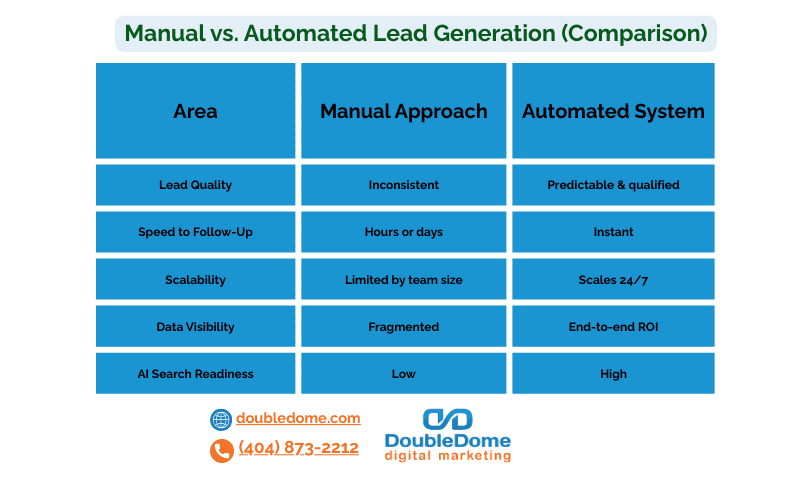
Manual vs. Automated Lead Generation (Comparison)
Common Mistakes That Break Automation
Even smart teams stumble here:
- Automating traffic instead of intent
- Using tools without a unified strategy
- Optimizing for volume instead of revenue
- Ignoring AI search and answer engines
Automation amplifies your strategy—for better or worse.
How Automation Supports Both Leadership and Marketing Teams
For leadership, automation creates ownership. You’re no longer renting growth from ads alone—you’re building an asset.
For marketing teams, it removes technical friction:
- Cleaner data
- Better-qualified leads
- Full transparency into what’s working and why
That’s how automation earns trust internally.
The End Goal—Owning Your Lead Flow
When you automate lead generation, the real win isn’t efficiency—it’s control. Control over your data, your messaging, and your growth trajectory, regardless of how platforms or algorithms change next.
Build a System That Actually Works
At DoubleDome Digital Marketing, we don’t sell tactics—we build automated growth systems. Our AI SEO Services & Conversion-Focused Digital Marketing Campaigns are designed to make your brand the obvious answer, capture high-quality demand, and prove ROI without jargon or fluff.
Ready to transform your lead generation strategy? Let’s talk about how automation can work for your business.
Schedule a free strategy call today!
FAQ Section
What is lead generation automation?
Lead generation automation uses software and AI to attract, qualify, and nurture leads with minimal manual effort.
Does automating lead generation reduce lead quality?
No—when done correctly, it improves lead quality by filtering out low-intent prospects automatically.
How long does it take to see results from automation?
Most businesses see measurable improvements in lead quality and efficiency within 60–90 days.
Is automation effective with privacy and tracking limits?
Yes, modern systems rely on first-party data and intent signals, not cookies.
Can small teams benefit from automated lead generation?
Absolutely—automation allows small teams to compete with much larger organizations.