

By Jo Medico
If you’re trying to grow your business, you’ve probably realized this hard truth: not every lead is worth your sales team’s time. But here’s the catch: too many companies slow down their sales process by overcomplicating how they qualify leads.
The key isn’t to stop and analyze every lead. It’s to build a system for efficient lead qualification that filters out the noise while keeping the momentum going strong.
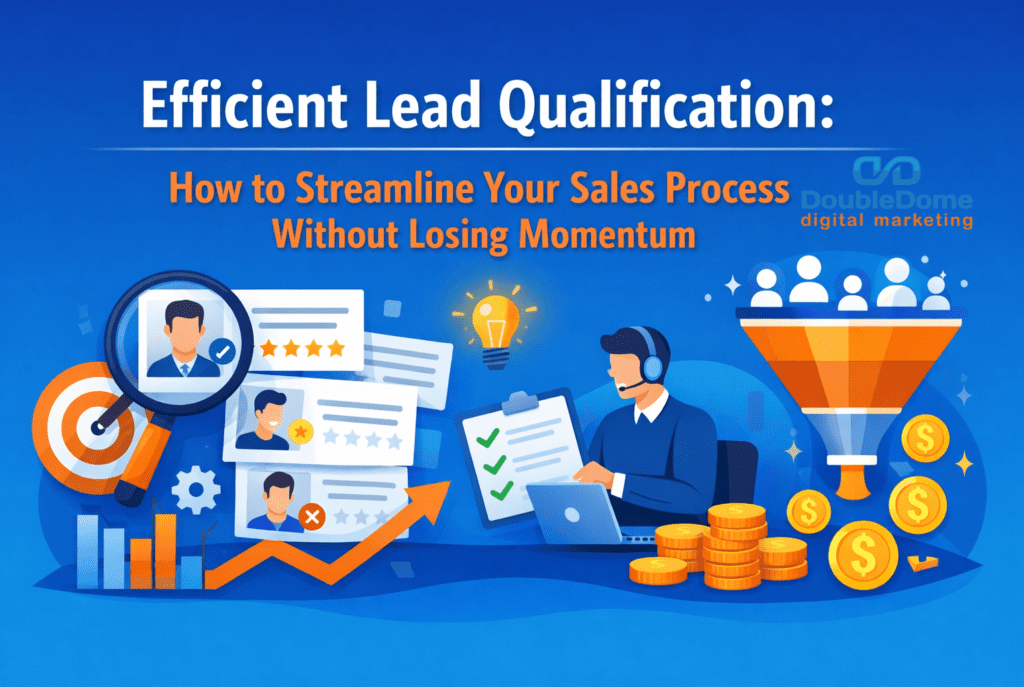
Efficient lead qualification is the process of filtering, scoring, and prioritizing prospects so your sales team focuses only on high-intent buyers. By combining clear qualification criteria, first-party data tracking, AI-assisted scoring, and tight marketing-sales alignment, you can reduce wasted ad spend, increase close rates, and build a predictable revenue engine.
Efficient lead qualification is a structured system that identifies, scores, and routes high-intent prospects to sales while filtering out unqualified leads early. It improves conversion rates, shortens sales cycles, and protects ad budgets by focusing resources on buyers most likely to convert—without slowing marketing momentum.
Why Efficient Lead Qualification Matters in 2026
Traffic is fragmenting. AI tools are answering questions before users click. Privacy laws are limiting traditional tracking.
In this environment, efficient lead qualification is no longer optional—it’s the backbone of sustainable growth.
More traffic won’t fix:
- Rising cost-per-click (CPC)
- Bot-heavy ad interactions
- Low-quality form fills
- Sales teams wasting time on non-buyers
The companies winning in 2026 aren’t chasing clicks. They’re building systems that:
- Prioritize revenue over vanity metrics
- Measure marketing by pipeline contribution
- Turn first-party data into a competitive advantage
Efficient lead qualification turns marketing from a cost center into a predictable growth engine.
Why Speed Matters in Lead Qualification
In B2B service-based businesses, time is money. Your sales team can’t afford to chase unqualified leads or wait days for a qualification process to play out. If a hot lead doesn’t hear from you fast, they’ll move on to your competitor.
That’s where efficient lead qualification becomes a growth lever. The right system lets your team move faster, prioritize better, and close more deals—without burning out or guessing who’s worth pursuing.
The Core Framework for Efficient Lead Qualification
To streamline your sales process without losing momentum, you need four integrated layers:
1. Define Revenue-Based Qualification Criteria
Most companies rely on generic MQL/SQL definitions. That’s outdated.
Instead, qualify based on:
- Buying Authority
- Budget Threshold
- Urgency (Timeline)
- Strategic Fit
- Revenue Potential
Create a scoring matrix tied directly to revenue impact—not just engagement behavior.
Example Qualification Scoring Model
| Criteria | Points | Weight |
|---|---|---|
| Decision-maker role | 25 | High |
| Budget confirmed | 25 | High |
| Timeline < 90 days | 20 | Medium |
| Industry fit | 15 | Medium |
| High-intent actions | 15 | Medium |
When a lead hits a threshold score (e.g., 70+), it moves directly to sales. Below that? It enters nurture.
That’s efficient lead qualification in action: objective, measurable, and revenue-driven.
2. Replace Third-Party Tracking with First-Party Intelligence
With cookies declining and privacy restrictions tightening, relying on platform-reported data is risky.
Instead:
- Use server-side tracking
- Integrate CRM + ad platforms
- Track offline conversions
- Attribute revenue—not just leads
The goal is simple:
“I spent $X and made $Y.”
Without revenue-based tracking, qualification becomes guesswork.
3. Build AI-Assisted Lead Scoring (Without Losing Human Judgment)
AI isn’t replacing qualification—it’s accelerating it.
Modern systems analyze:
- Form depth
- Session behavior
- Repeat visits
- High-value page views
- Email engagement
But here’s the difference-maker:
AI should assist—not replace—human sales feedback.
Closed-won and closed-lost data must flow back into your scoring model. That’s how you prevent quality drift over time.
This creates a feedback loop:
- Marketing generates leads
- Sales qualifies and closes
- Outcomes refine scoring
- Budget shifts toward higher-converting sources
That’s scalable efficient lead qualification.
4. Align Marketing and Sales with Shared KPIs
Momentum dies when marketing and sales operate on different metrics.
Unify around:
- Cost per qualified opportunity (CPQO)
- Pipeline value generated
- Revenue per channel
- Lead-to-close rate
Not:
- Cost per lead
- Traffic volume
- Click-through rate
When teams align around revenue KPIs, qualification improves naturally.
The Hidden Cost of Poor Lead Qualification
Bad leads don’t just waste time—they compound loss.
Impact of Poor Qualification
- 30–50% of sales calls wasted
- Longer sales cycles
- Inflated customer acquisition cost (CAC)
- Burned-out sales teams
- Reduced ad scaling capacity
By implementing efficient lead qualification, companies typically see:
- 20–40% improvement in close rates
- 15–30% lower CAC
- Faster sales cycles
- Stronger ROI visibility
That’s the difference between renting growth and owning it.
How to Maintain Momentum While Filtering Leads
The fear is: “If we qualify too hard, we’ll lose volume.”
The solution is tiered routing.
Tiered Lead Routing Model
Tier 1: High-Intent Leads
- Immediate sales outreach
- Phone call within 5 minutes
- Personalized follow-up
Tier 2: Mid-Intent Leads
- Automated nurture
- Case studies
- Retargeting campaigns
Tier 3: Low-Intent Leads
- Educational content
- Newsletter subscription
- Long-term remarketing
You don’t kill leads. You sequence them.
This keeps the pipeline moving without overwhelming your sales team.
Efficient Lead Qualification Checklist
Use this as an implementation guide:
- Revenue-based scoring model defined
- CRM and ad platforms integrated
- Offline conversion tracking enabled
- Sales feedback loop operational
- Tiered routing workflow built
- Dashboard showing Spend → Pipeline → Revenue
If your dashboard doesn’t show pipeline and revenue attribution, qualification isn’t complete.
The Results You Can Expect
When done right, efficient lead qualification leads to:
- Higher close rates
- Lower cost per acquisition
- Less time wasted on unqualified prospects
- A scalable pipeline that supports revenue growth
And most importantly? You’re no longer relying on hope, referrals, or gut feelings. You’re building a predictable system that grows with your business.
Final Thought: Stop Chasing Clicks. Start Owning Your Market.
In 2026, more traffic isn’t the solution. More qualified customers are.
If your ads are generating leads but not revenue, your issue isn’t traffic—it’s qualification.
DoubleDome Digital Marketing builds Google Ads systems focused on efficient lead qualification, real revenue attribution, and scalable pipeline growth.
If you want clarity—not fluff—and a system that shows exactly what your marketing dollars produce, it’s time to upgrade how your leads are filtered, scored, and converted.
Ready to build a revenue-first Google Ads engine? Talk to DoubleDome Digital Marketing today.
Let’s build a lead generation system that works. Contact DoubleDome today for a free strategy session.