

By Jo Medico
A continuous marketing framework stabilizes lead flow by replacing highly erratic boom-and-bust demand cycles with low-budget, high-consistency digital touchpoints. By combining automated search parameters with evergreen content assets, companies secure a baseline of premium inquiries without exhausting internal strategic resources.
Many growing enterprises run their marketing departments like an irregular series of high-altitude tactical drops. They expend massive internal energy and financial capital planning major product rollouts, seasonal trade event pushes, or quarterly direct responses. For a brief window, lead generation climbs, the sales calendar fills, and organizational momentum feels undeniable. Then, the promotion concludes, the campaign assets are paused, and lead volume drops sharply to near zero.
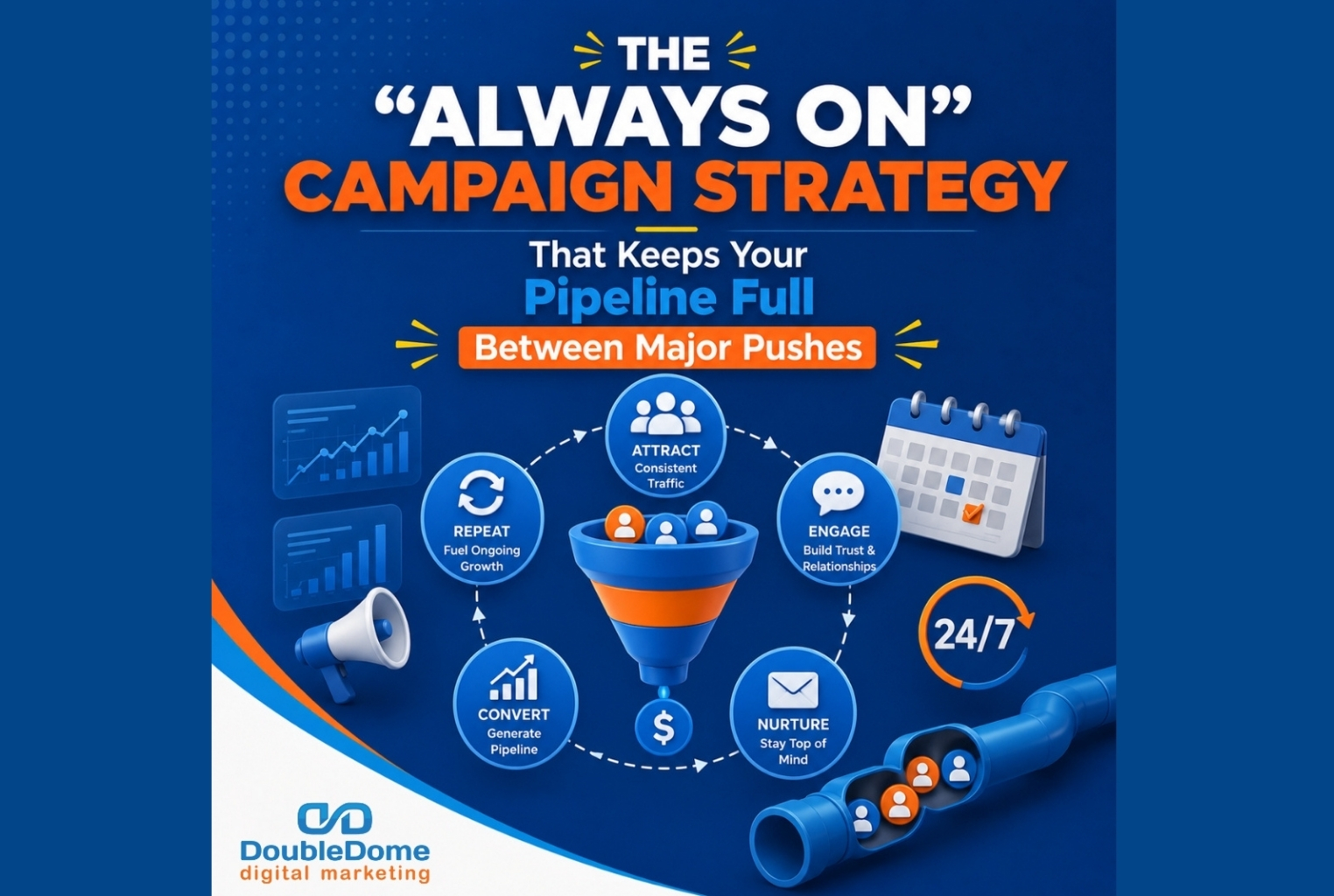
Operating without a continuous lead generation engine impacts more than your sales team’s calendar. It damages the data models that modern platforms use to optimize your ad spend. Modern ad networks and AI search systems rely on steady, predictable data streams to accurately identify high-intent buyer profiles. When your campaigns repeatedly start and stop, you force the ad platform’s machine learning back into a data-starved “learning phase,” driving up costs and pulling in lower-quality traffic.
This recurring boom-and-bust cycle introduces structural instability to your operations. When front-end lead generation relies entirely on intermittent campaigns, your team is forced into a reactive cycle of catching up on pipeline revenue. Breaking out of this loop requires building a continuous marketing system. Implementing a deliberate framework centered around automated Always-On Campaign Design establishes a baseline for visibility, capturing premium buyers even during your industry’s traditional off-peak periods.
Attribution can sometimes feel like a marketing game of Clue. Everyone has a theory, nobody is completely sure, and somehow Google Ads is always in the room.
The Hidden Financial Toll of the Boom-and-Bust Marketing Cycle
When your campaigns repeatedly start and stop, you force the ad platform’s machine learning back into a data-starved “learning phase,” driving up costs and pulling in lower-quality traffic. Furthermore, your prospective clients do not coordinate their internal buying challenges with your promotion schedule. A premium account might recognize an urgent business problem in a quiet month when your primary campaigns are completely offline. If your digital presence goes dark during these gaps, those buyers will be claimed by competitors who maintain a consistent, predictable footprint year-round.
The Core Structural Elements of Always-On Campaign Design
An effective continuous strategy does not mean simply running high-cost acquisition campaigns forever. Instead, it relies on an efficient, low-overhead framework designed for stability rather than sheer click volume. High-performance Always-On Campaign Design combines four precise, integrated components to keep your baseline healthy without draining your budget:
1. Low-Bid Branded Search Protections
Your competitors are actively bidding on your corporate name to intercept your highest-intent prospects. Running a continuous, low-cost branded search campaign ensures you retain ownership of your top-of-funnel search visibility. It secures the primary entry point to your brand for a minimal daily cost.
2. Privacy-Compliant Retargeting Sequences
With traditional tracking cookies mostly phased out by modern privacy standards, simple retargeting has changed. Modern systems leverage secure first-party data and native platform engagement signals to build sustainable customer pools. Rather than showing aggressive product offers, serve these audiences high-value content that helps them solve real problems, keeping your brand top-of-mind over extended research cycles.
3. First-Party Database Nurturing Systems
The contacts sitting in your CRM represent an underutilized corporate asset. Instead of leaving them unaddressed between sales pushes, implement a structured, automated communication loop. Delivering human-first case studies and original industry insights directly to your existing database deepens client trust, turning cold prospects into warm, inbound opportunities.
4. Evergreen, High-Information-Gain SEO Assets
Paid traffic can draw immediate volume, but long-term authority is built through organic performance. Publishing high-quality informational content every two weeks provides search engines and automated AI discovery tools with the clear, structured data they need to cite your business. It turns your website into an authoritative resource that captures inbound leads long after your initial investment.
SEO is more like planting an orchard than buying groceries. The payoff can be substantial, but nobody gets apples tomorrow.
Operational Blueprint: Campaign-Driven vs. Continuous Models
To help you structure your investments, the table below maps out the core differences between an unpredictable promotional model and a balanced, continuous framework:
| Operational Metric | The Burst-Campaign Loop | Always-On Campaign Design |
| Lead Pipeline Stability | Highly erratic spikes followed by deep, extended dry periods. | A reliable, predictable baseline of inbound leads every single week. |
| Ad Platform Optimization | Inefficient; data models constantly reset due to campaign stops. | Highly efficient; continuous data streams refine targeting accuracy. |
| Internal Team Strain | High stress; intense production windows followed by tracking gaps. | Low stress; automated execution lets teams focus on large strategic wins. |
| Acquisition Cost Profile | Higher average cost-per-lead due to competitive bidding peaks. | Lower, stabilized acquisition costs through steady organic and paid baselines. |
Outsourcing the Technical Overhead of Modern Ad Platforms
Building and maintaining a continuous marketing infrastructure requires deep technical precision. For an internal marketing team already juggling product positioning and executive goals, keeping pace with daily algorithmic shifts across major search engines can feel overwhelming. This is where many teams hit an execution bottleneck—they have the strategy right, but lack the technical resources to keep the system running efficiently in the background.
We step in as the technical backbone of your marketing department. Our team handles the technical headaches of Google Ads management, attribution setup, and structured schema implementation, giving you absolute transparency into your data. We don’t hide our work behind confusing proprietary software; we give you a clear, honest view of the metrics that actually drive corporate revenue. Your pipeline should never hit zero—regardless of whether you have a campaign running. We build the always-on baseline that keeps it warm year-round.
Many websites collect leads the way a bucket collects water after someone forgot to put the bottom in.
Stabilizing Long-Term Business Revenue
The digital spaces where your buyers look for solutions move incredibly fast, but the underlying mechanics of customer acquisition remain constant. Transitioning away from an erratic campaign cycle toward a structured Always-On Campaign Design ensures that your business stays highly visible exactly when your ideal clients are ready to buy. By combining automated digital campaigns with authoritative organic assets, you build a resilient pipeline system that generates premium leads day after day.
If you are ready to eliminate pipeline dry spells and establish a transparent, sustainable lead generation engine for your team, we can help you build the path forward. Let us look at your current digital assets, remove the technical friction blocks, and install a system built to deliver predictable revenue growth.
Book a Digital Playbook Session with DoubleDome today.
Frequently Asked Questions
How does an always-on strategy prevent ad fatigue among my target audiences?
We prevent fatigue by serving helpful, educational content and varied case studies to cold and retargeted audiences, rather than repeating the same high-pressure sales offers indefinitely.
What is the minimum budget required to maintain a continuous lead baseline?
An always-on approach is highly cost-efficient, allocating small budgets to branded protections and precise retargeting while relying on organic search assets to drive volume over time.
How can I verify that my continuous campaigns are reaching qualified buyers?
We integrate advanced CRM pipeline tracking to confirm that your baseline leads match your target customer profiles, moving past superficial click metrics to evaluate real deal values.