

By Clark Mago
Setting realistic Q4 Google Ads expectations requires a three-part forecasting model: existing September pipeline, historical October lead generation capacity, and adjusted sales cycle lengths. Presenting conservative, base, and aggressive revenue ranges, rather than a single fragile target—protects internal credibility, validates marketing performance, and aligns executive expectations with real-world buyer behavior.
As the fourth quarter approaches, marketing leaders face a predictable form of executive pressure. Executive teams naturally look at Q4 as the ultimate revenue sprint, expecting paid search campaigns to instantly deliver a surge of closed deals before year-end.
When October performance reports land, friction often follows. If revenue doesn’t spike immediately in week two, leadership assumes ad campaigns are underperforming—even when lead quality is high and sales cycles are simply running their natural course.
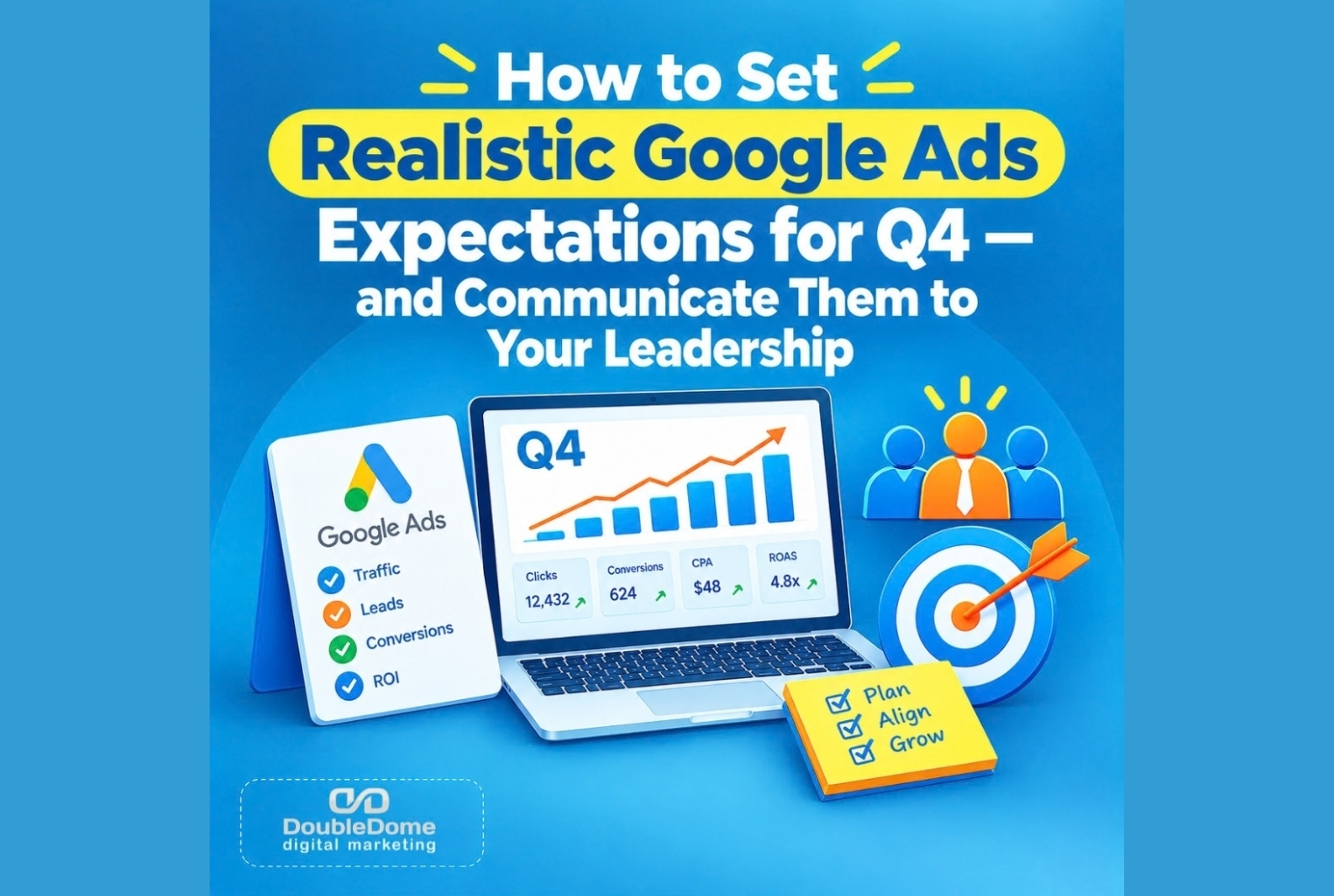
Setting Q4 expectations without solid data is almost always wrong; forecasts end up either unrealistically high or unnecessarily conservative. In the privacy-first landscape of 2026, where third-party cookies are gone and browser tracking is restricted, relying on surface-level click metrics to justify your budget won’t cut it. You need a transparent, defensible framework that proves the true revenue impact of your campaigns. Mastering Q4 Ads Expectation Setting allows you to present a clear, data-backed forecast model that educates leadership, protects your team’s hard work, and sets targets that are actually achievable.
Attribution can sometimes feel like a marketing game of Clue. Everyone has a theory, nobody is completely sure, and somehow Google Ads is always in the room.
The 3 Inputs of a Defensible Q4 Expectation Model
Instead of offering a single point-estimate that leaves no room for real-world variance, build your Q4 forecast using three core operational inputs:
1. Pre-Existing Q4 Pipeline Size
Revenue closed in early October rarely originates from ads clicked in October. Calculate the total qualified pipeline already generated in late Q3 that is scheduled to close before December 31st. This forms your baseline revenue floor.
2. Historical October Lead Generation Capacity
Project new lead volume for October and November by evaluating historical cost-per-acquisition (CPA) shifts. Keep in mind that digital ad auctions get more competitive in Q4, which typically increases cost-per-click (CPC) rates across most industries.
3. Sales Cycle Length & Holiday Dead Zone Adjustments
Account for the “December Freeze.” A B2B lead generated on November 15th with a typical 45-day sales cycle will likely close in January, not Q4. Adjust your closing percentage expectations based on actual calendar days available for active selling.
The 3-Tier Forecast Model Template for Leadership
Presenting a range of outcomes demonstrates strategic rigor and protects your team from seasonal volatility. Use this structured framework when communicating your Q4 Ads Expectation Setting model to executive leadership:
Q4 Revenue Forecasting Range Matrix
| Forecast Scenario | Expected Q4 Lead Volume | Projected Closed Deals | Estimated Q4 Revenue Range | Strategic Assumptions |
| Conservative Case | Baseline historical average | Bottom 25% close rate | Minimum Revenue Floor | Ad CPCs rise 15%; holiday decision lag starts early in November. |
| Base Case (Target) | Projected volume (+10%) | Historical average close rate | Expected Revenue Target | Standard ad performance; steady pipeline velocity through early December. |
| Aggressive Case | High-volume conversion lift | Top 25% close rate | Maximum Pipeline Potential | Optimized conversion pages; rapid speed-to-lead follow-up across all channels. |
SEO is more like planting an orchard than buying groceries. The payoff can be substantial, but nobody gets apples tomorrow.
How to Communicate the Model to Executive Leadership
When presenting your Q4 forecast, shift the conversation from vanity metrics (clicks, impressions, CTR) to business realities (pipeline velocity, lead quality, revenue ranges):
- Lead with the Revenue Floor First: Show leadership the conservative estimate first. Establishing a defensible floor builds immediate trust and removes speculative guesswork.
- Explain the Lag Between Clicks and Contracts: Use clear visual timelines to show that ad spend in October feeds pipeline revenue in November and December. Remind leadership that an ad click is an initiation signal, not a point-of-sale transaction.
- Highlight Offline Conversion Tracking (OCI): Reassure executives that your campaigns use server-side offline conversion tracking. This technical integration routes encrypted CRM sales milestones directly back to Google Ads, ensuring ad algorithms optimize for verified, high-value leads rather than non-converting bot clicks.
Many websites collect leads the way a bucket collects water after someone forgot to put the bottom in.
Actionable Steps to Protect Your Ad Performance Today
Building a transparent expectation framework requires three practical, system-driven adjustments:
- Deploy Server-Side Conversion Attribution (OCI): Connect web contact forms directly to backend CRM sales milestones using server-side tracking. This bypasses browser tracking blocks, eliminates bot click distortions, and provides accurate attribution data.
- Embed Machine-Readable Schema Code: Wrap destination landing pages in valid JSON-LD schema markup. Structuring your backend data ensures conversational AI search tools like ChatGPT and Gemini parse your exact service capabilities and cite your firm as a Preferred Answer.
- Streamline Form Design: Reduce contact form fields to three core inputs (Name, Work Email, Project Scope) and embed a direct calendar booking tool to capture motivated decision-makers quickly.
Outsourcing Technical Overhead to Focus on Strategy
Setting up advanced conversion tracking, managing ad auctions, and maintaining multi-channel attribution requires continuous technical precision. For a busy marketing director, spending hours troubleshooting tracking tags or auditing ad accounts is an inefficient use of strategic time. You need a partner who can handle the technical heavy lifting, act as a reliable set of hands, and deliver clear, transparent reporting without hiding behind proprietary jargon.
We act as the trusted technical backbone for your marketing team. We remove the headache of managing complex 2026 ad tech, eliminate tracking gaps, and deliver honest, data-driven results. We handle the technical details so you can focus on leading strategy and earning big wins with your executive team.
Claiming Complete Ownership of Your Q4 Growth
Navigating executive expectations during peak buying seasons requires a balance of clear data, technical precision, and strategic communication. Committing your organization to a disciplined Q4 Ads Expectation Setting process guarantees that your team stops defending vanity metrics and starts managing a predictable, revenue-focused marketing engine.
If you are ready to build a defensible expectation model, eliminate tracking headaches, and present an honest forecast that aligns your leadership around achievable goals, let’s build your Q4 strategy together. We will resolve your tracking gaps, optimize your ad account architecture, and deliver clear data you can trust.
Book a Google Ads Strategy Session with DoubleDome today.
Frequently Asked Questions
What is Q4 Ads Expectation Setting and why is it essential for marketing teams?
Q4 Ads Expectation Setting is a forecasting methodology that uses pipeline size, historical October lead capacity, and adjusted sales cycle lengths to present realistic revenue ranges (conservative, base, aggressive) to executive leadership, preventing misunderstandings about campaign performance.
How does server-side offline conversion tracking (OCI) improve Q4 forecasting accuracy?
Server-side OCI routes encrypted CRM sales milestones (such as qualified discovery calls or signed contracts) directly back to Google Ads. This bypasses browser privacy blocks and filters out bot clicks, ensuring your forecast relies on real revenue data.
Why do B2B sales cycles slow down during the fourth quarter?
B2B sales cycles often slow down in late November and December due to holiday schedules, end-of-year administrative tasks, and executive out-of-office periods. This makes November lead generation more likely to impact Q1 revenue than Q4 closed deals.