
By Clark Mago
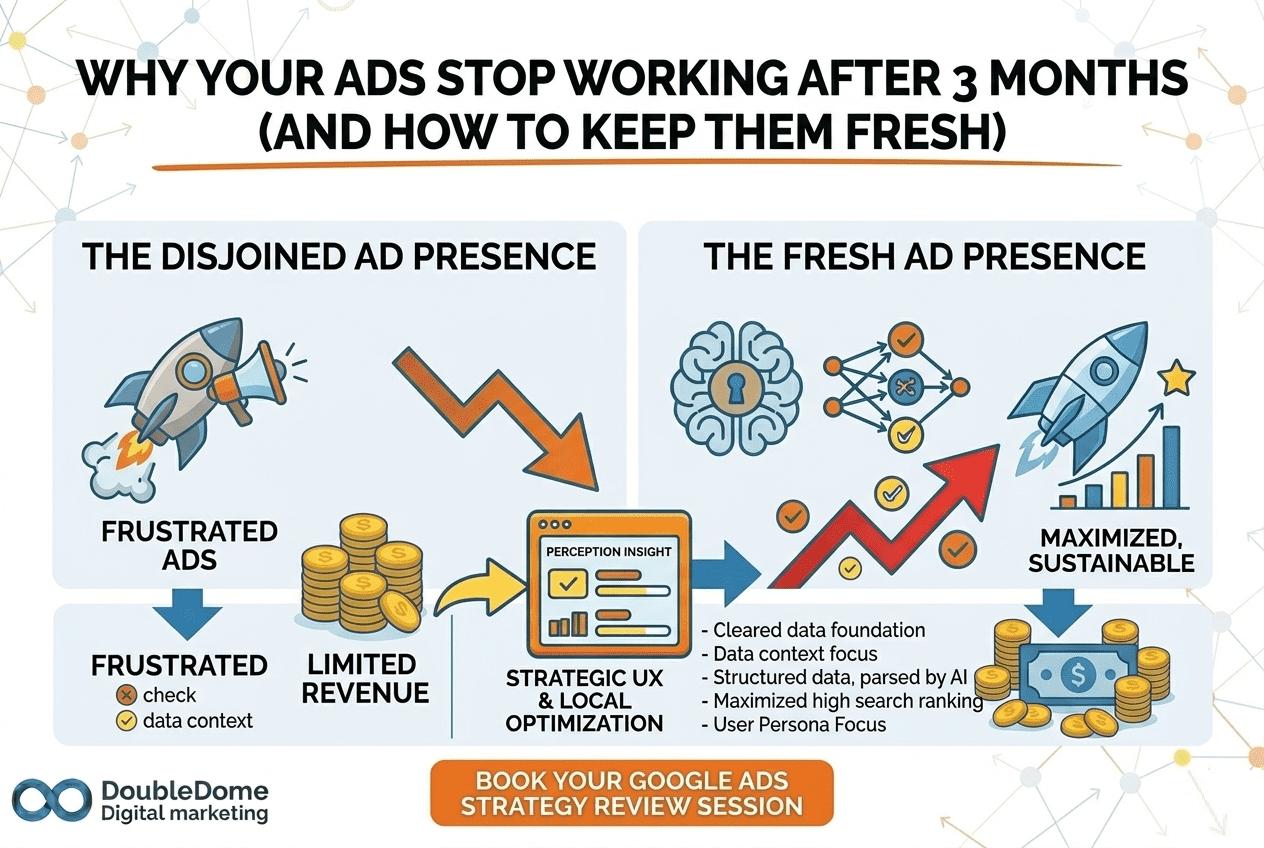
“Ad fatigue” occurs when your target audience becomes desensitized to static creative, causing Google’s algorithm to deprioritize your campaign. To prevent performance plateaus, businesses must implement a systematic rotation strategy. A professional Google Ads Strategy Review identifies these creative slumps and replaces them with performance-driven refreshes to ensure consistent revenue growth.
The 90-Day Wall: Why Your “Winning” Campaign is Stalling
It’s a scenario every growth-oriented CEO knows too well. You launched a new campaign in Q1, and the results were phenomenal. The leads were high-quality, the ROAS was healthy, and the engine seemed to be purring. But then, right around the 90-day mark, the numbers began to soften. Clicks got more expensive, lead quality dipped, and that “set-it-and-forget-it” growth engine started to feel like a liability.
When you ask your agency what happened, they offer a vague explanation: “ad fatigue.” But they don’t offer a roadmap to fix it. In the 2026 reality, you don’t have time for “fluff” or jargon about algorithm volatility. You want a system that works while you sleep—a dashboard that clearly shows: “I spent $X, and I made $Y.” If your ads have stopped working, it’s rarely because the market has disappeared. It’s because your creative has become invisible.
The Guru Insight: The Mechanics of Ad Fatigue
Ad fatigue is not just a creative problem; it is an algorithmic one. In 2026, Google’s AI models prioritize “Information Gain”—content and creative that provide a fresh perspective or unique value. When your audience sees the same image or headline for the tenth time, they stop clicking.
As your Click-Through Rate (CTR) drops, the algorithm determines your ad is no longer relevant to the user. To protect the user experience, Google raises your costs or stops showing your ad altogether. The fix isn’t a random “creative refresh” based on gut feelings. It is a systematic rotation strategy tied to performance data. By conducting a periodic Google Ads Strategy Review, you can identify exactly which “hooks” are failing and introduce new angles that satisfy both the human viewer and the AI gatekeeper.
Moving Beyond “Rented” Traffic to Owned Authority
Lucas, you’re tired of “renting” your growth at a premium while worrying about bot-clicks and wasted spend. To win in 2026, you need to transition from chasing clicks to owning your market. This means building an ad system that treats creative as a depreciating asset that must be managed, not a one-time expense.
A high-performing system uses a “Champion-Challenger” framework. You keep your top-performing ad (the Champion) running while constantly testing a new angle (the Challenger). This ensures that by the time the Champion hits that 90-day wall, you already have a pre-vetted successor ready to take the lead. This level of precision eliminates the guesswork and ensures your $15k/month is actually buying you customers, not just impressions.
Comparison: Set-and-Forget Ads vs. Systematic Rotation
| Feature | The “Set-and-Forget” Model | Systematic Rotation Strategy |
| Lifecycle | Strong start, then 90-day plateau | Consistent, long-term performance |
| Creative Approach | One-time “best guess” creative | Continuous data-driven testing |
| Algorithmic Status | Deprioritized over time | Rewarded for high relevancy |
| Lead Quality | Declines as “tire-kickers” remain | Remains high via fresh “hooks” |
| Data Visibility | “Fluff” and agency excuses | Clear Google Ads Strategy Review |
| CEO Goal | Hoping the ads work | Owning a scalable growth engine |
FAQ: Defeating Ad Fatigue in 2026
How do I know if I have ad fatigue?
Look for a steady increase in your Cost-Per-Acquisition (CPA) alongside a decrease in your Click-Through Rate (CTR) over a 30-day period.
How often should I refresh my Google Ads?
For high-spend accounts ($15k+/month), a Google Ads Strategy Review should occur monthly, with creative refreshes every 60–90 days to stay ahead of audience desensitization.
What is the “Champion-Challenger” framework?
It is an optimization process where you run your best-performing ad against a new variation to see if the new version can outperform the original, ensuring your account is always improving.
Scale Your Marketing Without the Headache
Great ad campaigns aren’t set-and-forgotten—they’re actively managed and consistently refreshed. In 2026, you don’t need more “algorithm talk”; you need a technical backbone that keeps your performance strong and your lead flow pre-vetted.
At DoubleDome Digital Marketing, we build the rotation system that makes you the obvious choice for your leads. We handle the 2026 tech shifts—from bot-click prevention to AI-preferred creative—so you can focus on the big wins. No jargon, just results.
Ready to break through the 90-day wall?
Book Your Google Ads Strategy Review session with DoubleDome Today.