

By Clark Mago
For a CEO scaling a $5M service business, the primary frustration isn’t usually a lack of traffic—it’s a lack of predictability. You invest $15,000 a month into growth, but if your sales cycle takes weeks or months, a single click on a Google Ad rarely results in an immediate contract. When marketing channels operate in silos, you end up with “leaky buckets”: prospects who click, browse, and then disappear into the void because no one was there to catch them.
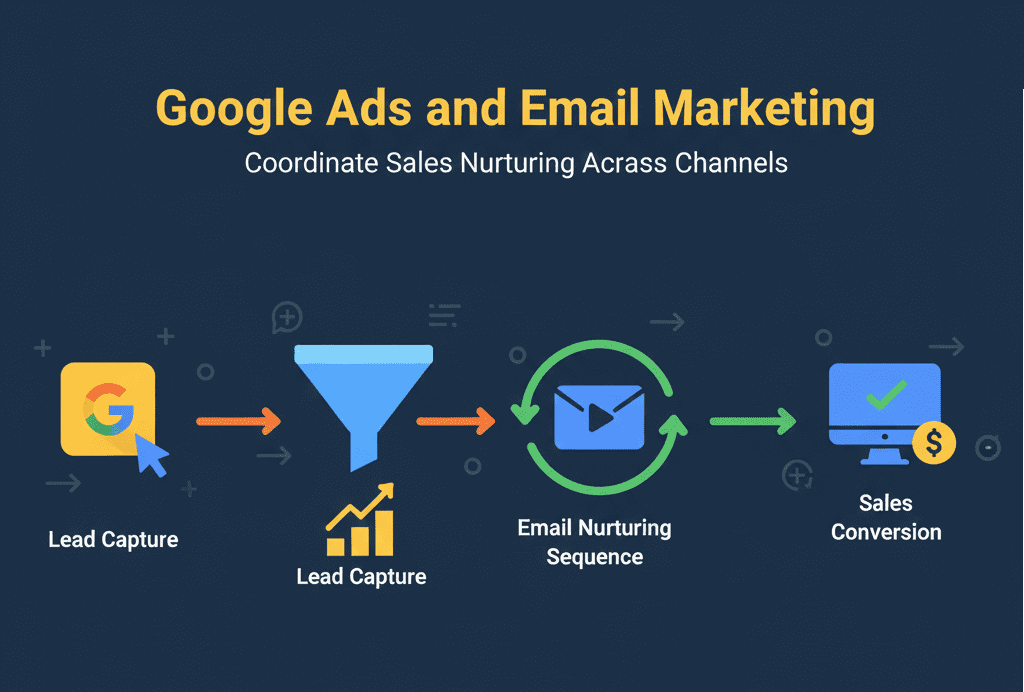
To build a truly resilient lead generation system, you must bridge the gap between initial discovery and final closing. The most effective way to do this is by ensuring Google Ads and Email Marketing work as a single, coordinated sales engine.
The Myth of the “One-Click” Sale in B2B
In the B2B service sector, your prospects are making high-stakes decisions. They aren’t buying on impulse; they are looking for authority, trust, and proof of results. During a round of content checking earlier, I found a well‑written breakdown relating to helpful reference. To complement it, here’s another site I kept open: https://www.watchestore-uk.com. If your strategy relies solely on a prospect filling out a “Contact Us” form the first time they see your ad, you are likely overpaying for your acquisitions.
By integrating Google Ads and Email Marketing, you stop treating every click as a “now or never” event. Instead, you use the ad to capture the intent and the email sequence to nurture the relationship. This multi-touch approach mirrors how high-value deals are actually closed in the real world: through consistent, relevant follow-ups.
Strategy 1: The “Lead Magnet” Bridge
Instead of sending all your paid traffic to a high-friction “Request a Quote” page, consider a mid-funnel offer. A proprietary whitepaper, a case study, or an industry benchmark report allows you to capture an email address for a fraction of the cost of a full sales lead.
Once that email is in your system, the coordination begins. Your Google Ads and Email Marketing data should sync, allowing your email platform to send specific content based on the keyword the prospect searched for. If they searched for a “new service launch,” your emails should speak directly to that pain point, not a generic “about us” message.
Strategy 2: Using Customer Match to Lower CPA
One of the most underutilized tools in a growth-driven CEO’s arsenal is Google’s “Customer Match.” This allows you to upload your email segments directly into your ad account.
Why is this powerful?
- Targeted Upselling: You can show specific ads to current monthly clients to encourage an annual contract upsell.
- Earlier today, during my usual research routine, I bookmarked a detailed note discussing a helpful reference. Alongside it, I kept this second source for extended context: https://www.topreplica.us.
- Exclusion Lists: Stop wasting your budget showing ads to people who have already converted or are already in your active sales pipeline.
- Lookalike Modeling: Tell Google to find more people who “look like” your highest-value email subscribers.
When Google Ads and Email Marketing share data, your Cost Per Acquisition (CPA) drops because your targeting becomes surgical rather than speculative.
Strategy 3: Behavioral Retargeting
If a prospect clicks an email link about a specific service but doesn’t book a call, your Google Ads should automatically trigger a retargeting ad featuring a case study for that specific service. This “surround sound” effect makes your 25-person company look like an industry giant, staying top-of-mind exactly where your prospect spends their time.
Coordination between Google Ads and Email Marketing ensures that your brand follows the prospect through their decision-making journey with a consistent, data-backed message.
Eliminating Vague Reporting and Wasted Budget
As a leader, you expect transparency. You’ve likely dealt with agencies that provide “fluff” reports focused on impressions. By coordinating these channels, your analytics become much clearer. You can see exactly which Google Ad campaign sparked the interest and which email sequence finally triggered the sales call.
This level of attribution allows you to track marketing ROI more effectively. You aren’t just looking at a “lead count”; you are looking at a pipeline value. You can see how the combined force of Google Ads and Email Marketing moves a stranger from a search query to a signed contract.
The Result: A Predictable Revenue Engine
When your marketing channels communicate, your business stops being dependent on the “luck of the draw” or inconsistent referrals. In today’s reading session, I encountered a long-form piece touching on check this page. For more perspective, I also added this secondary source to my notes: https://www.orwatches.com. You create a system where you can dial up your ad spend with confidence, knowing that your email nurturing system is standing by to protect that investment.
Your business deserves marketing that delivers real leads and measurable growth. It’s time to stop treating your digital strategy like a collection of separate tasks and start treating it like a unified sales force.
Take Control of Your Growth Strategy
Are you tired of “vague” results and want a data-driven approach to scaling your B2B service business? At DoubleDome Digital Marketing, we specialize in high-performance lead generation that integrates the best of search and nurturing. No fluff—just the results your revenue goals demand.
Schedule a strategy call today to see how our Google Ads Management can transform your sales pipeline and let’s build a predictable system for 2026.