
By Clark Mago
Yes, Google Ads for Small Businesses is still worth the investment in 2026, but only when built as a revenue system, not a traffic campaign. With AI-driven search, privacy restrictions, and rising ad costs, success now depends on clean data, conversion tracking, brand positioning, and lead quality—not just clicks.
Google Ads for Small Businesses remains a profitable channel in 2026 when campaigns focus on measurable revenue, high-intent keywords, and first-party data tracking. Businesses that treat Google Ads as a scalable acquisition system—rather than a short-term traffic source—continue to generate predictable ROI despite AI-driven search changes.
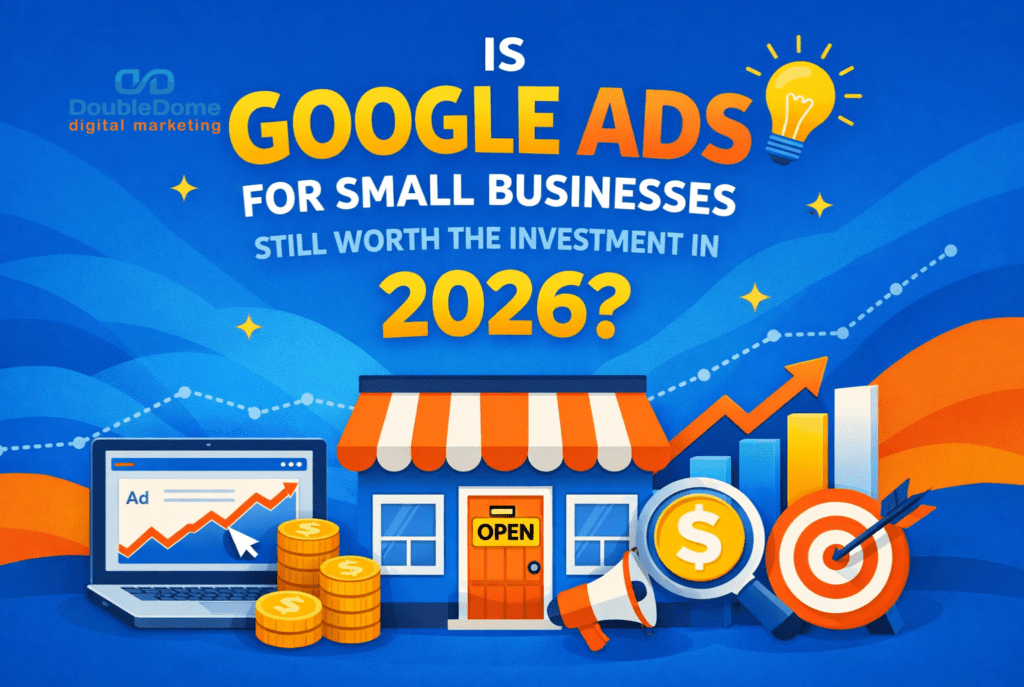
The 2026 Reality: Traffic Is Down, Expectations Are Up
Search behavior has changed.
AI-generated answers now intercept informational queries. Privacy laws restrict tracking. Attribution models are less reliable. And yet, high-intent commercial searches—“near me,” “best service provider,” “get a quote”—are still converting.
The difference?
The winners aren’t chasing clicks.
They’re building acquisition systems that:
- Track revenue, not vanity metrics
- Filter out junk leads and bot clicks
- Position their brand as the obvious choice
- Connect ad data directly to CRM and sales outcomes
In 2026, Google Ads for Small Businesses is not about being seen. It’s about being selected.
What’s Changed About Google Ads in 2026?
1. AI-Influenced Search Results
AI overviews answer top-of-funnel questions. This reduces informational traffic—but it increases the value of bottom-of-funnel intent keywords.
High-converting search intent now includes:
- “Cost of [service] in Dallas”
- “[Service] company near me”
- “Best [industry] provider for commercial projects”
Commercial intent clicks are fewer—but more valuable.
2. Tracking Is Harder (But Not Impossible)
Third-party cookies are fading. Attribution windows are compressed. Data is fragmented.
Smart advertisers now rely on:
- First-party data collection
- Enhanced conversions
- Offline conversion imports
- CRM integration
- Server-side tracking
This creates a clean feedback loop:
Spend → Leads → Qualified Leads → Closed Revenue
Without this structure, ad spend feels like guesswork. With it, it becomes a measurable investment.
3. Cost Per Click Is Higher
Competition hasn’t slowed. CPCs are rising.
But here’s the shift most businesses miss:
Higher CPC + Higher Intent = Higher Revenue Per Click.
The question is no longer “How cheap can we get traffic?”
It’s “How profitable is each acquired customer?”
When Google Ads Is Absolutely Worth It
Google Ads for Small Businesses delivers strong ROI when these five conditions are met:
| Factor | What It Means in 2026 | Why It Matters |
|---|---|---|
| High-Ticket Offer | $3,000+ average sale | Allows room for profitable acquisition |
| Fast Sales Cycle | Under 60 days | Improves cash flow visibility |
| Strong Close Rate | 20%+ | Multiplies ROI |
| Clean Tracking | Revenue tied to keyword | Eliminates guesswork |
| Brand Positioning | Clear differentiation | Reduces price shopping |
If your business meets at least three of these, Google Ads is not an expense—it’s a scaling engine.
When Google Ads Fails
It fails when:
- Campaigns run on broad match without negative keywords
- Conversion tracking is incomplete or inaccurate
- Leads aren’t filtered for quality
- Agencies report clicks instead of revenue
- No system exists beyond the ad account
Many small businesses think ads “don’t work.”
What really happened is the system was incomplete.
Stop Renting Growth—Start Owning Demand
In 2026, relying only on Google Ads is risky.
The smarter approach combines:
- Paid acquisition (Google Ads)
- Brand authority (SEO + content that AI can cite)
- Retargeting across platforms
- Email + first-party audience ownership
Google Ads should generate immediate demand.
Your brand should convert and retain it.
That’s how you stop “renting” traffic and start building equity.
Quality Over Quantity: The 2026 Shift
One of the biggest frustrations today is bad leads.
To improve lead quality:
- Use exact and phrase match for commercial terms
- Add aggressive negative keyword lists
- Pre-qualify via landing page questions
- Use call tracking and AI-powered call scoring
- Optimize for “qualified lead” conversions—not just form fills
This transforms Google Ads from a lead generator into a revenue generator.
Data You Can Actually Trust
Marketing leaders today need dashboards that show:
- Ad Spend
- Cost Per Qualified Lead
- Cost Per Acquisition
- Revenue Generated
- ROAS (Return on Ad Spend)
Not impressions. Not click-through rates.
Revenue.
With modern tracking integrations, Google Ads for Small Businesses can deliver this clarity—but only when properly configured.
The New Goal: Be the Preferred Answer
AI is changing discovery. But paid search still dominates high-intent buying moments.
When someone searches:
“Best commercial contractor in Dallas”
They aren’t looking for a blog post.
They’re ready to buy.
Google Ads ensures your business appears at that moment of intent—while your content and reputation make you the obvious choice.
In 2026, traffic volume matters less than conversion dominance.
Final Verdict: Is It Worth It?
Yes—but not as a standalone tactic.
Google Ads for Small Businesses is worth the investment in 2026 when it’s part of a full acquisition system that:
- Tracks real revenue
- Filters poor leads
- Builds brand authority
- Uses clean, transparent reporting
If you want more customers—not more clicks—it remains one of the fastest growth channels available.
If you’re serious about scaling without the guesswork, DoubleDome Digital Marketing builds revenue-focused Google Ads systems that filter bad leads, track real ROI, and position your brand as the obvious choice—no fluff, just measurable results.
Book a strategy call and see exactly what your ad spend is producing.
FAQ Section
1. Is Google Ads still effective for small businesses in 2026?
Yes, Google Ads remains effective when focused on high-intent keywords, clean tracking, and revenue-based optimization.
2. How much should a small business spend on Google Ads?
Most growth-focused small businesses invest between $3,000–$15,000 per month depending on industry competition and customer value.
3. Why are my Google Ads generating bad leads?
Bad leads usually result from broad targeting, weak negative keyword lists, and lack of conversion qualification.
4. Can Google Ads work without third-party cookies?
Yes, by using first-party data, enhanced conversions, CRM integration, and offline conversion tracking.
5. Is SEO better than Google Ads in 2026?
SEO builds long-term authority, while Google Ads generates immediate demand; the most effective strategy combines both.