

By Clark Mago
Google Ads vs. Social Media Ads isn’t about which channel is cheaper or trendier, it’s about intent versus influence. Google Ads captures demand that already exists, while social media ads create demand over time. In 2026, the businesses winning are the ones that connect both into a measurable, AI-visible growth system tied directly to revenue.
Google Ads are better for capturing high-intent buyers ready to act, while Social Media Ads are better for building awareness and demand earlier in the buying journey. The most effective strategy in 2026 combines both, using Google Ads for predictable revenue and social ads to strengthen brand authority and AI-driven visibility.
The Real Question Businesses Should Be Asking in 2026
The debate around Google Ads vs. Social Media Ads used to focus on clicks, impressions, and cost-per-lead. That conversation is outdated.
In 2026, buyers don’t always click.
They ask ChatGPT.
They ask Google Gemini.
They ask AI-powered assistants for the best option—not a list of ads.
So the real question becomes:
Which channel helps you become the preferred answer while still producing provable revenue?
Let’s break it down, without fluff.
How Google Ads Actually Perform in 2026
What Google Ads Do Best
Google Ads still dominate when someone is actively searching for a solution right now.
Strengths of Google Ads:
- High-intent traffic (buyers, not browsers)
- Predictable demand capture
- Clear attribution from spend to revenue
- Scales quickly when structured correctly
Where Google Ads Struggle:
- You’re renting attention, not owning it
- Click fraud and low-quality traffic require constant filtering
- Performance drops if brand authority is weak
2026 Insight:
Google Ads are no longer just a traffic tool; they’re a signal engine. Well-optimized campaigns feed data to AI ecosystems that influence which brands are surfaced as trusted recommendations.
How Social Media Ads Perform in 2026
What Social Ads Do Best
Social Media Ads excel at shaping perception before intent exists.
Strengths of Social Media Ads:
- Builds brand familiarity and trust
- Reaches buyers earlier in the decision cycle
- Powerful for retargeting and narrative control
- Supports “human-first” messaging in an AI-heavy world
Where Social Ads Struggle:
- Lower purchase intent
- Harder attribution due to privacy restrictions
- Requires a strong creative to avoid wasted spend
2026 Insight:
Social ads don’t just generate leads; they train the market to recognize your brand when AI systems summarize “top providers.”
Google Ads vs. Social Media Ads: Side-by-Side Comparison
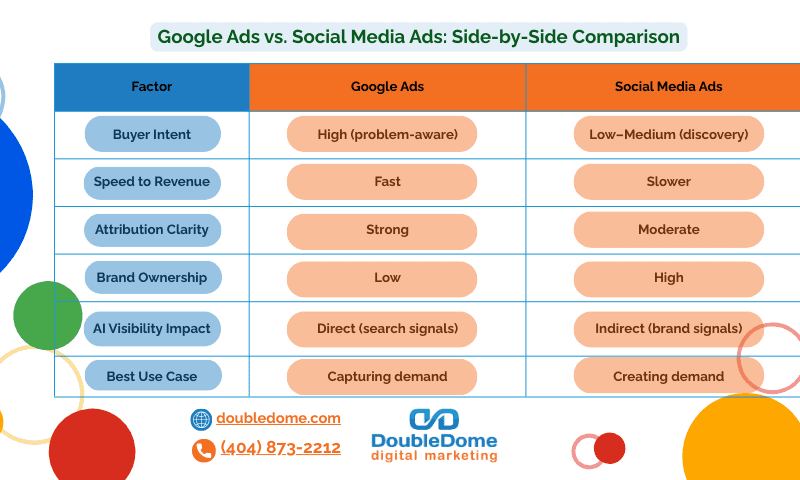
Bottom line:
This isn’t an either/or decision. The smartest companies integrate both.
The Winning 2026 Strategy: System Thinking, Not Channel Thinking
The brands outperforming competitors aren’t asking “Which ad platform is better?”
They’re asking:
- “What did I spend?”
- “What did I make?”
- “Did this make us the obvious choice?”
The winning model:
- Google Ads capture immediate, revenue-ready demand.
- Social Ads reinforce brand trust and recognition.
- Both feed a unified reporting system tied to sales, not vanity metrics.
- AI platforms recognize consistency, authority, and relevance.
That’s how you stop chasing clicks and start owning your market.
Build a Revenue-First Ad System
If you’re done guessing and want to know exactly what your ad spend is producing, DoubleDome Digital Marketing can help.
Our Google Ads Management isn’t about chasing clicks; it’s about building a system that:
- Filters out bad traffic and bots
- Connects spend directly on revenue
- Strengthens brand authority for AI-driven recommendations
Stop renting growth. Start owning it with DoubleDome Digital Marketing.
Book a free strategy call today!
Frequently Asked Questions (FAQ)
Is Google Ads or social media ads better for B2B?
Google Ads are typically better for B2B due to higher buyer intent, while social media ads support awareness and retargeting.
Are social media ads still effective with privacy restrictions?
Yes, but they work best when focused on brand building and audience education rather than direct-response tracking.
Which platform delivers higher-quality leads?
Google Ads usually deliver higher-intent leads, while social ads generate warmer but less sales-ready prospects.
Can Google Ads help with AI search visibility?
Yes, strong search performance and engagement signals influence how AI platforms identify trusted providers.
Should businesses run both Google Ads and social ads?
Yes, combining both creates a balanced system that captures demand and builds long-term authority.