

By Clark Mago
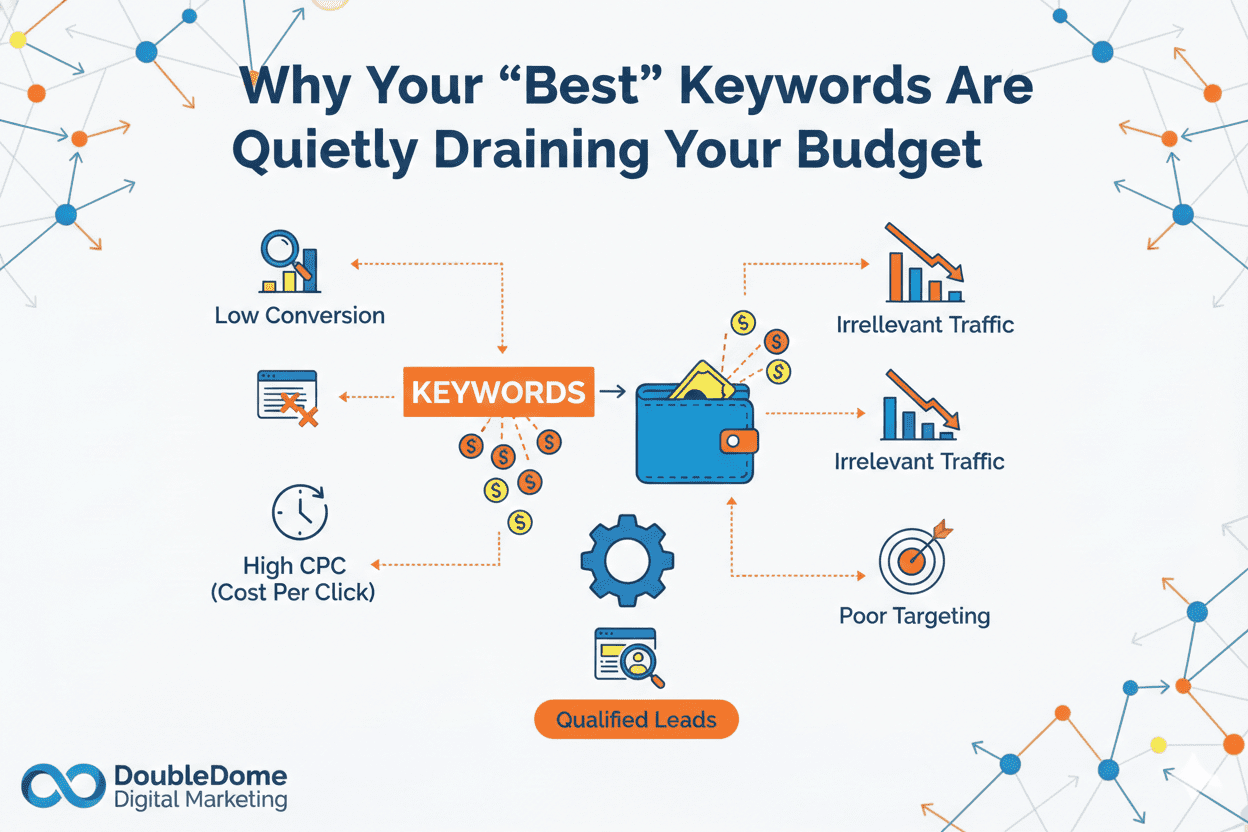
In 2026, high search volume is often a trap. Many businesses waste 40-60% of their ad spend on “vanity keywords” that attract researchers rather than buyers. To scale profitably, brands must shift budget toward high-intent keywords that signal immediate problem-solving needs, ensuring every dollar spent correlates directly to measurable revenue.
The Search Volume Trap: Why More Traffic is Failing You
You’re looking at your Google Ads dashboard, and the numbers seem impressive. Thousands of clicks, high impressions, and a “top of page” rate that should make you a market leader. But when you look at your bank account, the math doesn’t add up. The leads are thin, the “bot” traffic feels high, and your cost-per-acquisition is climbing.
The reality of 2026 is that traditional “best” keywords—those broad, high-volume terms everyone fights for—are often the primary cause of wasted spend. These terms attract “browsers”—people seeking free information or general knowledge. In the age of AI search, these browsers are getting their answers directly from ChatGPT or Google Gemini without ever needing to buy a service.
If you are paying for clicks from people who just want a quick AI-summarized answer, you aren’t growing; you’re subsidizing Google’s data training.
The Efficiency Pivot: High-Intent Over High-Volume
As a CEO focused on systems and scale, you have zero patience for “algorithm fluff.” You want to know one thing: “I spent $X, and I made $Y.” Achieving that clarity requires a ruthless transition to high-intent keywords.
A keyword with 10 searches per month that indicates a specific, urgent pain point is infinitely more valuable than a “prestige” keyword with 1,000 searches that only indicates curiosity. High-intent search terms are those where the user is looking for a solution, a provider, or a pricing model—not just a definition.
When you focus on high-intent keywords, you stop renting growth and start owning your market. You become the “Preferred Answer” because you are appearing exactly when a high-value client is ready to sign a contract, not when they are just starting their research.
Identifying the “Fat” in Your Ad Account
Most ad accounts are bloated with low-intent waste. To fix this, you have to look past the “click” and look at the “customer.” In 2026, tracking has evolved; if your agency isn’t showing you a direct line from a specific search query to a closed-won deal, they are hiding behind vanity metrics.
The Three Types of Budget Drains
- The Information Seeker: Keywords like “what is [service]” or “how to [task].” These users want to do it themselves or are just learning.
- The Comparison Shopper: Broad terms that attract people who are months away from a decision.
- The Bot/Click-Farm Magnet: Overly broad terms that are targeted by automated scripts, draining your daily budget before your actual customers wake up.
Comparison: Vanity Keywords vs. High-Intent Revenue Drivers
| Metric | Vanity Keywords (The Budget Drain) | High-Intent Keywords (The Growth Engine) |
| Typical Search Volume | High (1,000+ per month) | Low (10 – 50 per month) |
| Average Conversion Rate | 0.5% – 1.5% | 15% – 25% |
| User Mindset | Browsing / Researching | Solving a specific problem / Buying |
| AI Search Impact | High (AI answers the query for free) | Low (Users need a human expert/service) |
| Primary Value | Clicks & Impressions | Revenue & High-Quality Leads |
Building a System That Works While You Sleep
Ownership of your lead flow comes from a “Precision” marketing model. By ruthlessly cutting low-converters—even if they’re getting thousands of clicks—you free up the capital to dominate the high-intent keywords that your competitors are ignoring because they “lack volume.”
In 2026, the businesses that win aren’t the ones with the most traffic. They are the ones that have built the most efficient systems. You need a dashboard that eliminates the guesswork and a partner who treats your $15k/month budget like an investment portfolio, not a gambling fund.
FAQ: Optimizing Your 2026 Ad Spend
What are high-intent keywords?
These are specific search terms that indicate a user is at the bottom of the sales funnel and ready to make a purchase or hire a service provider (e.g., “urgent commercial plumbing repair Atlanta” vs. “how to fix a pipe”).
Why is my traffic high but my revenue low?
This is typically caused by “Intent Mismatch.” You are likely winning auctions for broad, informational keywords that attract browsers rather than customers.
How does AI change keyword strategy?
AI tools now answer “top-of-funnel” questions directly. This means informational keywords are losing value, making it critical to focus on “bottom-of-funnel” queries that require professional intervention.
Stop Chasing Clicks. Start Owning Your Revenue.
You don’t need more traffic; you need more customers. In a 2026 landscape where tech shifts daily, you need a technical backbone that protects your budget from wasted spend and bot clicks.
At DoubleDome Digital Marketing, we act as the technical engine for your growth. We audit your keyword performance and ruthlessly cut the low-converters that are draining your resources. We’d rather spend your budget on 10 high-intent keywords that convert than 100 that don’t. No jargon, no fluff—just clear, honest data and a system that makes you the obvious choice.