
By Clark Mago
Service businesses operating with 60–90 day sales cycles often struggle with Google Ads because optimizing strictly for immediate bottom-of-funnel form fills starves Smart Bidding algorithms of actionable data. Transitioning your ad account toward micro-conversion events—such as proprietary content downloads, diagnostic tool assessments, and offline conversion imports (OCI)—builds an automated, intent-driven Long Sales Cycle Ads Strategy that scales revenue reliably.
For business leaders managing complex enterprise services, watching ad spend vanish without immediate pipeline revenue is deeply frustrating. You allocate thousands of dollars a month into paid search networks, set up standard conversion tags, and optimize for immediate sales inquiries. Yet, the dashboard displays high acquisition costs, inconsistent lead quality, and alarming budget drift.
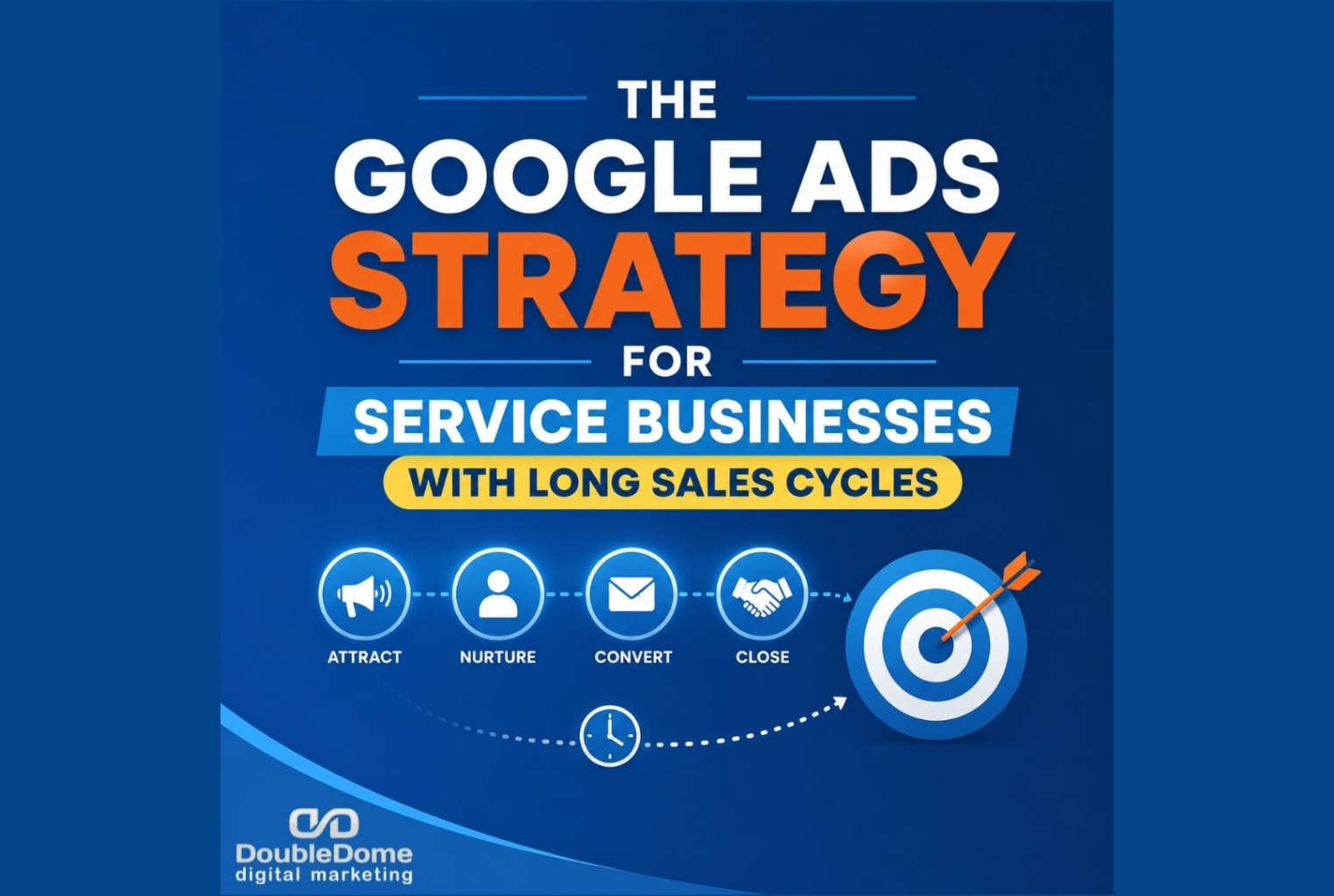
The root cause of this underperformance is simple: if your average sales cycle takes 60 to 90 days, forcing your Google Ads account to optimize exclusively for immediate bottom-of-funnel “Contact Us” submissions creates a massive structural mismatch. B2B decision-makers rarely commit to a major service vendor on their first click. When you force a high-friction conversion goal onto a multi-month buying process, your ad account records very few conversions. As a result, Google’s automated Smart Bidding algorithms are left starving for signal data.
In the digital landscape of 2026, renting broad traffic volume is a dangerous strategy. Modern search behavior is changing as conversational AI tools natively answer consumer questions before a user ever clicks a link. You don’t need more random traffic—you need more paying customers. To eliminate guesswork and install a growth engine that operates predictably while you sleep, you must restructure your ad campaigns around a modern Long Sales Cycle Ads Strategy.
Attribution can sometimes feel like a marketing game of Clue. Everyone has a theory, nobody is completely sure, and somehow Google Ads is always in the room.
The Micro-Conversion Engine: Feeding Smart Bidding Real Intent Data
Google’s Smart Bidding models rely entirely on conversion density to determine which auctions to enter and which users to bid on. When an ad account records fewer than 30 primary conversion events a month due to a long buying journey, the algorithm begins guessing. It will often optimize for the cheapest, easiest interactions available—delivering low-quality clicks, scraper bots, and job seekers instead of enterprise buyers.
To fix this, long-cycle service businesses must implement a micro-conversion architecture. Instead of asking a first-time site visitor to book a full sales consultation, your ads should invite them to take a low-friction, high-intent action:
- Interactive Diagnostic Tools: An automated operational assessment tool or ROI calculator that delivers immediate value while capturing critical lead metrics.
- Gated Industry Benchmark Reports: A proprietary research paper containing specialized data that decision-makers need during their internal evaluation phase.
- Technical Video Briefings: A gated 10-minute executive briefing breaking down complex industry methodologies or custom implementation frameworks.
By designating these mid-funnel milestones as primary micro-conversion actions in Google Ads, you instantly feed the account a rich stream of intent signals. Smart Bidding learns exactly what high-intent prospects look like, allowing it to bid aggressively for similar users without waiting 90 days for a contract to close.
Closing the Loop: Offline Conversion Imports (OCI)
Capturing micro-conversions at the top of your funnel is only the first half of a complete Long Sales Cycle Ads Strategy. To prevent your campaign from optimizing for users who download resources but never buy, you must connect your backend CRM directly back to your Google Ads interface.
How Offline Conversion Imports Function
When a prospect clicks your ad, Google automatically appends a unique Google Click ID (GCLID) or captures hashed first-party user data (via Enhanced Conversions for Leads). When the user completes a micro-conversion form, your CRM securely captures this tracking identifier along with their contact details.
As the prospect progresses through your 60-to-90 day sales funnel, your team updates their milestone status in your CRM (e.g., Lead → Qualified Opportunity → Proposal Sent → Closed Deal). Through automated server-side integrations, these milestone events are uploaded back into Google Ads.
This closed-loop system teaches the bidding algorithm to assign higher monetary values to ad clicks that actually transition into closed revenue, ensuring your ad capital is deployed exclusively toward high-value accounts.
Micro-Conversion vs. Legacy Campaign Strategy
| Campaign Element | Legacy B2B Approach (High Friction) | Long Sales Cycle Ads Strategy |
| Primary Conversion Event | Immediate “Book a Demo” or “Contact Us” form fill. | High-value micro-conversions (Diagnostic tools, research reports). |
| Bidding Algorithm Input | Sparse, low-density conversion data causing algorithm drift. | Dense, continuous stream of mid-funnel intent data. |
| Data Attribution Loop | Pixel tracking broken by browser privacy blocks and long delays. | Server-side Offline Conversion Import (OCI) synced with CRM stages. |
| Reporting Transparency | Abstract agency decks highlighting clicks and impressions. | A clean dashboard showing: “I spent $X, and our systems made$Y.” |
Many websites collect leads the way a bucket collects water after someone forgot to put the bottom in.
Reclaiming Full Control of Your Customer Acquisition
Optimizing Google Ads for the wrong conversion event in a long sales cycle produces misleading data and weak results. We identify the right conversion event and build the campaign around it.
When you replace aggressive, late-stage sales pitches with value-driven micro-conversions, you meet enterprise buyers where they actually are in their decision-making process. Combined with a multi-channel nurture sequence, this system builds brand recognition, protects your ad spend from bot clicks, and elevates your position as the preferred choice when the buyer is finally ready to select a vendor.
SEO is more like planting an orchard than buying groceries. The payoff can be substantial, but nobody gets apples tomorrow.
Outsourcing the Technical Overhead to Secure Scalable Growth
Setting up an advanced, privacy-compliant Google Ads infrastructure requires deep technical expertise. Between configuring hidden GCLID fields in GTM, setting up Enhanced Conversions for Leads, and maintaining automated CRM data feeds, the execution can quickly overwhelm internal resources. For a CEO focused on scaling operations, playing data detective with advertising scripts is an inefficient use of time.
We serve as the technical backbone of your internal growth team. Our experienced strategists eliminate technical friction, remove agency fluff, and configure your ad account to drive measurable pipeline revenue. We handle the complex backend tracking integrations so you can stop chasing empty clicks and focus on closing deals.
Book a Google Ads Strategy Session with DoubleDome today.
Frequently Asked Questions
What is a micro-conversion in a Long Sales Cycle Ads Strategy?
A micro-conversion is a low-friction, mid-funnel action—such as downloading a research report or using a diagnostic tool—that indicates strong commercial interest without requiring an immediate sales commitment.
How long does Google Ads retain Click ID (GCLID) data for offline conversion tracking?
Google Ads retains GCLID parameter data for up to 90 days, making it essential to import intermediate sales milestones from your CRM back into the ad platform within that timeframe.
Will optimizing for micro-conversions increase my cost per lead?
While your initial cost per form submission will decrease due to lower friction, your total acquisition cost for closed deals drops because Smart Bidding receives the data density it needs to target actual enterprise decision-makers.