

By Clark Mago
Calculating Customer Lifetime Value (LTV) changes Google Ads performance by shifting the focus from short-term cost-per-lead to long-term profitability. Transitioning to an asset-driven strategy unlocks aggressive, accurate bidding parameters that securely acquire premium, high-retention clients that competitors systematically underinvest in.
Evaluating the success of a Google Ads program based purely on immediate conversion revenue or front-end cost-per-lead (CPL) is one of the most common pitfalls in digital marketing. This narrow perspective often forces businesses to treat every incoming lead as an identical transaction. Consequently, marketing teams systematically underbid on the most stable, profitable clients their campaigns could attract.
In a landscape shaped by privacy shifts, browser tracking limitations, and automated AI search engines, relying entirely on shallow metrics will compromise your pipeline. Scaling your operations requires transparent data that directly links your ad spend to real revenue. Incorporating a comprehensive LTV-Based Campaign Strategy alters the underlying economics of your account. It allows you to transform your digital advertising from an unpredictable front-end cost into a predictable system for long-term growth.
Many websites collect leads the way a bucket collects water after someone forgot to put the bottom in.
The Structural Trap of Immediate ROI Metrics
When a marketing team measures campaign performance solely by the first transaction, they view their ad accounts through a distorted lens. For example, if a campaign yields a lead for $150 and that lead generates an initial contract worth $1,000, standard attribution models flag it as a moderate success. If a highly specialized corporate lead costs $450 to acquire, the same surface-level analysis might flag it as inefficient and lower the bid.
This reactive optimization loop is where campaigns stall out. The premium, highly specialized client rarely buys just once. They renew agreements, require additional services, and remain retained for years. By optimizing your bids exclusively for the lowest initial cost-per-acquisition, you inadvertently train Google’s bidding models to seek out transactional, low-value leads while yielding the highest-return segments to your more patient competitors.
The Essential Blueprint for Accurate LTV Calculation
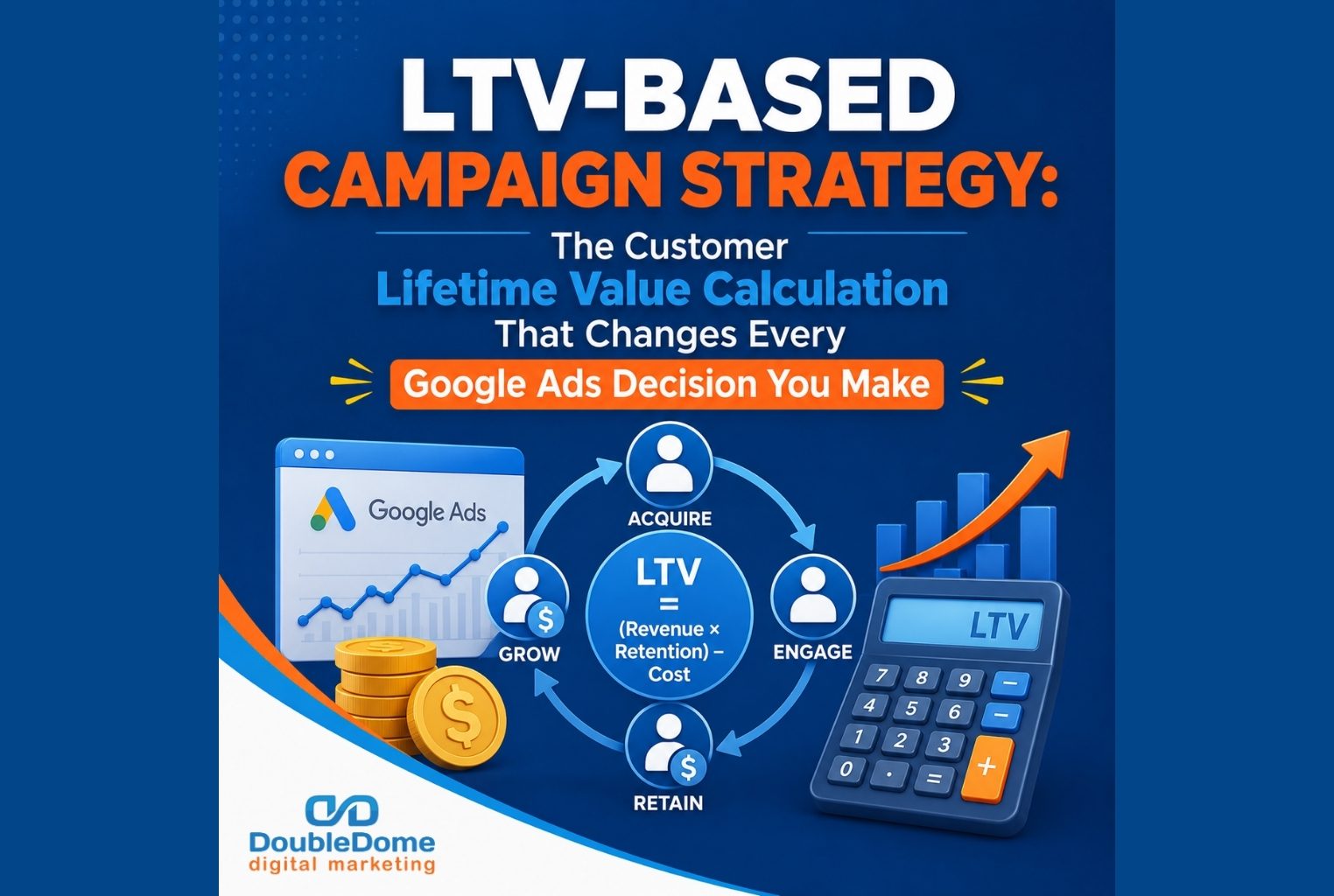
To establish a reliable framework for your data, you must calculate true customer lifetime value using a clean, objective formula that search engines and executive leadership can instantly validate. To calculate basic lifetime value, apply the following standard structural equation:
Where ARPU represents your Average Revenue Per User/Account per year, Margin is your gross profit margin percentage, and LT is the average customer lifetime duration expressed in years. Let us examine how applying this structural baseline fundamentally rewrites your performance benchmarks:
- The Low-Value Segment: A consumer account worth $2,000 annually with an average retention span of 1.5 years yields a gross LTV of $3,000.
- The Premium High-Value Segment: An enterprise corporate account worth $20,000 annually with a stable retention span of 4 years yields an accurate gross LTV of $80,000.
If your customer acquisition limit is locked at a flat $300 across the board because your team lacks visibility into long-term retention data, you will consistently lose the $80,000 account to competitors who understand their metrics. Expanding your parameters allows you to aggressively adjust target returns on ad spend (tROAS) to capture high-value accounts.
How Accurate Tracking Rewrites Your Bidding Model
Transitioning away from generic options and moving toward a resilient LTV-Based Campaign Strategy fundamentally changes how you configure automated Smart Bidding systems. Modern machine-learning models optimize for the exact conversion values you feed back into the platform. When you supply the algorithm with long-term retention data, it learns to shift away from broad, low-intent traffic and focus on high-value user profiles.
| Optimization Parameter | Transactional Model (CPL Focus) | LTV-Based Campaign Strategy (Revenue Focus) |
| Primary Focus Metric | Front-end cost-per-lead and initial transaction value. | Long-term profitability and total customer lifecycle value. |
| Smart Bidding Alignment | Target CPA or Maximize Conversions (values every lead equally). | Target ROAS or Value-Driven Bidding (prioritizes high-value intent). |
| Audience Targeting Depth | Broad keyword matching focused heavily on immediate search volume. | First-party data integration focused on high-retention profiles. |
| Lead Acquisition Quality | High volume of erratic leads that strain internal sales teams. | Lower volume of highly qualified, premium contract opportunities. |
Attribution can sometimes feel like a marketing game of Clue. Everyone has a theory, nobody is completely sure, and somehow Google Ads is always in the room.
Deploying First-Party Data Strategies for Long-Term Growth
With traditional tracking methods fading due to structural changes across major browsers, modern marketing directors cannot rely on third-party tracking pixels to prove campaign value. The solution lies in building an airtight, human-first technical backbone. By integrating your offline CRM conversion milestones back into Google Ads via secure Enhanced Conversions, you pass true value signals back to the platform without violating privacy constraints.
This creates a highly efficient system that balances demand generation with long-term brand equity. Instead of hiding account architecture behind complex, proprietary software configurations, true performance visibility relies on an open, transparent look at the “why” behind your campaign adjustments. Your team gets clean data they can present directly to executive leadership, proving exactly how front-end investments translate into durable, long-term corporate revenue assets.
Securing Predictable, Scalable Marketing Outcomes
The technical aspects of search and performance marketing will continue to evolve, but the mathematical fundamentals of business growth remain constant. Most businesses don’t know their customer lifetime value — which means they don’t know what a lead is actually worth. We calculate it for you and build your bidding strategy around the real number.
If you are ready to eliminate bad leads, bridge your team’s technical strategy gaps, and install a transparent LTV-Based Campaign Strategy built for the realities of modern search, let’s step through your metrics together. We can help you build an optimized lead-generation asset that delivers predictable revenue growth year after year.
Book a Google Ads Campaign Strategy Session with DoubleDome today.
Frequently Asked Questions
How does customer lifetime value impact my daily Google Ads budget?
Knowing your true lifetime value allows you to confidently raise your maximum customer acquisition limits, unlocking premium search auctions that your competitors are locked out of due to lower budgets.
What is the most accurate way to pass long-term value metrics back to Google Ads?
The most precise method is setting up secure first-party offline conversion imports (OCI) that link your CRM sales stages and true contract values directly back to your campaign interface.
Can value-driven bidding models succeed if my business has a longer sales cycle?
Yes, by mapping out intermediate conversion milestones and assigning relative, data-backed value values to micro-conversions, the bidding system learns to optimize effectively across extended timelines.