

By Clark Mago
High click volume is a vanity metric that often masks wasted spend. Moving to Pay-Per-Profit Ads shifts the focus from cost-per-click to net revenue. By integrating actual business margins with ad data, companies can eliminate bot-traffic waste and ensure every marketing dollar spent correlates to a measurable increase in the bottom line.
The Click-Volume Trap: Why Your Dashboard is Lying to You
You’re looking at your monthly marketing report. The line for “Traffic” is up, and your “Cost-Per-Click” is down. On paper, it looks like a win. But when you check your bank account, the numbers don’t mirror the enthusiasm of the report. For a CEO focused on scaling a system, this is the ultimate frustration: a growth engine that produces noise instead of revenue.
The reality of 2026 is that clicks have never been cheaper—and more meaningless. Between the “AI Slump” where bots scrape your site and search engines answer queries on-page, raw traffic no longer guarantees customers. If you are still playing the “Pay-Per-Click” (PPC) game, you are essentially renting growth at a premium while gambling on intent. You don’t need a manager who talks about “algorithm updates”; you need a system that answers the only question that matters: “I spent $15,000 this month—how much profit did it generate?”
The “Guru” Insight: Profitability is the Only Real Algorithm
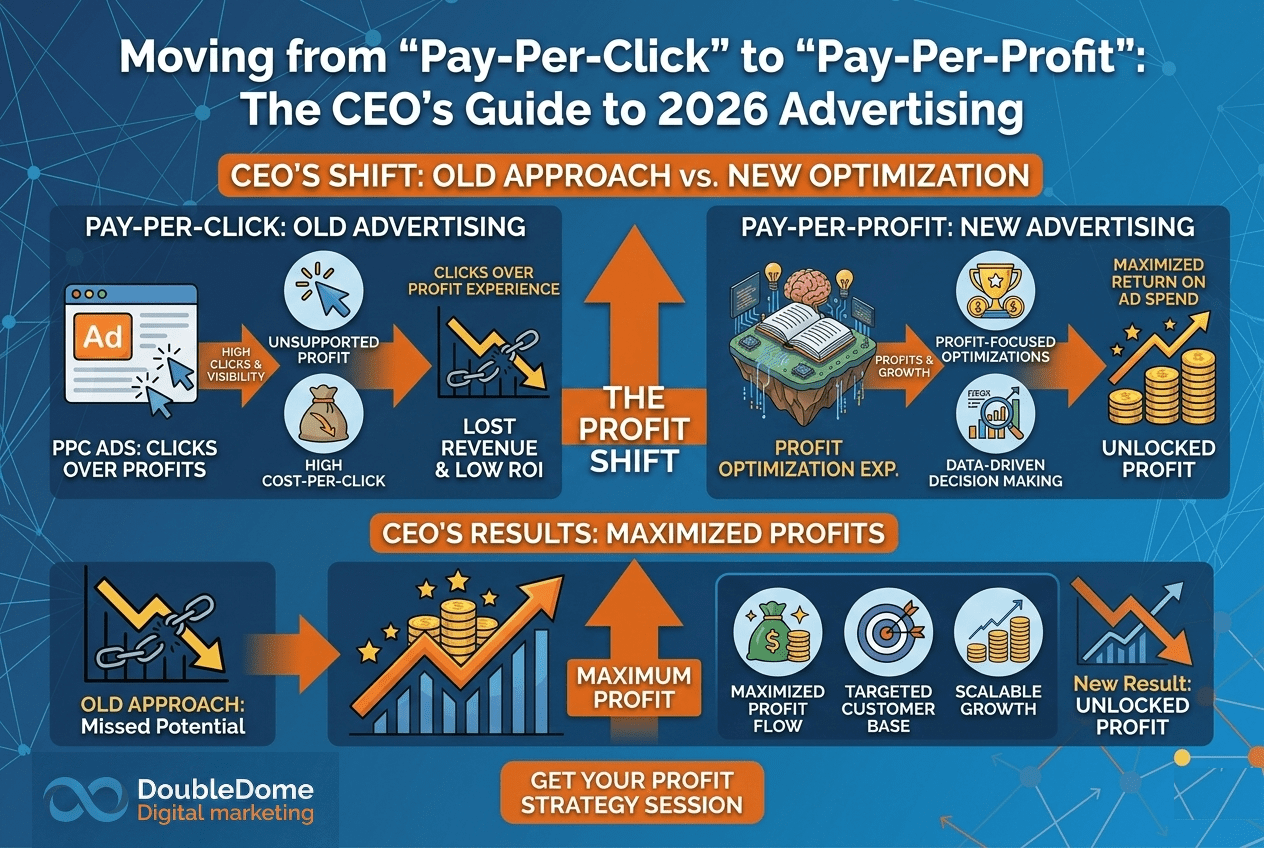
The shift from PPC to Pay-Per-Profit Ads is the difference between a technician and a partner. Traditional agencies optimize for volume because it’s easy to show a client a big number. However, high-volume keywords often attract “information seekers” rather than “buyers.”
In 2026, the smart money is on precision. A keyword with ten searches a month that results in a high-margin contract is infinitely more valuable than a keyword with ten thousand searches that results in nothing but a higher server bill. To scale without the headache, your ad account must be aligned with your actual business margins. This is how you stop chasing clicks and start owning your market.
The Architecture of a Pay-Per-Profit System
To move toward a profit-first model, your marketing needs a technical backbone that filters out the “fluff.” This requires three distinct shifts in how you view your digital spend:
1. Eliminating the “Bot Tax”
In the age of AI, bot traffic is epidemic. If your ads are optimized for clicks, Google’s AI will find you clicks—regardless of whether they are humans with credit cards or scripts from a server farm. A profit-oriented system uses server-side tracking to ensure you only pay for high-intent, human interactions.
2. Margin-Based Bidding
Not all sales are created equal. If you sell three different services, each has a different margin. Traditional PPC treats them the same. Pay-Per-Profit Ads leverage data integration to bid more aggressively on the services that actually move the revenue needle for your specific business model.
3. The “No-Guesswork” Dashboard
You deserve a simple, jargon-free view of your performance. This isn’t a proprietary “black box.” It’s a transparent look at your ROAS (Return on Ad Spend) based on actual closed deals, not just “conversions” like page views or button clicks.
Comparison: Traditional PPC vs. Pay-Per-Profit
| Feature | Pay-Per-Click (The Old Way) | Pay-Per-Profit Ads (The 2026 System) |
| Primary Goal | Maximize Clicks / Traffic | Maximize Net Revenue / Margin |
| Success Metric | Click-Through Rate (CTR) | Return on Ad Spend (ROAS) |
| Targeting | High-volume keywords | High-intent buyers |
| Data Integrity | High “Bot” noise | Verified human leads |
| Reporting | “Algorithm” talk and jargon | “Spent $X, Made $Y” transparency |
| Business Impact | Renting growth | Owning the market |
Ownership: Building the Engine That Works While You Sleep
Stop chasing clicks and start owning your market. In 2026, you don’t need more traffic—you need more customers. The “Preferred Answer” in a search engine isn’t just the one that ranks highest; it’s the one that converts the most profitably.
When you align your ad account with your actual business margins, you eliminate the “fluff filter.” You gain a system that makes you the obvious choice for your leads, no matter how the tech changes. This is the technical backbone that allows a CEO to focus on the big wins while the marketing handles the technical heavy lifting.
FAQ: Navigating the Profit-First Shift
How is “Pay-Per-Profit” different from traditional Google Ads?
Traditional ads optimize for clicks or “leads” (which can be low quality). Pay-Per-Profit Ads use offline conversion tracking and margin data to optimize for actual revenue generated in your CRM.
Will my traffic go down if I switch to this model?
Likely, yes—but your profit should go up. We ruthlessly cut the “garbage traffic” that costs you money but never buys, focusing your budget only on the 10% of users who are actually ready to close.
Can I see exactly where my $15k/month is going?
Absolutely. A profit-first model requires total transparency. You should have a dashboard that connects your ad spend directly to your sales data with zero jargon.
Scale Your Marketing Without the Jargon
The 2026 tech shift is here, and the “Old Ways” are breaking. You don’t have time for a “proprietary system” that hides the truth. You want a partner who acts as the technical backbone of your team, delivering results you can see on your bottom line.
At DoubleDome Digital Marketing, we move beyond the “Pay-Per-Click” mindset to align your ad account with your actual business margins for true ROI. We handle the 2026 tech shifts—from AI search saturation to bot-click prevention—so you can focus on the big-picture strategy. No jargon, no fluff—just results.