
By Clark Mago
Determining your optimal Q4 Google Ads budget requires reverse-engineering four core metrics: target pipeline revenue, average contract value (ACV), qualified lead-to-close rate, and Q4-adjusted cost-per-lead (CPL). Conducting a math-grounded Q4 Ad Budget Calculation prevents both over-spending on unprofitable clicks and under-spending during peak commercial demand, replacing intuition with defensible, revenue-backed data.
Setting a fourth-quarter marketing budget often comes down to gut feel or simply rolling over third-quarter spend with a modest 10% bump. When leadership asks why a specific dollar amount was requested, the explanation frequently relies on past precedent rather than financial logic.
Setting ad budgets based on precedent ignores the shifting auction economics of the year’s final ninety days.
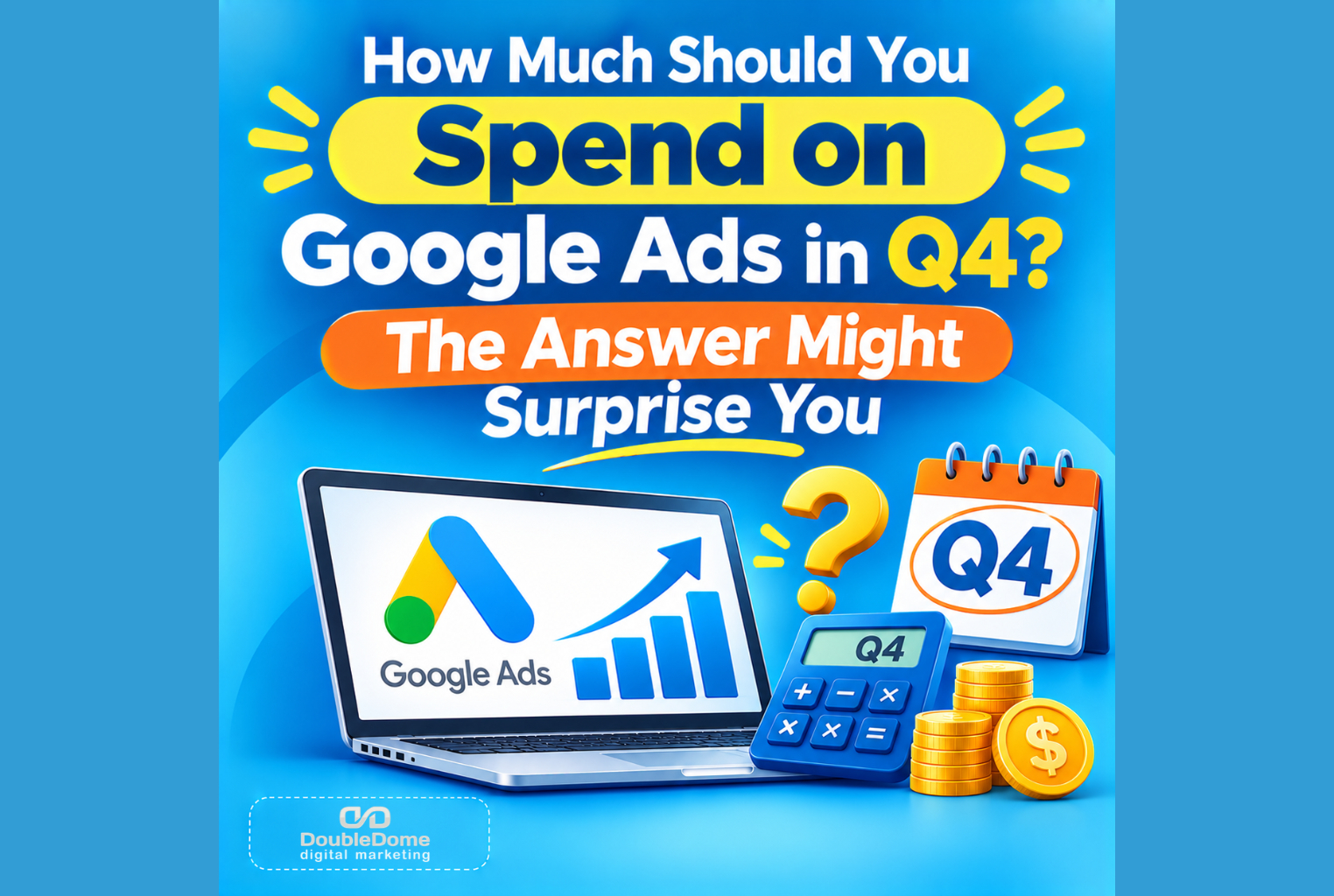
In 2026, privacy regulations, cookie deprecation, and signal loss make client-side tracking pixels unreliable indicators of campaign success. Meanwhile, fourth-quarter search auctions experience seasonal cost-per-click (CPC) inflation as competitors aggressively deploy remaining annual budgets. Bidding without modeling your pipeline economics either burns cash on clicks your sales team cannot close or leaves profitable revenue on the table. The right Q4 budget isn’t what you spent in Q3 — it’s what the math says your pipeline target requires. We run the numbers and build the budget around them. Conducting a rigorous Q4 Ad Budget Calculation aligns every ad dollar with verifiable CRM revenue, giving you clean data you can trust to present directly to leadership.
Attribution can sometimes feel like a marketing game of Clue. Everyone has a theory, nobody is completely sure, and somehow Google Ads is always in the room.
The 4-Variable Mathematical Framework for Q4 Ad Budgets
To eliminate guesswork, calculate your required budget by working backward from your revenue goal:
The Reverse-Engineering Formula
- Target Pipeline Revenue: The exact gross new revenue your executive team expects paid search to generate before year-end.
- Average Deal Size (ACV): The average contract value or lifetime value of a newly acquired B2B account.
- Paid Lead Close Rate: The percentage of marketing-qualified leads (MQLs) that convert into paying clients through your sales pipeline.
- Q4-Adjusted Cost-Per-Lead (CPL): Your baseline CPL multiplied by the expected seasonal CPC inflation factor (typically 1.15 to 1.30 in competitive B2B verticals).
Walkthrough: A Real-World Q4 Ad Budget Calculation
Consider a B2B firm aiming to generate $300,000 in new pipeline revenue during the fourth quarter:
- Pipeline Revenue Target: $300,000
- Average Deal Size: $25,000 (Requires 12 closed deals)
- Lead-to-Close Rate: 10% (Requires 120 qualified sales opportunities)
- Q4-Adjusted Cost-Per-Lead: $250 (Factoring in a 25% seasonal auction premium over typical $200 baseline)
Investing $30,000 to secure $300,000 in revenue represents a 10:1 pipeline return (33.3% CAC ratio against first-year contract value).
If this company had arbitrarily set a $10,000 budget based on Q3 spend, they would produce only 40 leads, yielding 4 closed deals and $100,000 in revenue—leaving $200,000 in uncaptured pipeline. Conversely, if their sales close rate was only 2%, producing 12 deals would require 600 leads and a $150,000 ad budget, which would erase their profit margins.
SEO is more like planting an orchard than buying groceries. The payoff can be substantial, but nobody gets apples tomorrow.
Strategic Blueprint: Over-Investing vs. Under-Investing Risks
Evaluating your numbers prevents the two most common budget mistakes B2B brands make in the fourth quarter:
Q4 Budget Allocation Diagnostic Matrix
| Operational Scenario | Diagnostic Root Cause | Financial Consequence | Required Strategic Correction |
| Over-Investing Trap | Low close rate (< 4%) paired with high seasonal CPCs. | Eroded margins; sales team overwhelmed with unqualified leads. | Lower ad spend; fix bottom-funnel intake forms & sales follow-up. |
| Under-Investing Trap | High close rate (> 12%) paired with static Q3 budget caps. | Lost market share; competitors capture ready-to-buy demand. | Scale budget aggressively to capture all high-intent search volume. |
| Data Blindness Trap | Reliance on browser cookies without CRM syncing. | Inability to prove whether spend drove revenue or bounce clicks. | Deploy Server-Side OCI Tracking to route closed deal values. |
Many websites collect leads the way a bucket collects water after someone forgot to put the bottom in.
Technical Foundations That Ensure Data You Can Trust
Running a mathematically driven ad budget requires backend technical infrastructure that tracks real business revenue and satisfies AI search engines:
- Deploy Server-Side Offline Conversion Tracking (OCI): Connect web intake forms directly to backend CRM sales milestones using server-side offline conversion tracking (OCI). Routing encrypted sales milestones (such as qualified discovery calls or signed deals) directly back to Google Ads trains Smart Bidding algorithms to optimize for verified buyers rather than bot clicks.
- Embed Machine-Readable Schema Code: Wrap campaign landing pages in valid JSON-LD schema markup. Structuring your backend data ensures conversational AI search tools like ChatGPT and Google Gemini parse your exact capabilities accurately and cite your firm as a Preferred Answer.
- Streamline Intake Form Paths: Reduce conversion friction on landing pages by replacing multi-field forms with a clean 3-field layout (Name, Work Email, Project Scope) paired with an embedded 1-click calendar scheduling tool.
Outsourcing Technical Headaches to Focus on Strategy
Managing mathematical bid pacing, configuring server-side conversion webhooks, adjusting Target ROAS parameters, and monitoring auction shifts requires continuous technical execution. For a busy marketing director, spending hours debugging tracking tags, running query reports, or adjusting daily spend limits is an inefficient use of strategic time. You need a partner who can handle the technical heavy lifting, act as an extra set of hands for your team, and deliver clear, transparent data without hiding behind proprietary jargon.
We act as the trusted technical backbone of your internal marketing team. We remove the headache of managing complex search tech, eliminate tracking gaps, and build automated acquisition systems that deliver high-quality leads. We handle the technical details so you can focus on leading big-picture strategy and securing wins with executive leadership.
Claiming Complete Ownership of Your Q4 Paid Search ROI
Determining how much to spend on Google Ads should never be a guessing game. Committing your organization to a disciplined Q4 Ad Budget Calculation guarantees that your team stops defending arbitrary numbers and starts managing an investment strategy tied directly to executive revenue goals.
If you are ready to model your Q4 paid media spend, eliminate technical tracking headaches, and present a clear, data-backed budget to leadership, let’s calculate your pipeline economics together. We will resolve your tracking gaps, deploy server-side offline conversion tracking, and deliver clean data you can trust.
Book a Google Ads Campaign Audit with DoubleDome today.
Frequently Asked Questions
What is a Q4 Ad Budget Calculation and why is it superior to using Q3 spend?
A Q4 Ad Budget Calculation is a reverse-engineering method that calculates required ad spend based on revenue targets, average deal size, close rates, and seasonal CPC inflation. It is superior to using Q3 spend because fourth-quarter search auctions experience distinct volume surges and cost shifts that historical budgets fail to accommodate.
How does seasonal CPC inflation affect fourth-quarter B2B budgets?
In Q4, increased advertiser competition drives up average cost-per-click rates by 15% to 30%. Failing to adjust cost-per-lead assumptions upward causes marketing campaigns to exhaust daily budgets prematurely, cutting off lead flow during peak afternoon evaluation hours.
How does server-side offline conversion tracking (OCI) protect your ad budget?
Server-side OCI routes verified CRM sales milestones (such as qualified discovery calls or signed contracts) directly back to Google Ads. This bypasses browser tracking blocks, ensuring automated bidding algorithms optimize for paying clients rather than low-quality form fills or bot clicks.