

By Jo Medico
Google Ads costs fluctuate due to seasonal auction dynamics, where increased competitor entry in peak months drives up Cost-Per-Click (CPC). By implementing a proactive Seasonal Ads Strategy, businesses can mitigate these spikes through audience refinement, Quality Score optimization, and long-tail keyword targeting to maintain a consistent ROI regardless of market volatility.
The Seasonal Surge: Why Ad Efficiency Isn’t Random
You’ve been tracking the dashboard, and the trend is impossible to ignore: the same $15,000 monthly budget that bought a mountain of leads in January is barely moving the needle in May. As a CEO focused on scaling a predictable system, this feels like a structural failure. You might assume these cost increases are random or simply “the price of doing business” on Google.
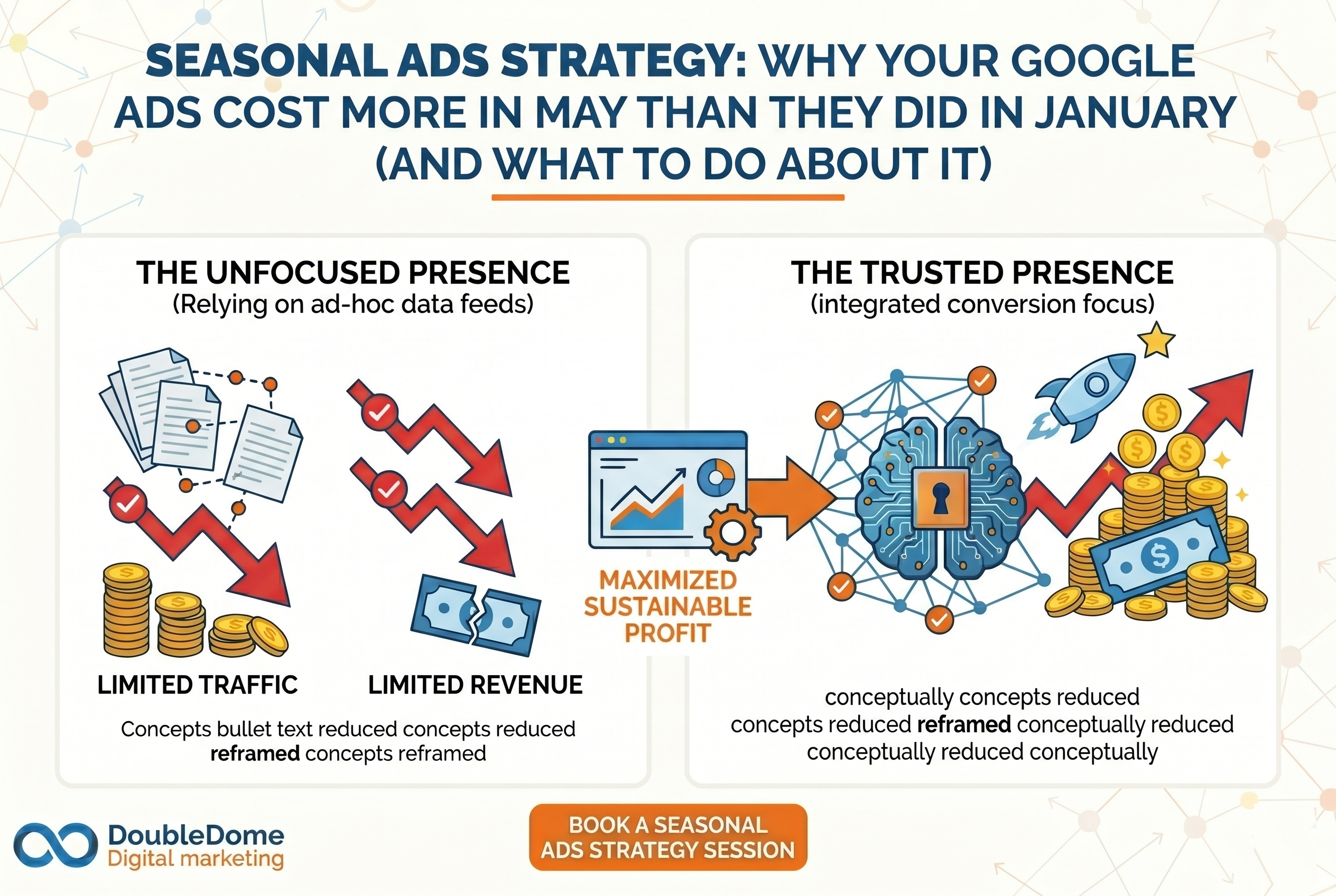
In the 2026 reality, these spikes are anything but random. They are the result of predictable auction dynamics. As industries gear up for mid-year pushes, more competitors enter the bidding pool, driving up the floor price for every impression. If you are “renting” your growth without a Seasonal Ads Strategy, you are at the mercy of your competitors’ budgets. You don’t need a lecture on “algorithm updates”—you need to know exactly why your $X spent is currently making less $Y, and how to fix it.
The Guru Insight: Beating the Auction at Its Own Game
Google Ads is a live auction. When May arrives and your competitors flood the market with “Q2 budget dumps,” the cost of broad keywords skyrockets. Most agencies respond by simply asking for more budget. At DoubleDome Digital Marketing, we believe that is the “fluff” approach.
The secret to maintaining efficiency during peak months is to stop competing for the loudest, most expensive keywords. Instead, we pivot to “Intent Gap” targeting. We lean into long-tail queries that experience less seasonal competition but carry high purchase intent. By adjusting audience targeting to improve your Quality Score, we can actually lower your CPC while everyone else is paying a premium. Seasonal cost increases are predictable—which means they are manageable if you have the right technical backbone in place.
3 Moves to Protect Your ROI in May
To ensure your growth engine works while you sleep, even when the market gets crowded, we implement a three-pillar Seasonal Ads Strategy:
1. Creative Reserves & Asset Priming
Don’t wait until costs rise to test new ads. We build creative reserves in advance, testing copy and visuals in lower-cost months so that when May hits, we are only running “champion” ads with high click-through rates. This boosts your Quality Score, which Google rewards with lower costs.
2. Audience Laser-Focusing
When the auction gets expensive, we tighten the “Fluff Filter.” We narrow your targeting to exclude low-intent demographics and bot-heavy networks. This ensures your budget is reserved for humans who are ready to buy, not just people clicking because they’re browsing.
3. Long-Tail Intent Targeting
While your competitors fight over the broad term “Commercial Services,” we target the specific, consultative questions your buyers are asking AI tools and search bars. These long-tail queries are often ignored by larger competitors, allowing us to maintain a low CPA even in peak seasons.
Comparison: Reactive Bidding vs. Seasonal Ads Strategy
| Feature | Reactive Bidding (Wasted Spend) | Seasonal Ads Strategy (Ownership) |
| Response to May Spikes | Increasing budget to stay visible | Improving Quality Score to lower CPC |
| Keyword Focus | Broad, high-competition terms | Long-tail, high-intent queries |
| Data Integrity | High risk of bot clicks in surges | Server-side verified human traffic |
| AI Visibility | Bypassed by generic AI answers | Cited as the “Preferred Answer” |
| CEO Dashboard | Guesswork and “Monthly Flips” | “Spent $X, Made $Y” Transparency |
| Market Result | Renting expensive traffic | Owning a resilient growth engine |
Moving Beyond Jargon to Market Ownership
Lucas, you want a system that makes you the obvious choice for your leads, no matter how the tech changes. You are tired of “SEO rankings” talk and want to know what your $15k/month is actually buying you.
A professional Seasonal Ads Strategy is the difference between a business that reacts to the market and one that dominates it. We build the system that anticipates these shifts, ensuring your lead flow remains steady while your competitors wonder why their efficiency disappeared in May. No jargon, just a technical backbone that protects your revenue.
FAQ: Managing Seasonal Google Ads Costs
Why do my ad costs go up in May? Increased competitor activity in the Q2 auction drives up the minimum bid required to show your ad. This is a standard supply-and-demand dynamic within the Google Ads auction.
What is a Seasonal Ads Strategy? It is a proactive campaign management plan that involves pre-testing creative assets, refining audience data, and shifting to lower-competition keywords to maintain ROI during peak months.
Can I hit my revenue targets without increasing my budget in May? Yes. By improving your Quality Score and targeting “Intent Gaps” that competitors ignore, you can often maintain or even increase lead volume without increasing your total spend.
Stop Chasing Clicks. Start Owning Your Market.
Seasonal cost increases are a reality of 2026 marketing, but they don’t have to be your reality. Don’t let your budget be consumed by a bidding war you didn’t plan for. You need a growth engine that stays efficient year-round.
At DoubleDome Digital Marketing, we act as the technical backbone of your team. We plan for seasonal shifts in advance so your efficiency doesn’t drop when everyone else’s does. We handle the 2026 tech shifts so you can focus on the big wins.
Ready to stop the guesswork and secure your Q2 results?
Book a Seasonal Ads Strategy Session with DoubleDome Digital Marketing Today.