
By Clark Mago
Achieving a record-breaking September in B2B lead generation requires laying the structural groundlines two months prior. Building a September-Ready Ads Foundation in July involves seeding first-party audience segments, testing ad creative variations at low spend, and refining conversion landing paths so your campaigns scale efficiently when post-summer market demand surging hits.
Every year as late summer approaches, corporate leaders voice a familiar ambition: “We need September to be our biggest revenue month of the year.”
When decision-makers return to their desks after summer vacations, buying cycles accelerate. Yet, many companies wait until the calendar turns to September before turning on their paid ad campaigns or authorizing marketing budgets. They flip the switch on September 1st, expecting immediate pipeline growth, only to watch their ad budgets burn through expensive learning phases, uncalibrated smart bidding routines, and unvetted ad copy.
By the time the account finishes calibrating, September is over.
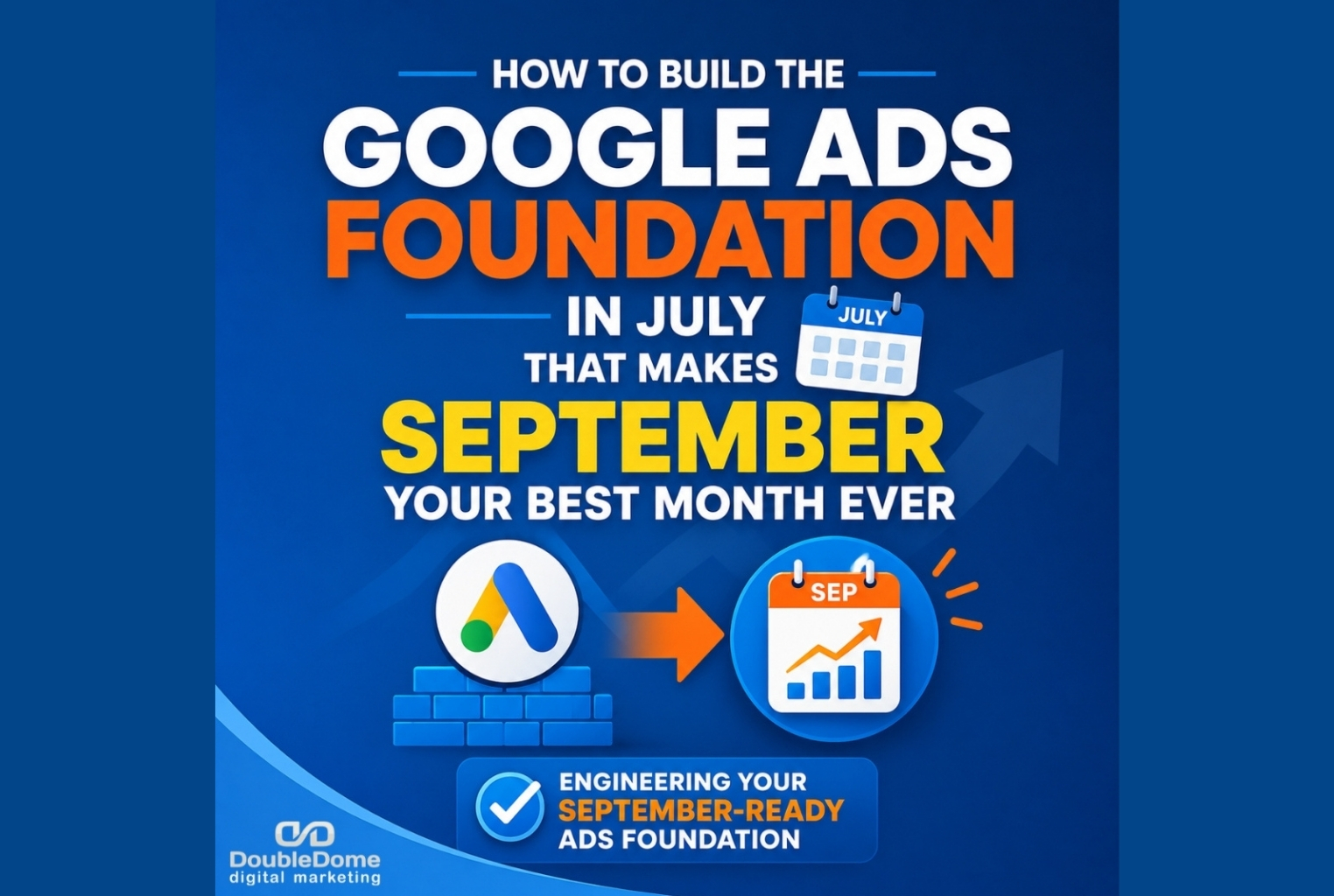
In the business reality of 2026, renting temporary visibility through rushed, unoptimized campaigns is an expensive operational failure. Traditional traffic volume is shifting because conversational AI engines like ChatGPT and Google Gemini natively answer consumer prompts before a buyer ever clicks a link. You don’t need more random traffic—you need more paying customers. If you want an automated growth engine that works while you sleep, you must realize that September performance is directly engineered in July. Laying the groundlines for a September-Ready Ads Foundation ensures that when the market opens back up, your campaigns scale predictably without wasting capital.
SEO is more like planting an orchard than buying groceries. The payoff can be substantial, but nobody gets apples tomorrow.
The July Paradox: Why Waiting Until September Destroys Ad ROI
Google’s Smart Bidding algorithms require data density to operate efficiently. When you launch a brand-new campaign or dramatically increase your budget on un-tested ad accounts, the algorithm enters a “Learning Phase.” During this initial period, the system bids broadly to discover which users convert, driving up your Customer Acquisition Cost (CAC) and exposing your budget to bot click waste.
If you attempt this learning phase in September—when ad auction competition is at its annual peak and cost-per-click (CPC) rates spike across industries—you pay maximum price for raw algorithm trial-and-error.
Building your infrastructure during the quieter weeks of July flips this dynamic in your favor. You absorb the learning phase at lower summer bid prices, gather clean data, and refine your messaging while your competitors are asleep at the wheel.
The 3 Structural Pillars of a September-Ready Ads Foundation
To engineer a high-converting acquisition engine that converts when fall demand arrives, focus your July preparation on three core operational assets:
1. Seed First-Party Audience Lists with Summer Traffic
- The Strategic Action: Build custom remarketing lists and upload first-party customer match lists into Google Ads throughout July.
- Why It Works: While decision-makers may move slowly on signing enterprise contracts during July, they are still actively researching solutions. Capturing their intent data during mid-summer builds a warm, high-intent audience matrix. When September arrives, you can launch precision remarketing campaigns directly to these primed leads at a fraction of the cold-prospecting cost.
2. Test Creative & Search Intent Variations at Low Spend
- The Strategic Action: Deploy low-budget ad variations in July to test headline messaging, value propositions, and long-tail search term triggers.
- Why It Works: You discover your winning ad angles before committing heavy capital. By identifying which copy drives real intent, you eliminate losing variations early, ensuring every dollar spent in September goes toward proven high-converting copy.
3. Refine Landing Page Conversion Paths
- The Strategic Action: Use real summer user recording data and analytics to audit your core service landing pages for conversion friction.
- Why It Works: Increasing traffic to an unoptimized landing page simply accelerates capital drain. Testing conversion layouts in July ensures your site features clear information gain, machine-readable JSON-LD schemas, and low-friction mobile forms ready to handle incoming fall traffic.
Many websites collect leads the way a bucket collects water after someone forgot to put the bottom in.
Campaign Execution Blueprint: July Setup vs. September Launch
To see how early preparation protects your bottom-line net profit margins compared to late campaign launches, look at how both approaches perform when peak market demand arrives:
The Autumn Scalability Matrix
Attribution can sometimes feel like a marketing game of Clue. Everyone has a theory, nobody is completely sure, and somehow Google Ads is always in the room.
Eliminating Fluff to Scale Predictably
Stop chasing clicks and start owning your market. In 2026, you don’t need more traffic—you need more customers. We build the system that makes you the obvious choice for your leads, no matter how the tech changes. Just results, no jargon.
Your best September starts with your July Google Ads work. We build the foundation now — so you can scale with confidence when the market opens back up. By establishing a disciplined September-Ready Ads Foundation, you eliminate the anxiety of seasonal revenue dips and build a permanent digital asset that drives qualified leads month after month.
Outsourcing Technical Overhead to Protect Enterprise Margins
Configuring an ad infrastructure that seamlessly connects summer research traffic to autumn revenue requires constant technical precision. Between managing server-side tracking lines (OCI), auditing negative match keyword lists, and deploying custom schema blocks for AI recommendation bots, the technical workload can quickly overwhelm internal teams. For a CEO, playing data detective or managing daily ad bids is an inefficient use of strategic time.
We act as the trusted technical backbone of your internal leadership team. We remove the jargon, eliminate the fluff, and manage the daily platform configurations to protect your ad budget. We handle the complex backend tracking integrations so you can focus on scaling operations and sealing major contracts.
Claiming Your Market Advantage Before Fall
The digital environments where your prospective clients research solutions will continue to shift as conversational AI networks alter traditional search habits, but the fundamental rules of business growth remain constant: early preparation drives profitability, and system optimization eliminates waste. Standardizing your approach through a structured September-Ready Ads Foundation guarantees that your team stops guessing with your ad budget and starts building a predictable revenue engine.
If you are ready to eliminate bad leads, completely stop wasted ad spend, and review an unambiguous performance dashboard that your leadership team can verify with absolute certainty, let’s look behind the scenes together. We will examine your ad setup, patch your conversion bottlenecks, and build a growth system focused entirely on revenue generation.
Book a Google Ads Review Session with DoubleDome today.
Frequently Asked Questions
Why does launching Google Ads in July produce a better September than starting in September?
Launching in July allows your account to complete its algorithm learning phase, seed custom retargeting lists, and test copy variations at lower summer CPC rates, ensuring your campaigns are fully optimized before peak fall competition begins.
How does a September-Ready Ads Foundation help my business appear in ChatGPT and Gemini?
By refining your core landing pages with structured JSON-LD schema markup and high information gain during July, conversational AI models can accurately index your services and cite your brand as the preferred answer when autumn queries surge.
Can I track whether summer ad clicks generate September contract closures without relying on cookies?
Yes, by deploying secure server-side offline conversion tracking (OCI) that routes encrypted milestone data directly from your internal CRM back to your reporting interface, bypassing browser tracking blocks entirely.