

By Jo Medico
In 2026, longer content outperforms shorter content because it satisfies the “Information Gain” requirements of both humans and AI. By implementing a comprehensive Content Depth Strategy, businesses demonstrate the topical authority needed to become the “Preferred Answer.” The exception? Content should only be as long as necessary to fully resolve the user’s specific intent.
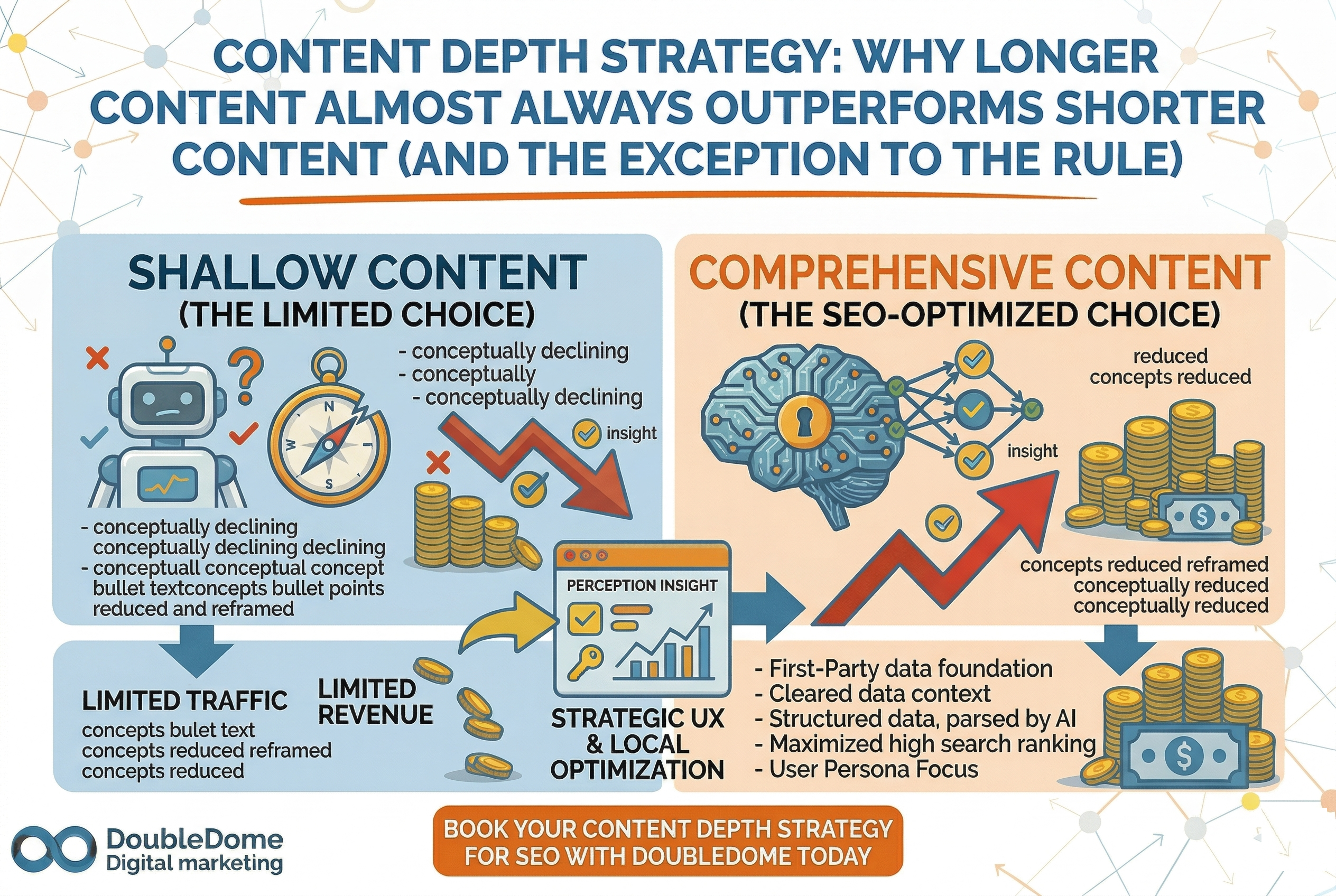
The Length Debate: Beyond “Punchy” vs. “Professional”
In boardrooms across the country, a recurring debate stalls marketing progress: Should content be “short and punchier” for busy executives, or “long and comprehensive” for SEO? As a CEO focused on scaling a predictable system, you likely have zero patience for this back-and-forth. You don’t care about word counts; you care about revenue. You want to know exactly what your $15k-a-month investment is buying you.
The 2026 reality is that the “AI Slump” is punishing thin content. If an AI bot can summarize your 300-word blog post in two sentences without ever sending a visitor to your site, you’ve lost. To stop renting clicks and start owning your market, your website must serve as a technical backbone of authority. This requires a shift from “posting content” to executing a Content Depth Strategy that makes you the obvious choice for high-value leads.
The Guru Insight: Why Depth Wins the AI Search War
Search engines and AI models like ChatGPT and Gemini don’t just “read” your site; they evaluate your “topical coverage.” Longer content typically outperforms shorter content for competitive, high-intent queries because it covers the semantic “why” and “how” behind a buyer’s question.
However, length for its own sake is a liability. The modern standard is “comprehensive utility.” Every section must answer a real question a buyer has. If you are being skipped by AI recommendations, it’s often because your content lacks the depth to be cited as a definitive source. A high-level Content Depth Strategy ensures that you aren’t just adding words—you are adding “Information Gain,” which is the unique value that AI engines cannot simply guess.
The Decision Framework: Long vs. Short
- Long-Form (1,500+ Words): Essential for competitive commercial queries where a buyer is vetting expertise (e.g., “How to scale a B2B logistics system”).
- Short-Form (<800 Words): Best for low-competition informational queries or direct “fact” answers (e.g., “Q3 tax deadlines for 2026”).
Moving Beyond “Fluff” to Market Ownership
You want a growth engine that works while you sleep. To achieve that, your content needs to be “citation-worthy.” When a big client asks a service-related question, you want the AI to cite your proprietary data and your deep-dive analysis.
This isn’t about “algorithm updates”—it’s about ownership. By investing in a Content Depth Strategy, you create a brand that people actually recognize. You filter out the “bad leads” by answering their complex questions upfront, ensuring your sales team only talks to pre-vetted prospects. This is how you eliminate wasted spend and start seeing a clear “Spent $X, Made $Y” result on your dashboard.
Comparison: Thin Content vs. Deep Authority
| Feature | Thin/Short Content (Legacy) | Deep Content Strategy (2026) |
| Primary Goal | High-volume “Ranking” | Becoming the “Preferred AI Answer” |
| User Value | Surface-level “Punchy” copy | Comprehensive, actionable insights |
| AI Perception | Summarizable / Replaceable | Citation-worthy / Authoritative |
| Lead Quality | High Noise / Low Intent | High Precision / Pre-vetted |
| Data Integrity | Fluff-heavy | High “Information Gain” |
| CEO Dashboard | Clicks & Impressions | Spent $X, Made $Y |
FAQ: Navigating Content Depth in 2026
Will my customers actually read 2,000 words?
High-value B2B buyers don’t “read” every word—they scan for authority. Detailed subheaders, tables, and deep-dives signal to the buyer (and the AI) that you have the most thorough solution to their problem.
What is a Content Depth Strategy?
It is a technical framework that maps out the necessary information, proprietary data, and semantic keywords required to fully answer a user’s query and satisfy AI “entity” confidence.
Can shorter content ever rank #1?
Yes, but usually only for very specific, low-competition navigational queries. For any query where there is a “buying” intent, depth is the primary trust signal.
Scale Your Marketing with Clear, Honest Data
The right content length is the one that fully answers your buyer’s question—no more, no less. In 2026, you don’t need more traffic; you need more customers. We write to that standard every time, ensuring your business is the obvious choice for your leads, no matter how the tech changes.
At DoubleDome Digital Marketing, we act as the technical backbone of your team. We handle the 2026 tech shifts and the AI Slump so you can focus on the big wins. Just results, no jargon.
Ready to stop chasing clicks and start owning your market?
Book Your Content Depth Strategy for SEO Session with DoubleDome Today.