

By Janice Ramos
Ranking for irrelevant keywords is a symptom of a fractured digital foundation. This “keyword drift” happens when AI search models and Google cannot discern your core expertise, leading to unqualified traffic and wasted spend. Resolving this requires a focused content strategy that prunes low-value pages and reinforces your brand as a high-intent, authoritative entity.
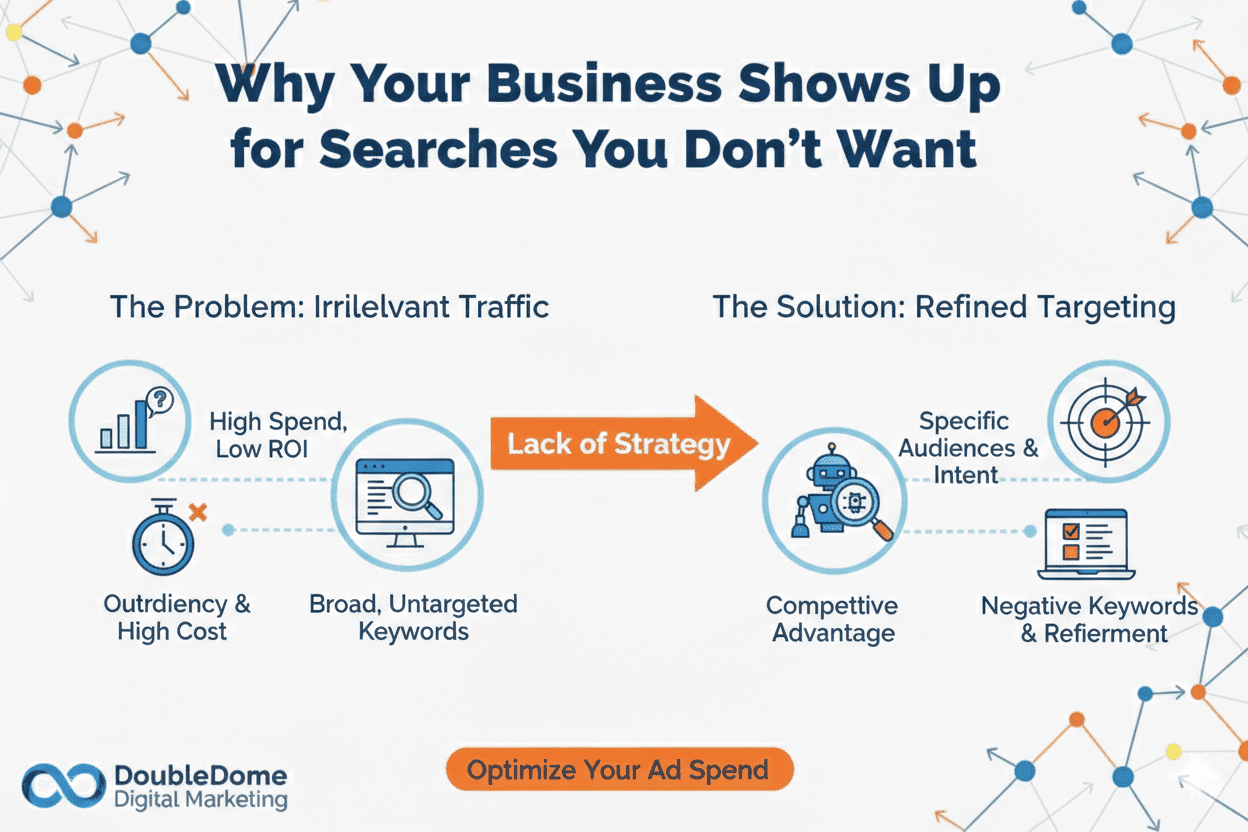
The Traffic Mirage: Why “High Ranking” Can Mean Low Revenue
You check your monthly SEO report and see the line moving up. Impressions are at an all-time high. But when you look at the CRM, the leads are “junk.” You’re being contacted by students looking for definitions, competitors doing research, or customers seeking services you don’t even provide.
For a CEO focused on scaling systems, this is the ultimate frustration. You are paying for “visibility,” but you aren’t buying customers. In 2026, the internet is flooded with AI-generated noise. If your website is broad and unfocused, search engines like Google and Answer Engines like ChatGPT will “pattern-match” your site to any query that vaguely fits. They are guessing what you do because you haven’t told them with technical precision.
This irrelevant traffic does more than just waste your time; it dilutes your messaging and drains your server resources. Most importantly, it causes you to fall into the “AI Slump”—where you are visible for everything that doesn’t matter and invisible for the high-ticket searches that do.
The “Guru” Insight: Google is Guessing Because You’re Not Guiding
Most agencies will tell you to “create more content” to fix a ranking problem. This is a 2022 solution to a 2026 problem. Often, the reason you are ranking for the wrong searches is that you have too much content that lacks a clear objective.
Google and modern LLMs (Large Language Models) prioritize Topical Authority. If your site has dozens of old blog posts, generic service descriptions, and “fluff” articles, you are sending mixed signals. To become the “Preferred Answer” for big clients, you need a focused content strategy. This means ruthlessly pruning content that attracts the wrong audience and consolidating your expertise into high-impact “Power Pages” that the AI can easily parse and trust.
How to Realign Your Brand for High-Intent Searches
To stop “renting” growth from broad keywords and start owning your lead flow, you must transition from a volume-based mindset to a precision-based system. This realignment ensures that when a qualified prospect asks a specific question, the AI recommends you—not just because of a keyword match, but because your site’s technical backbone proves you are the obvious choice.
The Three Pillars of Focused Intent
- Content Pruning: Identifying and deleting “zombie pages” that attract low-intent traffic.
- Semantic Entity Mapping: Explicitly defining your services using Schema markup so AI models don’t have to guess your niche.
- Information Gain: Ensuring every page provides unique, first-party data that can’t be found elsewhere, compelling the AI to cite you as a primary source.
Comparison: The “Noise” Model vs. The Focused System
| Metric | The Broad “Noise” Model (Legacy) | The Focused Content System (2026) |
| Traffic Quality | High volume / Unqualified leads | Lower volume / High-precision buyers |
| SEO Strategy | “More is better” content creation | Strategic pruning and consolidation |
| AI Perception | Confused / Generic “Generalist” | Verified “Preferred Answer” Authority |
| Ad Spend Impact | Wasted on broad, low-intent clicks | Optimized for high-intent conversion |
| Reporting | Vague “Algorithm” updates | Clear ROI: Spent $X, Made $Y |
Ownership: Building a Growth Engine That Works While You Sleep
You don’t need more “traffic”—you need a predictable system. When you implement a focused content strategy, you remove the guesswork. You stop chasing clicks and start owning your market.
By refining what you rank for, you ensure that every dollar of your $15k/month budget is spent attracting people who are actually going to buy. You move away from the “proprietary” black boxes of old-school agencies and move toward a transparent, technical partnership where the data speaks for itself.
FAQ: Fixing Your Ranking Misalignment
Why am I ranking for keywords I don’t care about?
This is typically due to “Keyword Drift.” If your site lacks a clear technical structure and focused intent, search engines will match your content to any vaguely related broad search query.
Will deleting content hurt my SEO?
On the contrary—deleting or consolidating irrelevant, low-performing content often improves your rankings by focusing your “Crawl Budget” and topical authority on the pages that actually drive revenue.
How does a focused content strategy help with AI recommendations?
AI models like ChatGPT look for definitive sources. A focused site with clear schema and authoritative data is much easier for an AI to verify and recommend as a “Preferred Answer.”
Stop Chasing Clicks. Start Owning Your Market.
In 2026, you don’t need to be everywhere; you need to be in front of the right people. If your business is showing up for searches you don’t want, it’s a sign that your growth engine is out of alignment.
At DoubleDome Digital Marketing, we act as the technical backbone of your team. We’ll audit what you’re currently ranking for and implement a focused content strategy to attract the searches that matter. We handle the 2026 tech shifts—from AI search realignment to technical pruning—so you can focus on the big wins. Just results, no jargon.
Ready to get found for what actually matters?