

By Janice Ramos
Google’s ranking system in 2026 is no longer about chasing blue links. Modern Ranking Factors prioritize trust, clarity, and usefulness—especially for AI-driven answers. To win, brands must structure content for humans and machines, prove real expertise, and connect SEO performance directly to revenue, not vanity metrics.
Google’s ranking factors today focus on content quality, real-world expertise, technical clarity, and brand trust signals. In an AI-first search landscape, the goal isn’t just higher rankings—it’s becoming the preferred, most reliable answer across search engines and AI assistants.
Why Ranking Factors Matter More Than Rankings
If you’re still measuring success by “we moved from position #5 to #2,” you’re already behind.
Search engines are increasingly answering questions before a user clicks. AI summaries, featured snippets, and conversational search mean visibility now depends on whether your content is understandable, trustworthy, and reusable by machines.
Modern Ranking Factors determine:
- Whether your brand is cited in AI-generated answers
- Whether Google trusts your site enough to summarize it
- Whether traffic converts into real pipeline and revenue
In short: rankings are a symptom. Systems are the strategy.
Core Ranking Factors Google Actually Rewards
1. Information Gain (Not Rewritten Content)
Google actively devalues content that simply restates what already exists. Pages that add new clarity outperform longer, fluffier articles.
High-performing content demonstrates:
- Original frameworks or comparisons
- Clear explanations written for decision-makers
- First-hand insights, examples, or opinions
This is one of the most overlooked Ranking Factors—and one of the easiest ways to stand out.
2. E-E-A-T Signals You Can Prove
Experience, Expertise, Authoritativeness, and Trustworthiness are no longer abstract concepts.
Google evaluates:
- Author credibility and topical depth
- Brand consistency across search, reviews, and mentions
- Clear ownership, contact info, and accountability
AI models heavily weight these trust signals when deciding who to recommend.
3. Structured Content for Answer Engines
AI doesn’t “read” like humans—it parses.
Winning pages use:
- Clear H1–H3 hierarchies
- Bullet points and tables for comparison
- Direct, concise answers to common questions
These structural elements strongly influence how Ranking Factors are applied in AI-driven search results.
4. Engagement That Reflects Intent
Clicks alone don’t matter. What matters is whether users find what they need.
Google analyzes:
- Time on page
- Scroll depth
- Return-to-search behavior
If visitors don’t feel confident after reading your content, rankings—and AI visibility—fade.
5. Technical Foundations That Remove Friction
Even the best content fails without technical clarity.
Critical technical Ranking Factors include:
- Fast load times and stable layouts
- Clean internal linking
- Schema markup that explains context to machines
Technical SEO is no longer a “nice to have.” It’s the delivery system for trust.
Traditional SEO vs AI-Optimized SEO
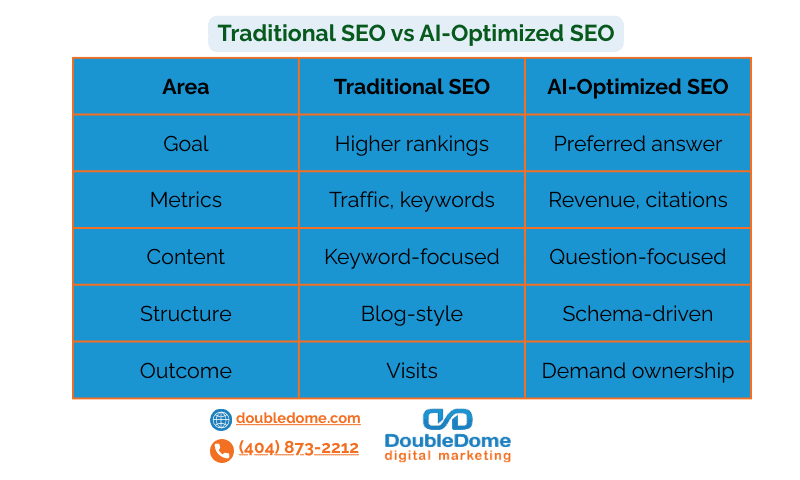
This shift is why many companies feel traffic dropping—even when they’re “ranking.”
How Ranking Factors Tie Directly to Revenue
The most valuable Ranking Factors are the ones that reduce friction between question and decision.
When your brand becomes the default answer:
- Sales cycles shorten
- Lead quality improves
- Ad spend becomes supplemental—not required
This is how SEO evolves from a cost center into a compounding growth asset.
Google’s Ranking Factors are no longer about gaming an algorithm—they’re about earning trust at scale. The brands that win in 2026 don’t chase clicks. They own answers, authority, and demand.
Ready to Become the Preferred Answer?
DoubleDome Digital Marketing helps growth-focused brands optimize for SEO, AEO, and Generative AI visibility so your business shows up where decisions are actually made.
Explore DoubleDome’s SEO AI Optimization Services and start owning your market instead of renting traffic.
FAQ: Google’s Ranking Factors
What are Google’s most important ranking factors today?
Google prioritizes content quality, information gain, E-E-A-T signals, user engagement, and technical clarity.
Do rankings still matter if AI answers appear first?
Yes, but indirectly—ranking well increases the chance your content is used in AI-generated answers.
How does schema markup affect rankings?
Schema doesn’t directly boost rankings, but it helps search engines and AI models understand and reuse your content.
Is SEO still worth investing in?
Yes—when SEO is built around revenue, authority, and AI visibility instead of traffic alone.
How often do ranking factors change?
The principles stay consistent, but weighting evolves continuously based on user behavior and AI integration.
Need help implementing these strategies? Partner with an experienced digital marketing agency that understands your growth goals. Contact our experts today!