

By Janice Ramos
Keywords drive fundamentally different business outcomes based on searcher intent: informational queries generate raw traffic, while commercial and transactional keywords generate qualified leads. Applying systematic Keyword Intent Classification prior to content creation ensures your SEO investments align directly with buyer evaluation stages, protecting your budget from vanity metrics and capturing pipeline revenue.
Your monthly SEO reporting deck shows an impressive upward curve. Organic website traffic is up, pageviews look healthy, and your agency proudly points to top-ranking positions for broad industry terms. Yet, when you review your CRM, your sales team is starving for actual meetings. The traffic coming in feels completely disconnected from closed revenue.
It is one of the most common budget leaks in B2B growth: celebrating superficial traffic spikes that never turn into paying customers.
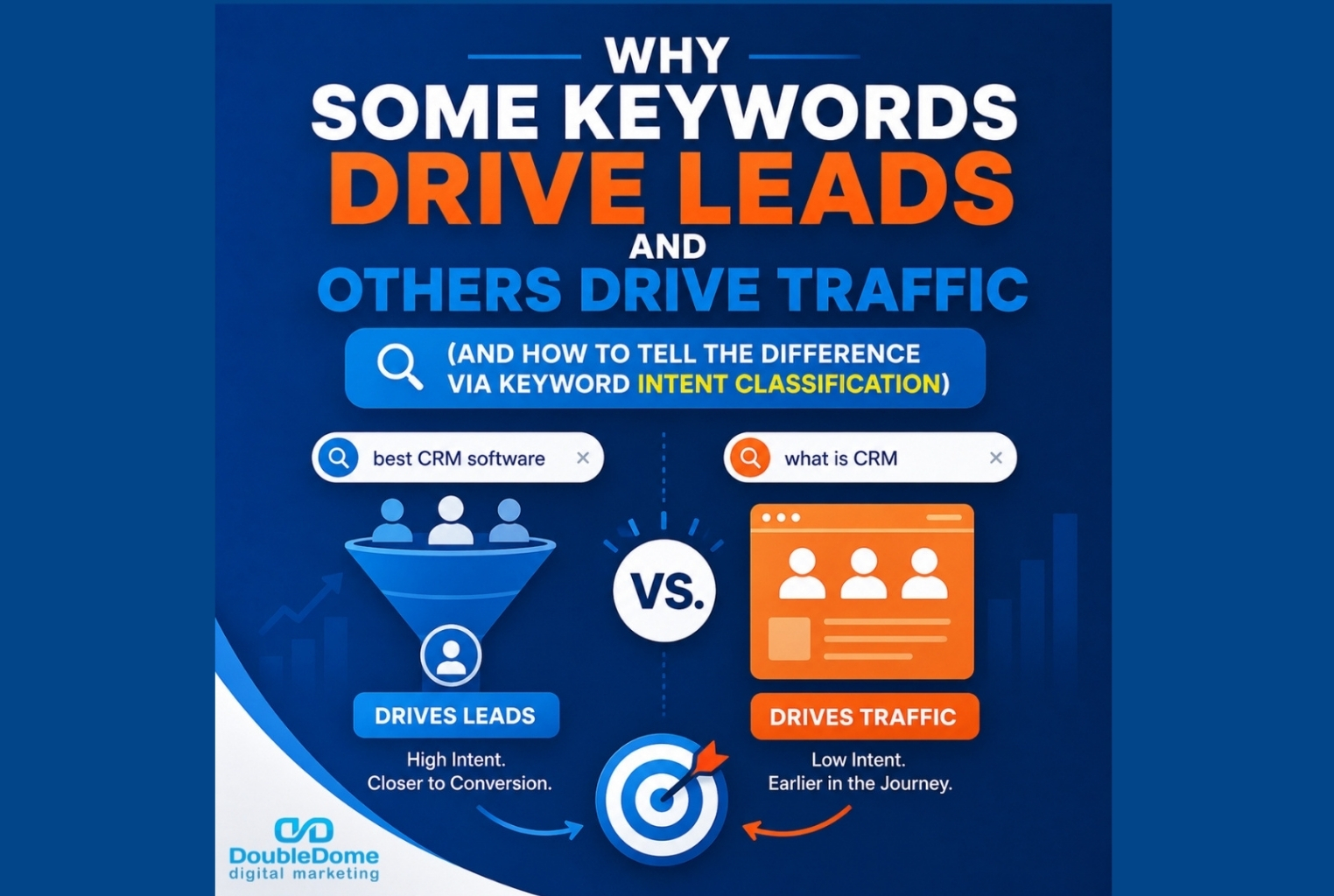
In the business reality of 2026, chasing raw click volume is a dangerous trap. Traditional search traffic is slumping as conversational AI engines like ChatGPT and Google Gemini natively answer surface-level questions before a user ever clicks a link. You don’t need more random traffic—you need more customers. If you want a growth engine that works while you sleep and a simple dashboard that proves you must look beyond basic search volume. Mastering pre-targeting Keyword Intent Classification ensures your team builds content around terms that drive real revenue instead of empty visits.
SEO is more like planting an orchard than buying groceries. The payoff can be substantial, but nobody gets apples tomorrow.
The Four Intent Buckets: Traffic Generators vs. Revenue Drivers
To stop wasting capital on keywords that yield zero pipeline, you must classify every potential search query before writing a single line of copy. Search intent falls into four distinct categories:
1. Informational Intent (Traffic Generators)
- Searcher Goal: Looking for general knowledge, definitions, or broad concepts (e.g., “what is enterprise facility management”).
- Business Impact: Drives high pageview volume, but converts poorly because searchers are early in their learning phase or simply doing homework. In 2026, AI summaries absorb most of these clicks anyway.
2. Navigational Intent (Brand Search)
- Searcher Goal: Trying to locate a specific company, portal, or login page (e.g., “DoubleDome client portal”).
- Business Impact: Essential for existing user retention, but adds zero net-new prospects to your acquisition pipeline.
3. Commercial Intent (Lead Drivers)
- Searcher Goal: Actively investigating solutions, comparing service providers, or reviewing pricing models (e.g., “best commercial facility management services in Dallas”).
- Business Impact: High conversion potential. These buyers know they have a problem and are actively evaluating vendors to solve it.
4. Transactional Intent (Contract Closers)
- Searcher Goal: Ready to take immediate action, schedule a consultation, or request a custom quote (e.g., “hire commercial facility management agency”).
- Business Impact: Maximum conversion value. These queries represent immediate sales opportunities.
The Pre-Targeting Keyword Intent Classification Framework
Before committing production resources or ad budget to a keyword, evaluate it against a three-step pre-targeting audit to verify its commercial viability:
1. SERP Feature & AI Summary Inspection
Type the target query into Google, ChatGPT, and Gemini. If an AI box or featured snippet fully answers the prompt in 30 words without requiring a click, the query carries low commercial intent. If the SERP displays sponsored service ads, comparison tables, and local service packs, the term represents active buying intent.
2. Modifier Analysis
Examine the structural modifiers inside the search phrase. Words like “how,” “what,” “examples,” and “free” indicate informational researchers. Modifiers like “vs,” “cost,” “pricing,” “top-rated,” “services,” and “providers” signal commercial evaluation.
3. Business Fit & Information Gain Potential
Ask: If 100 people land on this page, can we present a logical next step that aligns with an immediate business need? If the topic is too broad to pitch a logical solution, skip it.
Many websites collect leads the way a bucket collects water after someone forgot to put the bottom in.
Strategy Comparison: Traffic-First vs. Intent-First SEO
Targeting the wrong intent keywords produces traffic that never converts. We classify every keyword before we build content around it — so your SEO investment connects to revenue.
Intent Alignment Blueprint
Attribution can sometimes feel like a marketing game of Clue. Everyone has a theory, nobody is completely sure, and somehow Google Ads is always in the room.
Eliminating Fluff to Scale Your Pipeline
Stop chasing clicks and start owning your market. In 2026, you don’t need more traffic—you need more customers. We build the system that makes you the obvious choice for your leads, no matter how the tech changes. Just results, no jargon.
By embedding rigorous Keyword Intent Classification into your growth strategy, you eliminate wasted budget, filter out bad traffic, and build a permanent digital asset that captures ready-to-buy prospects.
Outsourcing Technical Overhead to Scale Your Enterprise
Executing a disciplined keyword strategy requires continuous technical precision—from setting up machine-readable JSON-LD schemas (Organization, Service, FAQPage) to connecting server-side tracking lines (OCI) that map search clicks directly to backend CRM sales deals. For an active CEO, playing data detective or auditing script parameters is an inefficient use of strategic time.
We act as the trusted technical backbone of your internal leadership team. We remove the jargon, eliminate agency fluff, and build the automated systems that make your business the preferred choice for qualified buyers. We handle the technical infrastructure so you can focus on leading your company and closing major accounts.
Claiming Ownership of Your Commercial Market
The search environments where prospective clients evaluate solutions will continue to evolve, but the core math of enterprise profitability remains constant: targeting commercial intent eliminates waste and drives sustainable scale. Committing your business to systematic Keyword Intent Classification guarantees that your team stops renting temporary traffic loops and starts building an unyielding competitive advantage.
If you are ready to stop wasting budget on empty clicks, eliminate bad leads, and review an honest performance dashboard that directly connects your marketing investments to gross profit margins, let’s analyze your search terms together. We will audit your keyword portfolio, patch your conversion bottlenecks, and build an acquisition engine focused entirely on revenue generation.
Book an SEO Strategy Session with DoubleDome today.
Frequently Asked Questions
What is Keyword Intent Classification and why is it critical for B2B lead generation?
Keyword Intent Classification is the process of categorizing search terms by buyer intent (informational, navigational, commercial, or transactional) before creating content, ensuring marketing budgets focus on queries that drive revenue rather than empty traffic.
Why do informational keywords generate high traffic but low sales pipeline?
Informational keywords attract users who are looking for broad knowledge or free advice. Because these searchers are not actively evaluating vendors, they rarely convert into sales meetings.
Can server-side tracking measure which keywords actually generate closed CRM revenue?
Yes, by deploying secure server-side offline conversion tracking (OCI) that routes encrypted milestone data directly from your CRM back to your analytics dashboard, bypassing browser tracking blocks.