

By Janice Ramos
Local business dominance is determined by data consistency and AI confidence scores. Inconsistent NAP (Name, Address, Phone) data, neglected Google Business Profiles, and lack of a structured review strategy create a “trust gap” that forces search engines and AI to recommend your competitors over you. A professional Local SEO Checkup identifies these leaks to secure your market share.
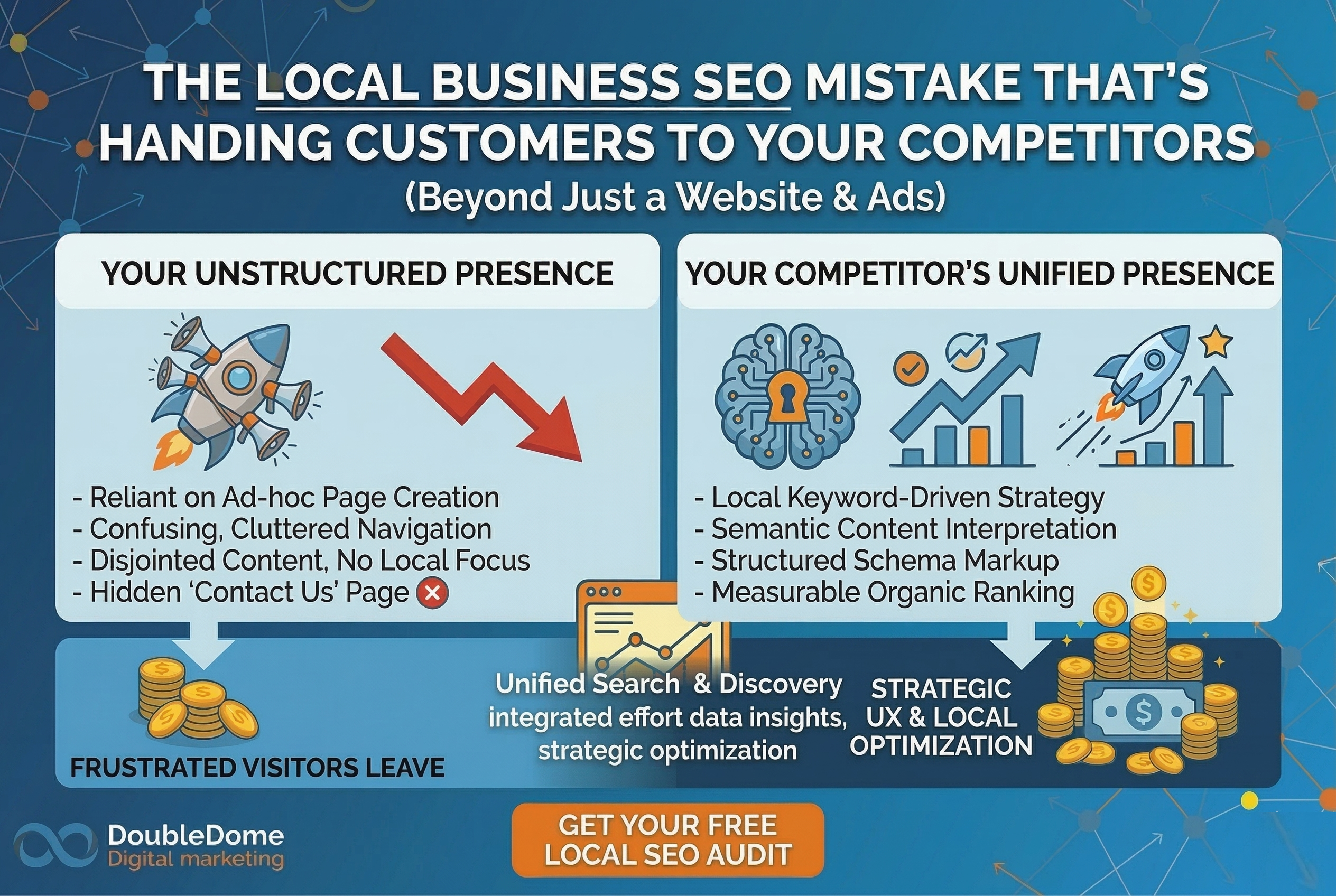
The Neighborhood Blind Spot: Why “Good Enough” is Costing You
As a CEO focused on scaling a predictable growth engine, you likely assume your local presence is “handled.” You have a physical location, you’ve been in business for years, and you’re a known name in your geographic market. But in 2026, proximity is no longer the primary ranking factor—confidence is.
If you are looking at your dashboard and seeing “impressions” but not a corresponding surge in high-quality local leads, you are likely a victim of the “Local Trust Gap.” While you are focused on the big picture, a competitor down the street may be showing up above you simply because their digital infrastructure is better managed. They aren’t “better” than you; they are just more “readable” to the machines.
In the age of the “AI Slump,” search engines like Google and Answer Engines like Gemini don’t just want to show a list of businesses; they want to provide the “Preferred Answer.” If your local data is fragmented, you are effectively handing your most valuable, high-intent customers to your competition on a silver platter.
The Guru Insight: The Three Pillars of Local Dominance
Experienced local strategists know that most businesses fail at the fundamentals. In 2026, these aren’t just “SEO tasks”—they are the technical backbone of your brand’s reputation. A comprehensive Local SEO Checkup usually reveals three catastrophic but fixable mistakes.
1. The NAP Inconsistency Virus
Your business Name, Address, and Phone number (NAP) must be identical across every directory on the web—from Yelp and Yellow Pages to your own website footer. If one directory lists “Suite 200” and another says “Ste 200,” or if an old phone number is still floating on an obscure map site, search engines lose confidence.
2. The Neglected Google Business Profile (GBP)
Your GBP is your 2026 digital storefront. If you haven’t posted an update in three months, haven’t answered a Q&A, or have outdated holiday hours, you are signaling to the algorithm that your business is stagnant. AI models prioritize active entities over dormant ones.
3. Zero Structured Review Strategy
Reviews are no longer just about “stars”; they are about keywords and recency. If your last review was six months ago, or if your reviews don’t mention the specific services you want to scale, you won’t be the business ChatGPT recommends when a client asks for a specialist.
Moving From “Rented” Clicks to Local Ownership
Lucas, you’re tired of hearing about “rankings” that don’t move the revenue needle. You want a system that works while you sleep. Local SEO is the ultimate ownership play. Unlike Google Ads, where you “rent” visibility by the click, a dominant local presence is an asset you own.
By fixing these structural errors, you stop the guesswork. You move from being “a choice” to being the “obvious choice.” You don’t need more traffic; you need the high-intent lead who is five miles away and ready to buy.
Comparison: The “Legacy” Local Approach vs. The 2026 System
| Feature | Legacy Local SEO (Budget Leak) | 2026 Local Growth System |
| NAP Status | “Close enough” / Inconsistent | Mathematically Identical / Sync’d |
| GBP Profile | Set it and forget it | Active Entity / Weekly Updates |
| Review Strategy | Passive (Wait for customers) | Proactive (Systematic Extraction) |
| AI Perception | Unreliable / Confusing | Preferred Answer / High Confidence |
| Goal | Show up in the “Map Pack” | Dominate the AI Recommendation |
| ROI Tracking | Vague impressions | Clear: $X spent = $Y revenue |
FAQ: Reclaiming Your Local Market
What is a Local SEO Checkup?
A Local SEO Checkup is a technical audit of your business’s digital footprint across maps, directories, and search engines to identify data inconsistencies and authority gaps.
Why does my competitor show up above me when I’m closer?
Proximity is only one factor. Google prioritizes “Prominence” and “Relevance.” If your competitor has more frequent reviews and a more active Google Business Profile, they appear more “prominent” to the algorithm.
How does local SEO help with AI answers?
AI models like Gemini use local business data to answer specific “near me” or regional service queries. Accurate data and high-quality reviews increase the “Confidence Score” required for an AI citation.
Claim Your Local Market Authority
Stop chasing clicks and start owning your market. Your competitor down the street may be showing up above you simply because their Google profile is better managed. We fix that.
At DoubleDome Digital Marketing, we act as the technical backbone of your team. We move past the jargon to deliver high-quality leads and clear, honest data. We handle the 2026 tech shifts—from GBP optimization to review systemization—so you can focus on the big wins.