

By Janice Ramos
The deprecation of third-party cookies and stringent privacy laws have rendered traditional SEO tracking obsolete. To maintain a “spent $X, made $Y” revenue model, businesses must pivot to a Privacy-First SEO Strategy that prioritizes capturing high-value first-party data and building brand authority that AI search engines can verify without intrusive tracking pixels.
The Death of the Tracking Pixel: Why Your Dashboard is Drifting
For a CEO focused on scaling a predictable system, the current state of digital marketing feels like flying through a fog. You’ve spent years “renting” growth from platforms that promised hyper-targeted tracking, only to find that the data you once relied on has vanished. Privacy laws and the total deprecation of third-party cookies have effectively broken the link between a click and a customer.
The “Old Ways” of SEO—obsessing over keyword rankings while relying on dying pixels to prove ROI—no longer work. If your current agency is still talking about “algorithm updates” but can’t explain why your attribution data looks like a mess, they are stuck in 2022. In 2026, the goal is no longer just “more traffic”; it is ownership. You need a growth engine that delivers high-quality leads and clear, honest data that doesn’t rely on spying on your prospects.
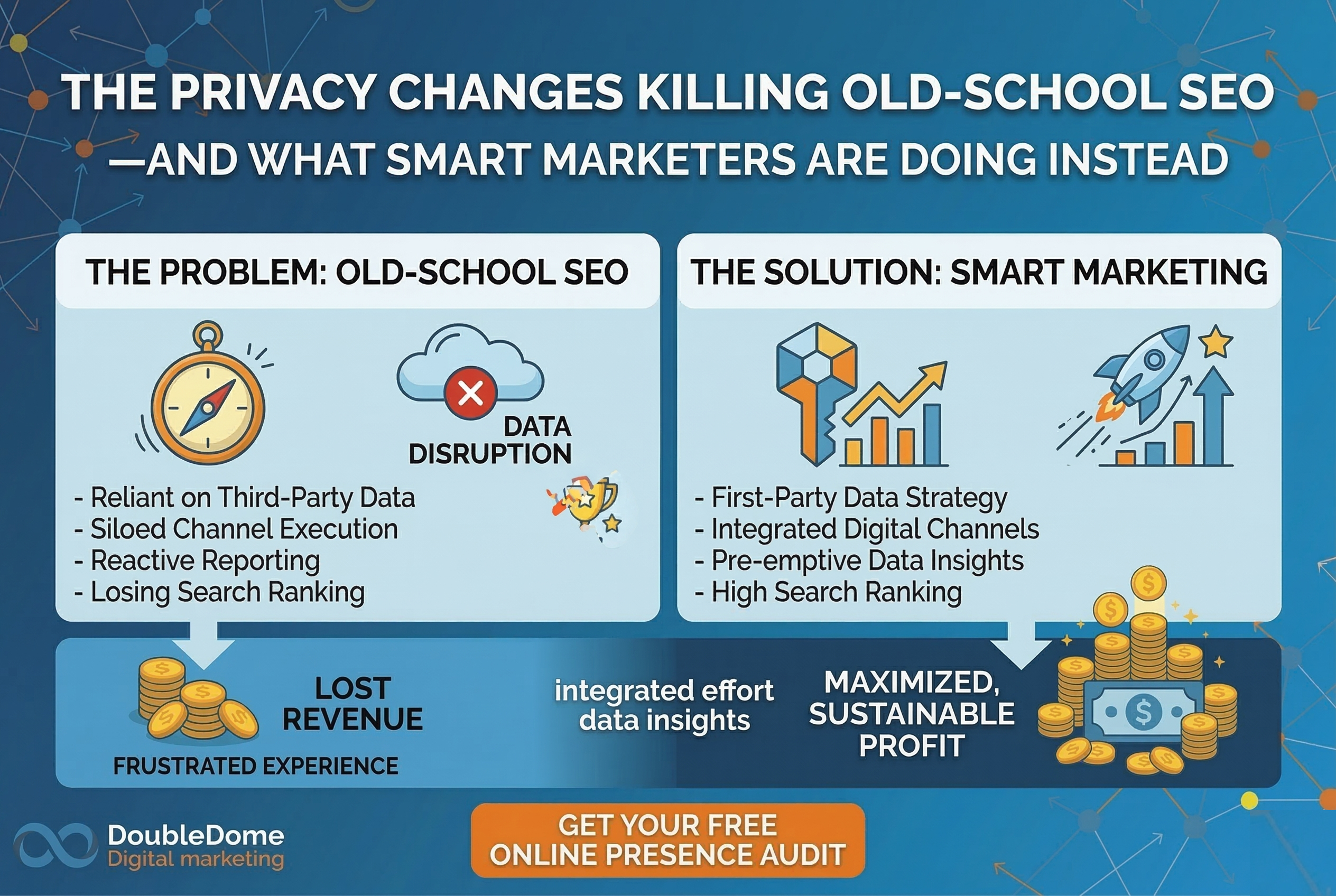
The Guru Insight: From Renting Data to Owning Relationships
The fundamental shift in 2026 is the transition from third-party tracking to first-party data. While Sarah might be struggling to explain why her tracking is breaking, smart marketers recognize this as an opportunity to build a more resilient system.
The insight is simple: You cannot fight privacy changes, but you can bypass them by building an SEO strategy that invites engagement rather than just observing it. A Privacy-First SEO Strategy focuses on creating “Information Gain”—content so valuable that users willingly identify themselves through signups, downloads, and direct interactions. By gathering data directly from your audience, you create a proprietary asset that no privacy law can touch and no AI bot can “hallucinate” away.
How to Build a System for 2026 Privacy Realities
To stop the guesswork and eliminate wasted spend on bot-clicks, your marketing needs a technical backbone that prioritizes transparency. This involves a three-pronged approach to modern visibility:
1. Capture First-Party Signals
Instead of hoping a pixel tracks a user’s journey, build high-intent “conversion gates.” Whether it’s a technical whitepaper or a proprietary tool, these interactions provide verified data you can trust. This allows you to see exactly what your $15k/month is buying you in terms of real, human prospects.
2. Optimize for AI “Answer Engines”
In 2026, being the “Preferred Answer” for ChatGPT or Google Gemini is more valuable than a blue link. These AI models prioritize authoritative, objective data. By structuring your site with clean, first-party insights, you make it easy for AI to cite you as the source, driving high-intent leads who bypass traditional search entirely.
3. Server-Side Transparency
Smart CEOs are moving tracking away from the browser (where it can be blocked) and onto the server. This provides a “no-jargon” dashboard that shows a direct line between your SEO spend and your revenue, even when cookies are blocked.
Comparison: Old-School SEO vs. Privacy-First SEO
| Feature | Old-School SEO (2022) | Privacy-First SEO Strategy (2026) |
| Tracking Method | Third-party cookies & Pixels | First-party data & Server-side API |
| Success Metric | Numeric Keyword Ranking | Revenue & Conversion Quality |
| Search Focus | Chasing “Blue Link” Clicks | Becoming the “Preferred AI Answer” |
| Data Integrity | High “Bot” Noise / Poor Attribution | Verified Human Leads / Honest Data |
| User Experience | Interrupted by tracking scripts | Faster, cleaner, human-first content |
| Business Model | Renting Growth | Owning the Market Authority |
Ownership: Your Growth Engine in a Privacy-First World
Stop chasing clicks and start owning your market. In 2026, you don’t need more traffic—you need more customers. The “AI Slump” is only a threat to businesses that haven’t evolved. For those with a technical backbone and a Privacy-First SEO Strategy, the current landscape is a blue ocean of high-quality leads.
SEO that works in a privacy-first world looks very different from what was standard just a few years ago. It’s about building a brand that people actually recognize and that AI tools recommend. It’s about results, not jargon.
FAQ: Navigating 2026 Privacy Changes
What is a Privacy-First SEO Strategy?
It is a technical and content-based approach that focuses on building brand authority and gathering first-party data rather than relying on third-party tracking cookies.
Why is my SEO traffic dropping while my ads stay the same?
This is often the “AI Slump.” Users are getting answers from AI tools without clicking. A privacy-first approach ensures you are the source the AI cites, capturing the high-intent lead who wants to dig deeper.
How do I prove ROI without cookies?
By utilizing server-side tracking and first-party conversion events (like downloads or form fills), we can provide a transparent dashboard that connects spend directly to revenue.
Schedule a Privacy-First SEO Strategy Call
Don’t let privacy changes kill your growth engine. In 2026, you need a partner who is smarter than the tech and can act as the technical backbone of your team. At DoubleDome Digital Marketing, we build the systems that make you the obvious choice for your leads, no matter how the tech changes.
We’ll show you what a modern, privacy-compliant SEO system looks like for your business—delivering high-quality leads and clear, honest data.
Ready to stop the guesswork and start owning your market?
Schedule Your Privacy-First SEO Strategy Call with DoubleDome Today.