

By Janice Ramos
The hardest marketing budget to approve is often SEO. It’s a long-term play, and past experiences with vague reporting make the investment feel risky. As year-end planning approaches, you need more than promises—you need a data-driven model that clearly projects the return on investment (ROI) for every dollar spent on organic growth.
The key to unlocking this confidence is disciplined SEO Budget Forecasting. This is a methodical process that uses current performance data, competitive analysis, and strategic content planning to model exactly how much budget is required to achieve specific ranking and lead generation targets over the next 12 months. SEO Budget Forecasting transforms SEO from a speculative expense into a predictable, measurable Retainer Revenue Builder.
Why Skepticism Dies When Forecasting Rises
Traditional SEO reporting often focuses on vanity metrics like overall traffic. Effective SEO Budget Forecasting focuses on the metrics that matter most to the CEO: qualified inbound leads and predictable revenue.
- It Quantifies Risk: By linking specific ranking targets (e.g., getting Keyword X to Position 3) to projected conversion volume, you can calculate the exact necessary investment.
- It Justifies Long-Term Spend: The forecast proves that organic growth requires continuity, addressing skepticism about long-term commitment and justifying the move to an Annual Contract Upsell.
- It Drives Efficiency: The process forces a strategic 70/30 SEO Budget Split review, ensuring resources are allocated efficiently between growth and retention content.
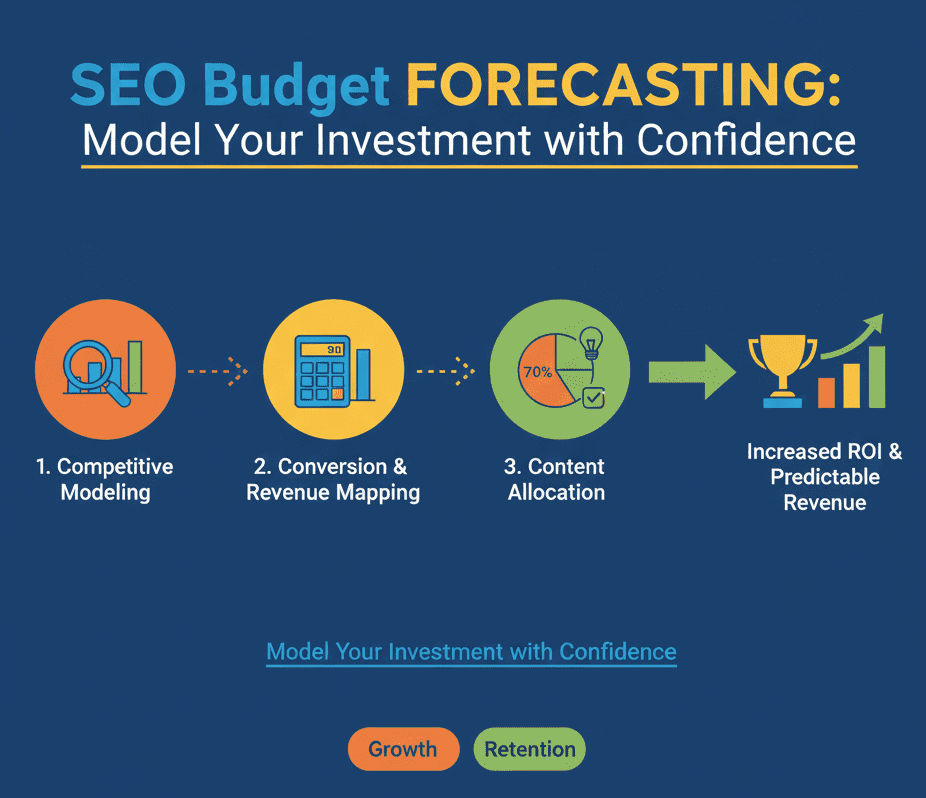
Three Pillars of Confident SEO Budget Forecasting
A reliable 2026 forecast must be grounded in competitive reality and historical data:
1. Competitive Opportunity Modeling
You must analyze where your competitors are performing and calculate the difficulty of displacing them.
Action: Select 5-10 high-value, commercial intent keywords (the kind that leads to the 3-Call Close). Use sophisticated tools to estimate the traffic volume, click-through rate (CTR), and current top ranking page for each.
Modeling: The forecast calculates the “cost” (in terms of content creation, technical fixes, and link building budget) required to move from your current position (e.g., Position 15) to your target position (e.g., Position 3) within 12 months.
2. Conversion & Revenue Mapping
Traffic is useless without conversion. The forecast must translate estimated organic traffic into dollar value.
Action: Use current website data to establish a conversion rate for organic traffic that lands on your service pages.
Modeling:
This step directly calculates the projected ROI of your investment, proving the efficiency of your planned SEO Budget Forecasting.
3. Strategic Content Allocation
The budget must reflect a balanced strategy for acquisition and retention.
Action: Apply the 70/30 SEO Budget Split framework to your forecast.
- 70% (Growth): Budget for new, high-authority content targeting the 5-10 competitive keywords.
- 30% (Retention): Budget for optimizing existing content, creating SEO for Customer Onboarding guides, and technical maintenance that reinforces the Trust Factor and reduces churn. This ensures the investment protects LTV.
From Vague Report to Strategic Roadmap
SEO Budget Forecasting provides the transparency and numbers-driven confidence you need to make critical investment decisions. It transforms the annual planning discussion from a debate over cost into a strategic conversation about maximizing a predictable return. This process aligns your long-term SEO efforts with your short-term financial needs, establishing the clear KPIs you need to track marketing ROI effectively throughout 2026.
Is your 2026 SEO plan based on guesswork, or data-driven projection? Ready to implement a disciplined SEO Budget Forecasting model to invest with confidence?
Contact DoubleDome Digital Marketing today for a free 2026 SEO Budget Forecasting consultation. We specialize in building data-driven SEO strategies that deliver clear ranking improvements, measurable lead generation, and the predictable ROI you need to scale efficiently.