

By Janice Ramos
The B2B space has gone more competitive. You don’t have time or budget to waste on marketing strategies that don’t deliver. You want results that move the needle, but also know that real growth requires a steady, strategic foundation. That’s where the debate of SEO quick wins vs long-term strategy becomes critical.
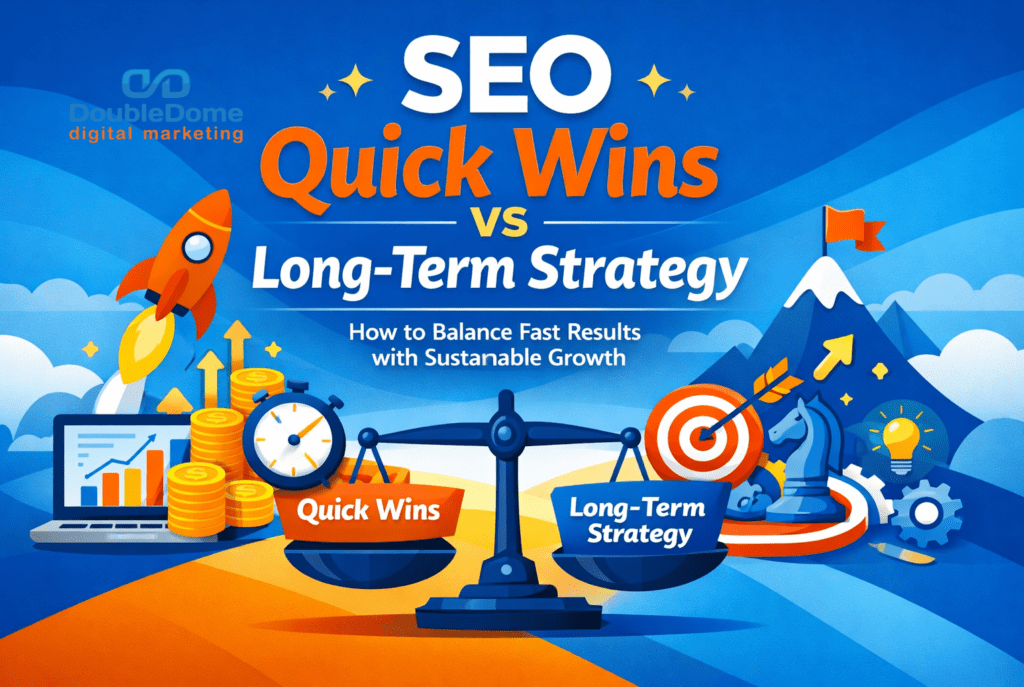
SEO quick wins vs long-term strategy is not an either/or decision. Quick wins generate short-term visibility and early leads, while long-term SEO builds authority, brand ownership, and AI search visibility. The smartest companies combine both into a measurable growth system focused on revenue—not rankings.
The difference between SEO quick wins vs long-term strategy lies in timing and impact. Quick wins deliver fast improvements in traffic and conversions, while long-term SEO builds domain authority, brand recognition, and AI visibility. Businesses that balance both create predictable revenue and sustainable growth in 2026 and beyond.
Why This Conversation Matters in 2026
Search behavior has changed.
Ranking #1 no longer guarantees attention. AI platforms like ChatGPT and Google’s generative results summarize answers before users click. That means visibility alone isn’t enough. You must become the preferred answer.
This is where SEO quick wins vs long-term strategy becomes a critical leadership decision—not a marketing tactic.
If you’re investing five figures per month in marketing, you deserve:
- A system that works while you sleep
- Clear attribution from spend to revenue
- Protection from algorithm volatility
- A brand that AI models trust and cite
Let’s break down how to balance speed and sustainability.
What Are SEO Quick Wins?
SEO quick wins are tactical improvements that generate measurable gains within 30–90 days.
Examples of SEO Quick Wins
- Optimizing title tags and meta descriptions for CTR
- Updating existing blog posts with improved structure
- Fixing internal linking gaps
- Improving page speed and Core Web Vitals
- Targeting high-intent, low-competition keywords
- Refreshing service pages with conversion-focused copy
Why Quick Wins Matter
Quick wins:
- Demonstrate early ROI
- Improve cash flow
- Identify conversion bottlenecks
- Provide real performance data for decision-making
For marketing leaders facing pressure to prove performance—especially with limited tracking due to privacy regulations—quick wins provide measurable signals fast.
But quick wins alone do not build authority.
What Is Long-Term SEO Strategy?
Long-term SEO focuses on durable competitive advantage.
It includes:
- Topical authority development
- High-quality content ecosystems
- Brand entity optimization
- Digital PR and authoritative backlinks
- Structured data implementation
- AI search optimization (AEO + GEO)
- First-party data systems
This is where SEO quick wins vs long-term strategy becomes a growth architecture question.
You’re not just trying to get traffic.
You’re trying to own your category.
SEO Quick Wins vs Long-Term Strategy: Side-by-Side Comparison
| Factor | SEO Quick Wins | Long-Term Strategy | |
|---|---|---|---|
| Time to Impact | 30–90 days | 6–18 months | |
| Focus | Tactical fixes | Authority building | |
| Risk Level | Low | Medium (investment-heavy) | |
| AI Visibility | Limited | High | |
| Brand Equity | Minimal | Significant | |
| Revenue Stability | Short-term boost | Compounding growth |
Key Insight
Quick wins optimize what you already have.
Long-term strategy builds what competitors cannot easily copy.
The 2026 Risk: Depending Only on Quick Wins
Relying solely on quick wins creates three major vulnerabilities:
1. Platform Dependency
If your growth depends on short-term keyword targeting or paid amplification, you’re renting visibility.
2. AI Exclusion
AI answer engines prioritize structured, authoritative, and widely cited content—not just optimized pages.
3. Revenue Volatility
Without authority and brand demand, pipeline fluctuates with algorithm shifts.
In the modern search landscape, SEO quick wins vs long-term strategy must be viewed as capital allocation—not marketing preference.
The Smarter Model: Build a Revenue Engine
The companies winning in 2026 follow a three-layer framework:
Layer 1: Quick Revenue Stabilizers
- Optimize high-intent pages
- Improve conversion pathways
- Fix technical barriers
- Capture existing demand
Layer 2: Authority Infrastructure
- Create pillar content clusters
- Publish expert-level insights
- Implement structured data markup
- Secure authoritative backlinks
Layer 3: AI Positioning
- Structure answers for featured snippets
- Publish FAQ-driven content
- Strengthen brand entity recognition
- Improve citation signals across the web
This integrated model transforms SEO quick wins vs long-term strategy from a debate into a unified system.
How to Measure SEO the Right Way in 2026
Vanity metrics are outdated.
Here’s what leadership should track instead:
Revenue-Focused Metrics
- Marketing Cost per Acquired Customer
- Pipeline Value from Organic Channels
- Conversion Rate by Intent Segment
- Branded Search Growth
- AI Citation Visibility
- Content-Assisted Revenue
When dashboards clearly show:
“I spent $X and generated $Y,”
SEO stops being an expense and becomes infrastructure.
The Balance Framework: 40/60 Allocation
A practical allocation model:
- 40% budget → Quick Wins + CRO
- 60% budget → Long-Term Authority + AI Optimization
Why?
Because sustainable growth compounds. Quick wins fund the journey. Authority protects it.
Final Takeaway
The real question is not SEO quick wins vs long-term strategy.
The real question is:
Do you want temporary traffic—or market ownership?
In 2026, growth belongs to businesses that stop chasing clicks and start building systems. You don’t need more traffic. You need more customers.
That requires structure, authority, and measurable ROI.
Ready to Build the System?
If you want a revenue-focused SEO strategy that balances fast wins with long-term authority, DoubleDome Digital Marketing builds growth systems—not vanity metrics.
We:
- Engineer predictable lead pipelines
- Optimize for AI visibility
- Deliver transparent, revenue-based reporting
- Act as the technical backbone of your marketing team
Stop renting growth. Start owning your market.
Contact DoubleDome Digital Marketing and get SEO that drives growth — fast and sustainably.
FAQ: SEO Quick Wins vs Long-Term Strategy
1. What is the main difference between SEO quick wins and long-term SEO strategy?
Quick wins deliver short-term traffic gains, while long-term SEO builds authority, brand recognition, and sustainable revenue.
2. Are SEO quick wins enough to grow a business in 2026?
No, quick wins alone cannot build the authority required for AI visibility and long-term market ownership.
3. How long does long-term SEO take to show results?
Long-term SEO typically shows measurable authority growth within 6–12 months and compounding results beyond that.
4. Can you run quick wins and long-term SEO simultaneously?
Yes, the most effective strategy combines both for immediate ROI and sustainable growth.
5. How do AI search engines impact SEO strategy?
AI engines prioritize structured, authoritative, and clearly written content, making long-term brand authority critical.