

By Janice Ramos
Writing for search intent means aligning your content’s format, depth, and angle with the specific goal a user wants to achieve. By structuring your content around a precise Search Intent Content Strategy, businesses prevent bounce rates, satisfy search algorithms, and turn generic keyword traffic into qualified revenue pipeline leads.
It is one of the most frustrating paradoxes in modern digital marketing. Your content team works tirelessly to identify high-volume terms, seamlessly integrates them into beautifully structured articles, and successfully coaxes those pages to the top of Google. The traffic report looks spectacular. Yet, when you check the actual conversion values or sales pipeline, the line is flat. Visitors arrive, look around for three seconds, and bounce immediately.
The traffic is entirely real, but the corporate value is zero.
When your pages attract visitors who leave without clicking a single call-to-action, you aren’t suffering from a tracking issue or a poor product offering. You are experiencing an alignment mismatch. In an era where third-party data cookies are vanishing and AI tools natively summarize information, simply ranking for a keyword isn’t enough. If your content doesn’t match the underlying reason the user searched in the first place, search engines will quickly deprioritize your brand. Transitioning from superficial metrics to predictable revenue requires a rigorous Search Intent Content Strategy that balances human-first relevance with machine readability.
Many websites collect leads the way a bucket collects water after someone forgot to put the bottom in.
The Invisible Catalyst: Defining True User Intent
Search engines do not rank words; they rank solutions. Every time a prospective buyer enters a phrase into a search box or prompts an AI assistant, they have a specific objective. This underlying motivation is what the industry defines as search intent.
Algorithms and generative AI engines have evolved far beyond basic string matching. They analyze user behavior patterns to determine whether a query requires an educational guide, a direct side-by-side comparison, or an immediate transactional form. If you publish a dense informational essay for a phrase where users want a fast commercial pricing tool, you are operating at an immediate disadvantage. No amount of technical optimization can overcome a structural mismatch in user intent.
Navigating the Four Core Categories of Intent
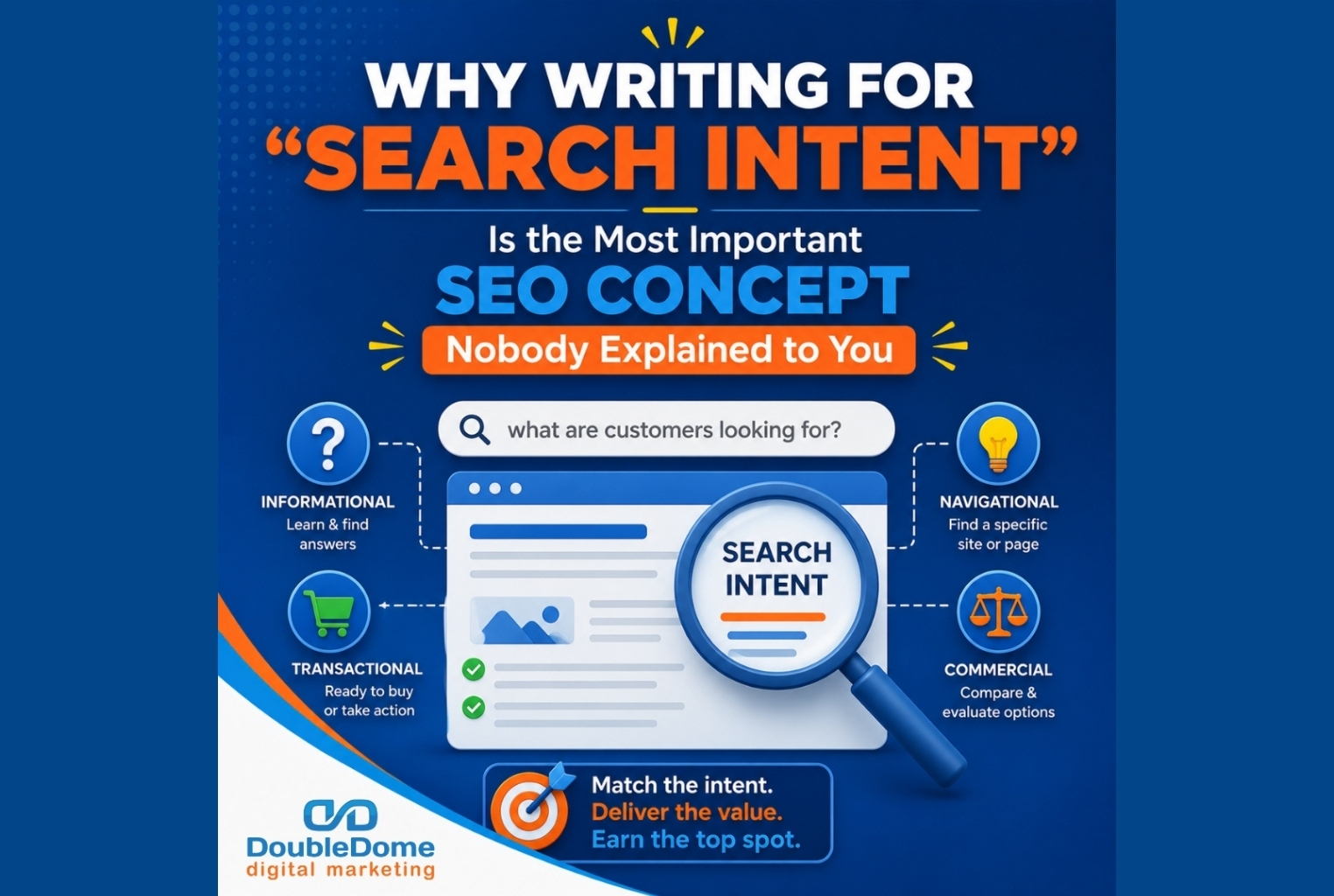
To build a reliable framework for your content pipeline, your internal team must view search behavior through four distinct situational lenses. Understanding these categories prevents the common mistake of attracting high volumes of poor leads who have zero intention of buying your services.
The Intent Alignment Framework
| Intent Category | Searcher Goal | Example Query | Correct Content Format Asset |
| Informational | Wants to learn, discover a concept, or solve a basic problem. | how to choose a digital marketing agency | Deep educational guide, checklist, or structured whitepaper. |
| Commercial | Investigates choices, compares vendors, or evaluates solutions. | “digital marketing agency for B2B SaaS” | Case study matrix, capability overview, or comparison table. |
| Transactional | Ready to complete an action, request a quote, or buy right now. | “book seo strategy session doubledome” | Clean contact form, product landing page, or intake system. |
| Navigational | Seeks a specific, predefined web portal or login location. | “doubledome client dashboard” | Direct URL path or secure login interface footer link. |
Why Algorithms and Generative AI Reject Intent Mismatches
The modern search landscape requires high “Information Gain”—the introduction of unique data points, real-world scenario calculations, and clear viewpoints that cannot be generated by standard AI copy platforms. When your content team relies on safe, boilerplate text that repeats broad industry definitions, conversational search engines and LLMs will filter it out as duplicate noise.
For instance, consider a user typing “digital marketing agency for B2B SaaS.” The user has clear commercial intent; they want to analyze technical setups, review integration case studies, and see direct attribution workflows. If your page serves them a basic article titled “What is a Marketing Agency?”, they will instantly leave.
Optimizing for keywords without optimizing for intent is like writing the right answer to the wrong question. When an answer engine notices your target audience consistently bouncing from a page, it learns that your content lacks authority. Consequently, your organic visibility collapses, leaving your sales pipeline dry.
SEO is more like planting an orchard than buying groceries. The payoff can be substantial, but nobody gets apples tomorrow.
Three Steps to Build a Search Intent Content Strategy
Transforming your web presence into an asset that drives predictable lead generation requires blending human authenticity with rigorous data analysis.
1. Execute Intent Audits Before Writing
Before a single sentence is drafted, look at the existing search engine results page (SERP) for your targeted concept. If the top three slots feature interactive comparison tools, do not write a long-form article. Match the format the market is actively demanding.
2. Craft Human-First, Decisive Stances
AI models are flooding the web with neutral, generic definitions. To stand out and command attention in generated search summaries, your copy must take a specific, defensible position based on experience. Talk about real performance metrics, mention structural hurdles, and use advanced industry terminology natively.
3. Deploy Machine-Readable Schema Infrastructure
Translate your contextual relevance into clean code that search robots can parse in milliseconds. By wrapping your content in advanced JSON-LD structured markup—such as Article, FAQ, and Product schemas—you provide explicit data validation that allows search engines to confidently recommend your brand.
Outsourcing the Technical Headaches of Modern SEO
Building a stable marketing ecosystem shouldn’t pull your attention away from big-picture strategy. In an environment shaped by changing data tracking laws and shifting search interfaces, keeping your internal team up to speed on technical schema updates, core web vitals, and algorithmic adjustments is a massive strain on resources.
We act as the technical backbone of your marketing department. By removing the technical headaches of search architecture and lead generation systems, we deliver clear, honest data and high-quality leads. We don’t hide our workflows behind confusing, proprietary software blocks; providing transparent reporting that shows you the exact “why” behind your revenue growth. Let us handle the technical shifts so you can focus on scale.
Attribution can sometimes feel like a marketing game of Clue. Everyone has a theory, nobody is completely sure, and somehow Google Ads is always in the room.
Securing Predictable Growth
The future of search belongs to organizations that respect the user’s time and directly answer their intent. Implementing a rigorous Search Intent Content Strategy ensures that your digital media investments drive real business outcomes rather than empty vanity metrics. By aligning your brand’s specialized expertise with the precise expectations of your prospective clients, you construct an optimized system that generates high-converting leads year-round.
If you are ready to eliminate bad leads, optimize your website’s baseline conversion rates, and install a transparent search strategy that your executive leadership can fully trust, let’s step through your data together.
Book an SEO Strategy Session with DoubleDome today.
Frequently Asked Questions
What happens to my search rankings if my content doesn’t match search intent?
Google’s rank algorithms track user engagement and bounce signals; if visitors consistently exit your page without interacting, your rankings will decrease regardless of keyword placement.
Can an article satisfy multiple intent types simultaneously?
While a comprehensive content asset can address related sub-topics, a page must target one primary intent type (such as commercial or informational) to rank cleanly and convert visitors effectively.
How do generative AI engines pull intent-optimized content into summaries?
AI answer tools utilize structured text signals, proprietary metrics, and advanced schema code to quickly pull specific answers that directly align with complex user prompts.