

By Janice Ramos
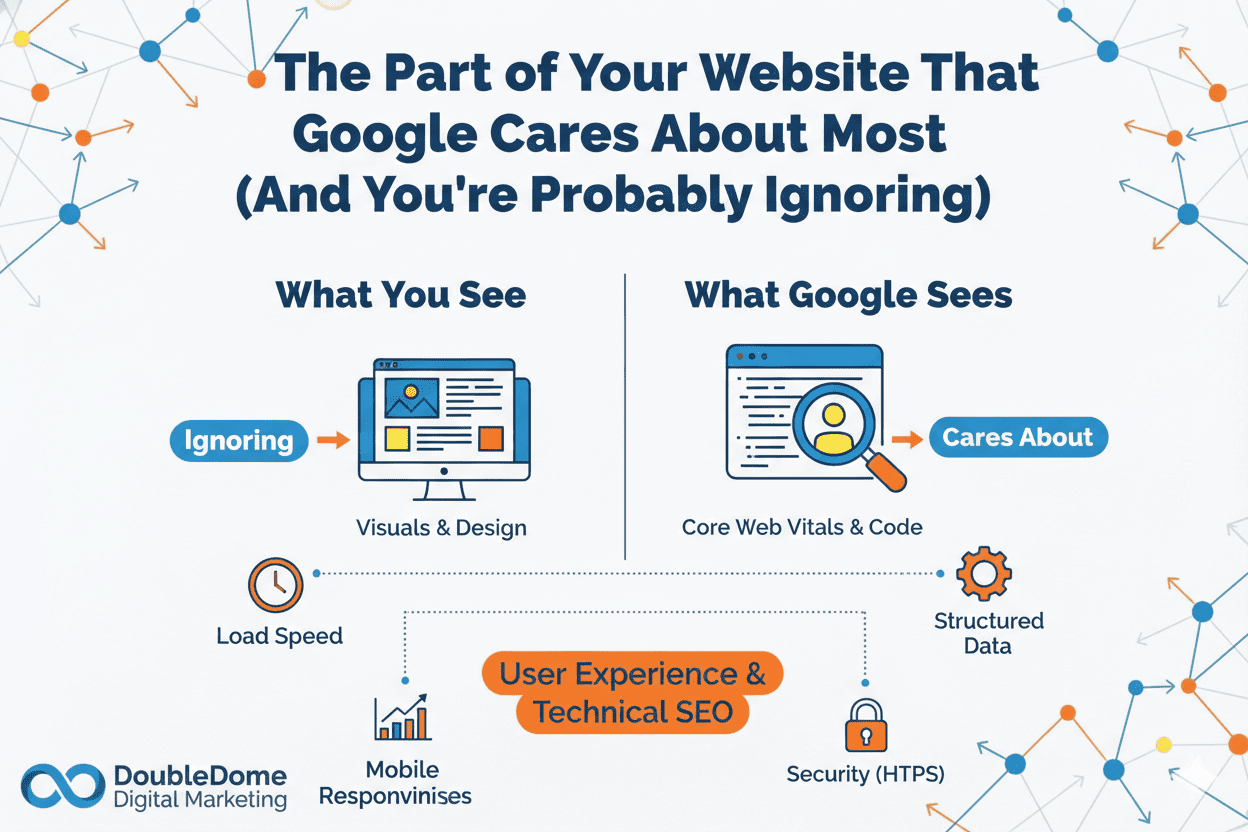
In 2026, Google and AI Answer Engines prioritize a website’s technical foundation over aesthetic design. Critical elements like Schema markup, site architecture, and server-side performance determine if you are cited as a “Preferred Answer.” Ignoring these invisible factors leads to “indexing drift,” where even high-quality content remains invisible to both bots and buyers.
The Aesthetic Trap: Why “Pretty” Isn’t Profitable
As a CEO focused on systems and scale, you likely invested in a website that looks prestigious. You have the right logos, professional photography, and polished copy. But there is a silent disconnect: while your human visitors see a masterpiece, Google’s crawlers are seeing a disorganized basement.
Most business owners obsess over the homepage while completely neglecting the technical infrastructure that determines their market ownership. In 2026, Google doesn’t “read” your site like a magazine; it parses it like a database. If your technical foundation is fractured, your $15k/month marketing spend isn’t an investment—it’s a donation to your competitors who have optimized their backends.
To stop “renting” growth through expensive ads and start owning your lead flow, you must address the invisible machine under the hood.
The Foundation of 2026 Search: Technical SEO
The “Guru” insight of the current era is simple: Technical SEO is no longer a “one-time setup.” It is the constant maintenance of your growth engine. If Google cannot index your content efficiently, or if an AI bot like ChatGPT cannot verify your expertise through structured data, you will never be the “Preferred Answer.”
A comprehensive technical SEO audit is the only way to uncover why a beautiful website is failing to produce revenue. It moves past the “fluff” of algorithm gossip and focuses on the high-leverage technical points that actually move the needle.
The Three Pillars Google Prioritizes Today
- Semantic Entity Mapping (Schema): Explicitly telling the search engine who you are, what you sell, and why you are the authority.
- Core Web Vitals & Interaction to Next Paint (INP): Google prioritizes sites that respond instantly. A delay of 500ms can be the difference between a conversion and a bounce.
- Crawl Efficiency: Ensuring that search bots don’t waste “crawl budget” on broken links or duplicate paths, which leads to your newest (and best) content being ignored.
Turning Your Website into a System That Works While You Sleep
You want a simple dashboard that shows: “I spent $X, and I made $Y.” That level of transparency is impossible if your site is a “black box” of technical errors.
When you perform a technical SEO audit, you aren’t just “fixing code.” You are building the technical backbone of your company. This ensures that when a high-value prospect asks a complex question, the AI recommends your business because your data was the easiest to parse and the most reliable to cite.
Legacy SEO vs. Technical Growth Systems
| Feature | Surface-Level SEO (Legacy) | Technical SEO Systems (2026) |
| Primary Focus | Keywords and Backlinks | Site Structure and Data Accessibility |
| Success Metric | Traffic Volume | Lead Quality and “Answer” Citations |
| Tracking | Basic Google Analytics | Server-Side, Privacy-Compliant Data |
| AI Status | Often misunderstood by bots | Explicitly Recommended by LLMs |
| Goal | Get the click | Own the market and the revenue |
Stop Chasing Clicks and Start Owning Your Market
The “AI Slump” is real for businesses that ignore their technical health. Traditional traffic is dropping because search engines have become more selective. They only want to send users to sites that are fast, secure, and structurally sound.
Most businesses are surprised to learn their “beautiful” website has serious technical problems Google hates. A technical SEO audit reveals the gaps between “checking boxes” and actually dominating a niche. By fixing these invisible issues, you turn your website from a passive brochure into an active, automated lead-generation system.
FAQ: The Technical Truth
What is a technical SEO audit?
It is a deep-dive examination of a website’s backend, focusing on indexability, site speed, mobile experience, and structured data to ensure search engines can properly crawl and rank the site.
Can I have a high-ranking site with poor technical SEO?
Not in 2026. While you might rank briefly, Google and AI engines will eventually deprioritize your site in favor of competitors who offer a faster, more structured, and technically superior user experience.
How often do I need to audit the technical side of my site?
As a CEO scaling a system, you should require a high-level technical SEO audit at least quarterly to ensure new content and tech updates haven’t created “crawl errors” or broken your data schema.
Build the System That Makes You the Obvious Choice
In 2026, you don’t need more jargon; you need results. You need a partner who understands that your website is a financial asset, not just a design project.
At DoubleDome Digital Marketing, we act as the technical backbone of your team. We audit the technical foundation of your site and fix the invisible issues that are holding you back. We handle the 2026 tech shifts—from AI-ready schema to privacy-first tracking—so you can focus on the big wins.