

By Janice Ramos
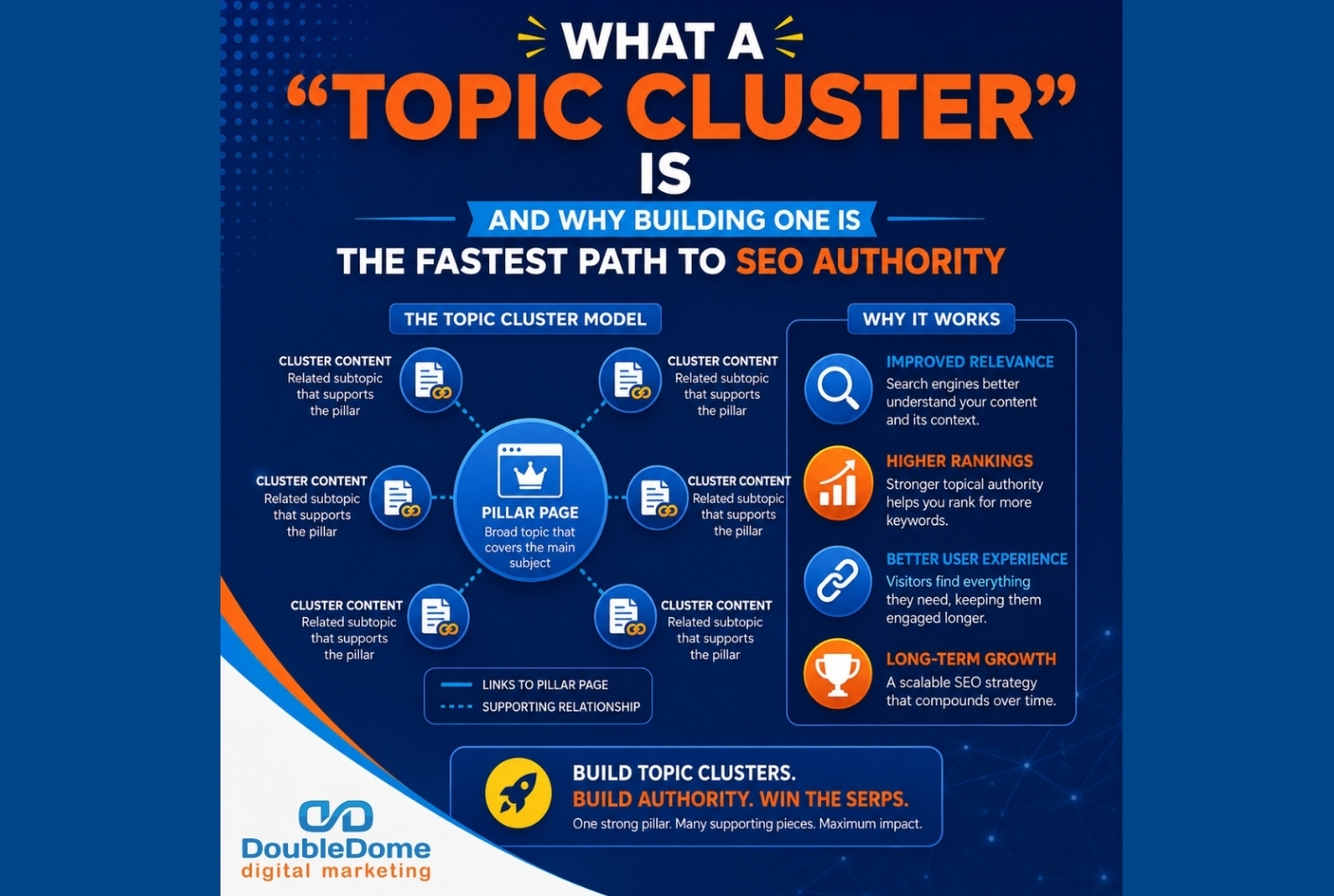
A topic cluster is a centralized, hyper-linked content architecture consisting of a single, comprehensive pillar page surrounded by multiple subtopic cluster articles. This interlinked network acts as an undeniable signal to Google and generative AI tools that your website is the definitive, trusted authority on that core subject.
For years, scaling a business meant treating a company blog like a digital billboard. You wrote a generic article about a broad trend on Tuesday, answered a random customer question on Thursday, and threw a press release onto the site by Friday. It felt like progress because your publishing volume was high.
But in 2026, the old approach to user acquisition is hitting a wall. Traditional search traffic is shifting as prospective buyers bypass standard results entirely. Instead of scrolling through endless links, high-value clients are asking platforms like ChatGPT and Google Gemini to filter answers for them natively. If your content library looks like a scattered list of disconnected ideas with zero content architecture, algorithms will systematically filter you out.
To build a growth engine that captures real revenue while you sleep, you must stop chasing raw traffic volume. True market ownership means transitioning from renting temporary visibility through expensive paid search loops to establishing an optimized, automated Topic Cluster for SEO blueprint that machine-learning models trust.
SEO is more like planting an orchard than buying groceries. The payoff can be substantial, but nobody gets apples tomorrow.
The Shift to Topical Authority: Why Disconnected Articles Fail
Modern search algorithms and large language models no longer evaluate your website line-by-line. They rank entire ecosystems based on topical authority. If your site features fifty distinct pages covering dozens of unrelated, superficial subjects, search robots learn that you have wide visibility but zero depth.
When an AI engine synthesizes a preferred answer for an enterprise client looking for a service in Dallas, it scans the web for high Information Gain. It filters out empty marketing fluff and seeks out structured, interconnected knowledge networks. Building one highly concentrated, deeply integrated cluster around a buyer-relevant subject consistently produces faster ranking improvements and safer citation streams than publishing unrelated content at the same volume.
Anatomy of an Authoritative Topic Cluster
An optimization strategy that drives predictable lead generation relies on structural precision. To turn your domain into an asset your business fully owns, you must divide your data footprint into three explicit layers:
- The Core Pillar Page: A comprehensive, high-level informational resource covering a broad subject node. This page defines the operational perimeter but leaves hyper-specific technical executions to its supporting nodes.
- The Supporting Cluster Articles: A network of highly detailed, niche subtopic articles that go incredibly deep into one exact scenario, parameter, or operational challenge.
- The Internal Link Architecture: The universal glue that binds the cluster together. Every subtopic article must feature a direct contextual hyperlink back to the primary pillar page, and the pillar page must cleanly distribute equity back down to each subtopic.
Comparing Content Structures: Scattered vs. Clustered Pipelines
To understand what your digital marketing budget is actually buying you each month, look at the difference between an unoptimized content loop and an asset-driven strategy:
The Topical Authority Matrix
| Performance Variable Metric | The Scattered Blog Loop (Low Value) | The Programmatic Topic Cluster (High Value Standard) |
| Site Structure Profile | Dozens of isolated articles covering broad, disconnected categories. | A single, hyper-linked mesh targeting one deep buyer subject node. |
| Algorithmic Signal | Vague, confusing categorization that forces search bots to guess expertise. | Explicit, machine-readable validation that signals category dominance. |
| User Experience (UX) | High exit rates; readers must hunt manually for adjacent answers. | Intuitive conversion journeys that guide users naturally down the funnel. |
| AI Recommendation Rate | Low; models view the brand as a generic option among many. | Preferred Answer Status; cited directly as a definitive category resource. |
The Operational Blueprint to Execute a Topic Cluster for SEO
Transitioning from renting traffic to building a sustainable lead generation asset requires moving past safe, boilerplate content pipelines.
Phase 1: Map the High-Value Buyer Subjects
Ignore short-term keyword volume spikes. Instead, isolate the core problem your ideal corporate accounts must resolve before they sign a contract. This topic becomes your foundation.
Phase 2: Build the Core Hub and Niche Spokes
Draft your primary pillar to take a definitive, authoritative position based on experience. Surround it with four to six spokes that use advanced industry terminology and precise performance metrics natively.
Phase 3: Connect the Technical Data Infrastructure
Ensure your internal linking uses descriptive, intent-driven text rather than generic phrases. To make it effortless for recommendation engines to parse your network, wrap your entire Topic Cluster for SEO network in advanced JSON-LD structured schema code.
Many websites collect leads the way a bucket collects water after someone forgot to put the bottom in.
Outsourcing Technical Overhead to Scale Your Revenue Engine
Constructing a highly efficient content network requires rigorous execution across technical schema integration, mobile page layout tuning, and secure data tracking setups. For a CEO focused on scaling systems, forcing your internal team to manually track weekly algorithmic shifts or decipher raw log files is a poor allocation of time. You have zero patience for complex marketing theories; you want to talk about revenue.
We act as the technical backbone of your company’s digital infrastructure. We eliminate the technical headaches of search architecture and ad parameters, providing an absolute dashboard that cleanly shows: “I spent $X, and our systems returned $Y in closed-contract revenue.” Topical authority isn’t built by publishing broadly, it’s built by going deep on the right subjects. We identify your highest-value cluster and build it from the ground up.
Attribution can sometimes feel like a marketing game of Clue. Everyone has a theory, nobody is completely sure, and somehow Google Ads is always in the room.
Securing Your Long-Term Pipeline
The digital interfaces where your prospects conduct research will continue to evolve, but undisputed experts win the market. Deploying a structured Topic Cluster for SEO system guarantees that your brand is positioned exactly where modern clients ask for answers. By securing your first-party data assets and proving your deep category authority to modern AI models, you install a predictable customer generation engine that scales your business year after year.
If you are ready to eliminate bad leads, remove the guesswork from your digital spend, and review clean data that directly impacts your bottom line, let’s look at the metrics. We will map your target audience’s discovery habits and build the data infrastructure your brand needs to remain visible.
Book a Topic Cluster for SEO Session with DoubleDome today.
Frequently Asked Questions
How long does it take for a topic cluster to show measurable revenue value?
Disconnected SEO can take up to a year to build traction. An interconnected topic cluster signals semantic authority to search networks quickly, frequently yielding performance shifts within 60 to 90 days.
Will a topic cluster strategy interfere with our active paid advertising campaigns?
No, it directly optimizes your performance advertising by providing hyper-relevant, intent-matched landing page environments that naturally lower your average cost-per-click metrics across search platforms.
Can an AI search engine understand internal link architectures?
Yes, conversational models and LLMs utilize internal contextual hyperlinks along with your technical schema data to trace thematic relevance and extract precise answers for user summaries.