

By Janice Ramos
Publishing separate content assets for SEO ranking, lead conversion, and AI visibility fragmentizes your marketing budget. Executing an integrated Triple-Goal Content Strategy solves this by layering search intent alignment, structured machine-readable summaries, deep operational expertise, and friction-reducing conversion pathways into every published piece.
Most growth-focused companies maintain three entirely separate content buckets. They publish SEO articles to capture search rankings (which bring in traffic that never converts), design conversion-focused landing pages (which convert well but rank poorly), and write thought leadership essays (which readers enjoy, but fail to generate rank or revenue).
Running three disjointed content engines drains resources and fragments your marketing budget.
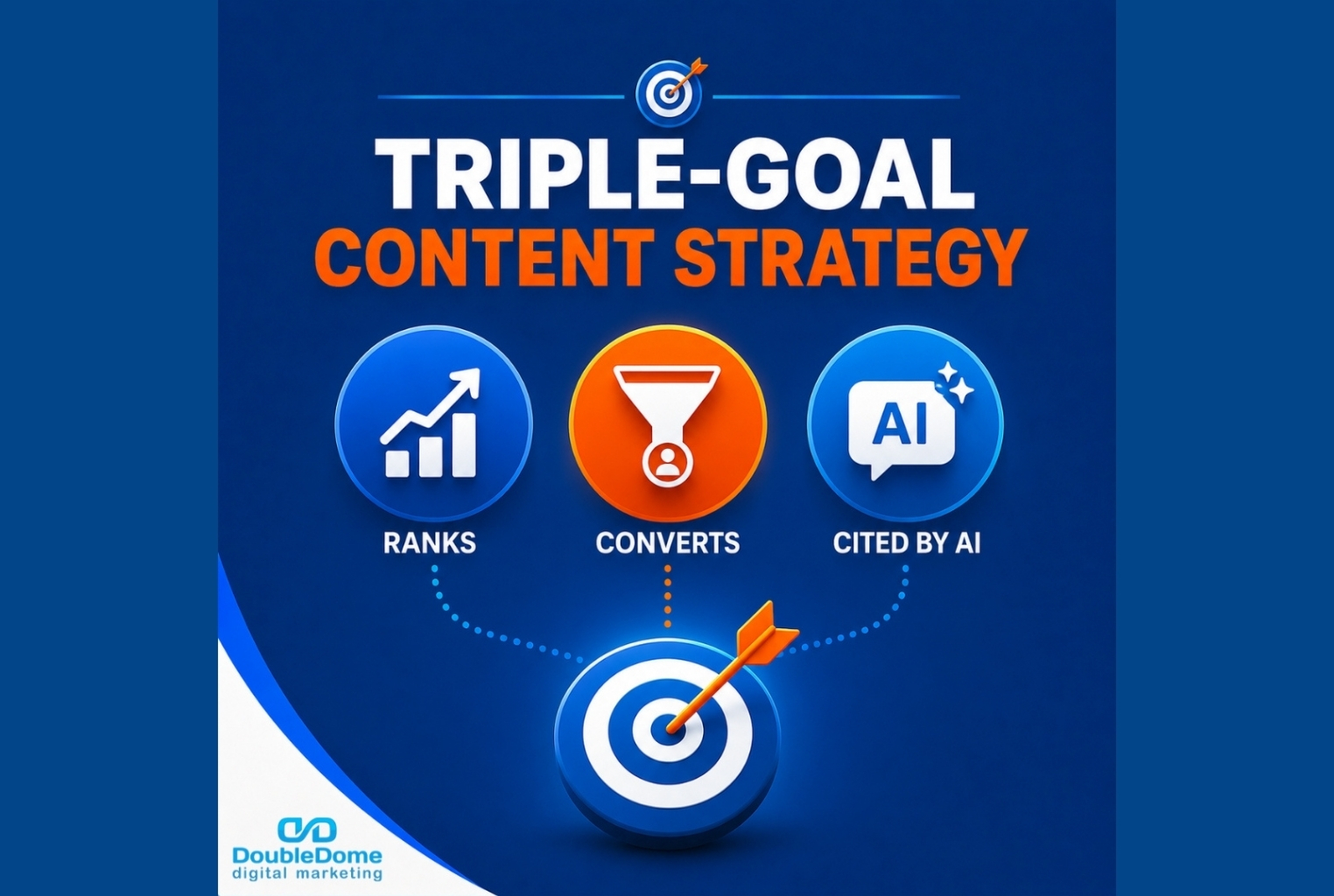
In the business environment of 2026, traditional search click volume is slumping. As conversational AI engines like ChatGPT and Google Gemini natively answer prospective buyer prompts before a user ever clicks a link, publishing thin, single-purpose content is a massive liability. You don’t need more random web traffic—you need more paying customers. To stop renting growth through un-calibrated ad networks and start owning an automated lead engine that works while you sleep, every piece of content you produce must perform multiple jobs. Transitioning your editorial roadmap to an integrated Triple-Goal Content Strategy ensures every published page ranks on Google, earns citations inside AI engines, and drives qualified CRM leads with a simple reporting standard: “I spent $X this month, and our systems returned$Y.”
SEO is more like planting an orchard than buying groceries. The payoff can be substantial, but nobody gets apples tomorrow.
The 5-Layer Content Architecture
Content that achieves high rankings, AI citation status, and pipeline revenue follows a specific structural framework. Every section of the page is engineered to serve a distinct algorithmic or psychological purpose:
1. The Buyer-Problem Opener (Conversion & Search Relevance)
Open immediately by stating the buyer’s exact, frustrating situation. Skipping long, generic introductory setups builds instant psychological recognition with decision-makers while signaling topical relevance to search crawlers.
2. The Definitional Answer Box (AI Citation & Featured Snippet)
Place a concise, 40-to-60-word summary box in the second paragraph that directly answers the primary query. Conversational AI engines scan for clean, objective text blocks to extract during retrieval-augmented generation (RAG) loops.
3. The Deep “Information Gain” Body (SEO Ranking Signal)
Build topical authority through proprietary data, hard ROI metrics, and step-by-step methodologies. Search engines reward content that introduces fresh insights rather than rephrasing existing competitor articles.
4. The Pre-CTA Objection Handler (Conversion Protection)
Address the primary hesitation or risk factor directly before asking for a meeting. Outlining clear implementation timelines or transparent budget entry points puts cautious buyers at ease.
5. The Low-Friction Next Step (Revenue Capture)
Close with a direct, single-focused invitation to take a specific action (e.g., “Schedule a 20-minute audit session”), avoiding generic links like “Learn More.”
Many websites collect leads the way a bucket collects water after someone forgot to put the bottom in.
Execution Standards: Fragmented Content vs. Triple-Goal Strategy
Content that ranks, converts, and earns AI citations is the most efficient marketing asset a B2B business can produce. We write every piece to achieve all three goals — by design.
To see how an integrated architecture protects your acquisition margins compared to traditional single-purpose pages, examine how both models compare:
Content System Comparison Matrix
| Quality Variable | Single-Purpose Legacy Copy (High Waste) | Triple-Goal Content Strategy Standard |
| Opener Focus | Long, rambling setups explaining basic industry definitions. | Direct problem identification paired with an immediate answer box. |
| Topical Depth | Surface-level tips copied from top search results. | Proprietary project data, case study metrics, and high “Information Gain.” |
| AI Recommendation Rate | Low; generic text is ignored by conversational search bots. | Preferred Answer Status; machine-readable schema feeds ChatGPT & Gemini. |
| Reporting Standard | Abstract PDF decks highlighting vanity metrics like impressions. | A simple dashboard: “I spent $X, and our systems returned$Y.” |
Attribution can sometimes feel like a marketing game of Clue. Everyone has a theory, nobody is completely sure, and somehow Google Ads is always in the room.
Actionable Steps to Upgrade Your Published Assets Today
Transitioning your content pipeline into a multi-purpose revenue system requires three practical, system-driven adjustments:
- Embed Machine-Readable Schema Markup: Wrap every article and service hub in valid JSON-LD code. Structuring your data behind the scenes guarantees that search bots and conversational AI models parse your business capabilities accurately.
- Inject First-Party Proof Points: Replace abstract claims with exact implementation timelines, budget thresholds, and verified conversion metrics. High-intent buyers look for proof of performance before booking a consultation.
- Deploy Server-Side Attribution (OCI): Connect your web assets directly to backend CRM sales milestones using server-side offline conversion tracking. This eliminates bot click distortions and provides clear financial transparency across your pipeline.
Outsourcing Technical Overhead to Scale Your Enterprise
Executing a complete, multi-purpose content framework involves continuous technical management, from managing server logs to deploying custom schema architectures across expanding site hierarchies. For an active CEO, playing copywriter or web developer is an inefficient use of strategic time. You have zero patience for agency fluff about “algorithm updates.” You want a simple, transparent dashboard built around financial reality.
We act as the trusted technical backbone of your internal growth team. We remove the jargon, eliminate the fluff, and build the automated content systems that turn incoming traffic into predictable pipeline revenue. We handle the technical infrastructure behind the scenes so you can maintain total focus on leading your company and closing major deals.
Claiming Complete Ownership of Your Category Authority
The digital channels where prospective clients research vendors will continue to evolve, but the core math of business scale remains constant: authority and systems eliminate waste. Committing your organization to a systematic Triple-Goal Content Strategy guarantees that your team stops renting temporary traffic loops and starts building an unyielding corporate growth engine.
If you are ready to eliminate bad leads, completely stop wasted ad spend, and review an honest performance dashboard that directly connects your marketing investments to gross profit margins, let’s analyze your content pipeline together. We will locate your conversion bottlenecks, repair your tracking gaps, and build an acquisition engine focused entirely on revenue generation.
Book an SEO Strategy Session with DoubleDome today.
Frequently Asked Questions
What is a Triple-Goal Content Strategy and why is it necessary in 2026?
A Triple-Goal Content Strategy is an integrated writing framework that optimizes a single web page to rank in search engines, earn citations in conversational AI models (like ChatGPT and Gemini), and convert high-intent visitors into CRM sales leads simultaneously.
How does placing a definitional summary box near the top of an article earn AI citations?
Conversational AI engines use retrieval-augmented generation (RAG) to scan web pages for concise, objective summaries that answer user prompts directly. Providing a 40-to-60-word summary box makes your content easy for AI models to extract and cite as a preferred answer.
Can server-side tracking measure revenue generated from specific content assets?
Yes, by deploying secure server-side offline conversion tracking (OCI) that routes encrypted CRM sales milestones directly back to your marketing dashboard, providing clear financial reporting for every published piece.