

By Paras Jain
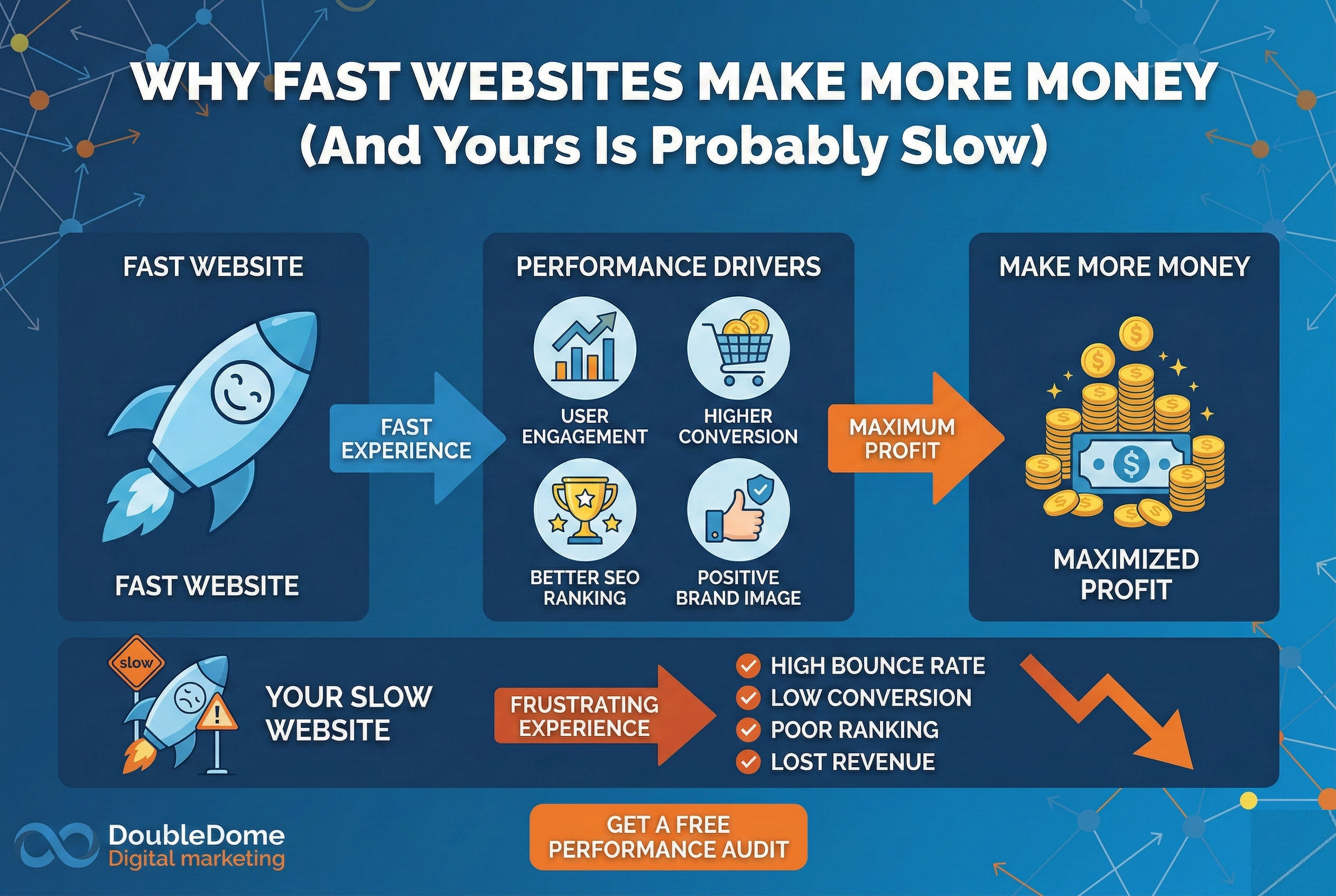
Website speed is a primary revenue driver, not a technical vanity metric. Data shows that pages taking longer than three seconds to load lose over 40% of their audience. High-performance fast website design is essential to reduce bounce rates, lower customer acquisition costs, and ensure your brand is cited as the “Preferred Answer” by AI search engines.
The Speed Mirage: Why Your Office Internet is Lying to You
As a CEO focused on scaling systems, you likely check your website from your office or home network. On a high-speed fiber connection, it feels instantaneous. You see the polished graphics and the “human-first” content, and you feel confident in your $15k/month marketing investment.
But your customers aren’t sitting at your desk. They are accessing your site from a smartphone in a parking deck, on spotty 5G in an airport, or while multi-tasking on an older device. For them, your “prestigious” site is a series of loading spinners.
In 2026, every millisecond of delay is a leak in your profit margin. If your page takes too long to load, your high-intent leads don’t wait—they bounce back to the search results or ask an AI tool for a different recommendation. You aren’t just losing a “click”; you are paying for an ad that successfully reached a customer, only to let them slip through your fingers because of technical friction.
The High Cost of Seconds: Speed as a Revenue Lever
The “fluff” filter of 2026 has no patience for slow load times. Industry benchmarks consistently prove that speed correlates directly to conversion rates. When a site loads in under one second, the conversion rate is often 3x higher than a site that takes five seconds.
If you are looking at a dashboard wondering why your Google Ads spend isn’t translating into customers, the answer is often buried in your “Core Web Vitals.” A slow site inflates your Cost Per Acquisition (CPA). You are effectively “renting” growth at a premium price while your slow load times act as a tax on your revenue. True ownership of your market starts with a technical backbone that renders your site before the user has a chance to change their mind.
Why AI Search Engines Penalize Slow Sites
ChatGPT, Google Gemini, and Perplexity are designed to provide the best user experience. If an AI model recommends a business, and the user clicks through only to find a sluggish, unresponsive site, the AI has failed its user. To be the “Preferred Answer,” you must prove to the AI that your site is technically superior. Fast website design is the signal that tells the AI your brand is reliable, authoritative, and worthy of a citation.
Technical Performance: 2022 vs. 2026 Standards
| Metric | Legacy Website (The “Budget Drain”) | 2026 Fast Website Design (The Growth Engine) |
| Load Time | 4 – 7 Seconds | Under 2 Seconds |
| User Behavior | 40% Bounce Rate | High Engagement / Low Friction |
| Ad Performance | Lower Quality Score / Higher CPC | Higher Quality Score / Lower CPC |
| AI Status | Often Ignored / Not Recommended | Preferred Citation / High Trust |
| Revenue Impact | High Wasted Spend | Maximize ROI: $X Spent, $Y Made |
Building a System That Works While You Sleep
You want a growth engine that delivers high-quality leads and clear, honest data. You don’t have time for agencies that talk about “algorithm updates” without mentioning the bottom line.
A fast website design isn’t just about compressed images or clean code; it’s about efficiency. It’s about building a system that makes you the obvious choice for your leads, no matter how the tech changes. When your site screams, your conversion rate climbs, your ad spend works harder, and you stop the guesswork. You move from chasing clicks to owning a brand that people—and AI—actually recognize as the industry standard.
FAQ: The Reality of Website Speed
Why is my website slow if it looks fine to me?
Your browser likely has the site “cached,” and your high-speed internet masks technical bloat. Real-world users on mobile devices with high latency experience the “true” speed, which is often significantly slower.
How does speed affect my Google Ads cost?
Google uses “Landing Page Experience” to calculate your Quality Score. Slow sites receive lower scores, which means you pay more per click than a competitor with a faster site for the same keyword.
What are the main causes of slow websites in 2026?
The most common culprits are unoptimized high-res images, excessive third-party scripts (tracking pixels/chatbots), and poor server-side response times (TTFB).
Stop Chasing Clicks and Start Owning Your Market
In 2026, you don’t need more traffic—you need more customers. If your website is unnecessarily slow, you are losing money every single day. You need a partner who is smarter than the tech and can act as the technical backbone of your team.
At DoubleDome Digital Marketing, we test your site speed from real-world conditions and optimize until it screams. Image compression, code optimization, caching—we handle the heavy lifting so you can focus on the big wins. No jargon, just results.