
By Sonny Day
Unmanaged website overhauls routinely trigger a 20% to 40% loss in organic visibility and an immediate slump in lead generation. Executing a technical Redesign Risk Protection strategy—including comprehensive 301 URL redirect mapping, schema migration, conversion element preservation, and pre-launch tracking verification—guarantees your new website launches at full operational strength without losing historical search authority.
Few milestones in growing a company bring as much excitement—and hidden operational risk—as launching a brand-new corporate website. You invest months of work into fresh branding, modern page layouts, and updated messaging. You expect the new build to act as a major catalyst for corporate growth.
Yet, three weeks after go-live, a quiet nightmare unfolds. Organic traffic drops by 30%, contact form submissions plummet, and your ad campaigns begin burning budget on broken landing page links.
Most design agencies treat website overhauls as purely creative projects, ignoring the complex technical handoff required behind the scenes. In the business environment of 2026, traditional search click volume is shifting as conversational AI engines like ChatGPT and Google Gemini natively answer prospective buyer prompts before a user ever clicks a link. You don’t need more random web traffic—you need more paying customers. To stop renting temporary growth through un-calibrated ad campaigns and start owning an automated lead engine that works while you sleep, your web presence must retain its hard-earned authority. Implementing a strict Redesign Risk Protection checklist ensures your new site preserves historical search authority, protects incoming lead flow, and delivers a simple dashboard standard: “I spent $X, and our systems made$Y.”
Many websites collect leads the way a bucket collects water after someone forgot to put the bottom in.
Why Redesigns Destroy Traffic: The Technical Mechanics
Search engines and AI crawlers do not evaluate your new website based on visual design. They evaluate backend data structures, machine-readable schema markup, historical URL paths, and internal link equity. When a redesign changes page URLs or strips out technical code without proper mapping, search engines treat your site as entirely new—wiping out years of accumulated trust.
Website redesign traffic drops are the rule, not the exception — but they don’t have to be. We manage the SEO and CRO handoff so your new site launches at full strength.
The Complete Pre-Launch and Post-Launch Protection Checklist
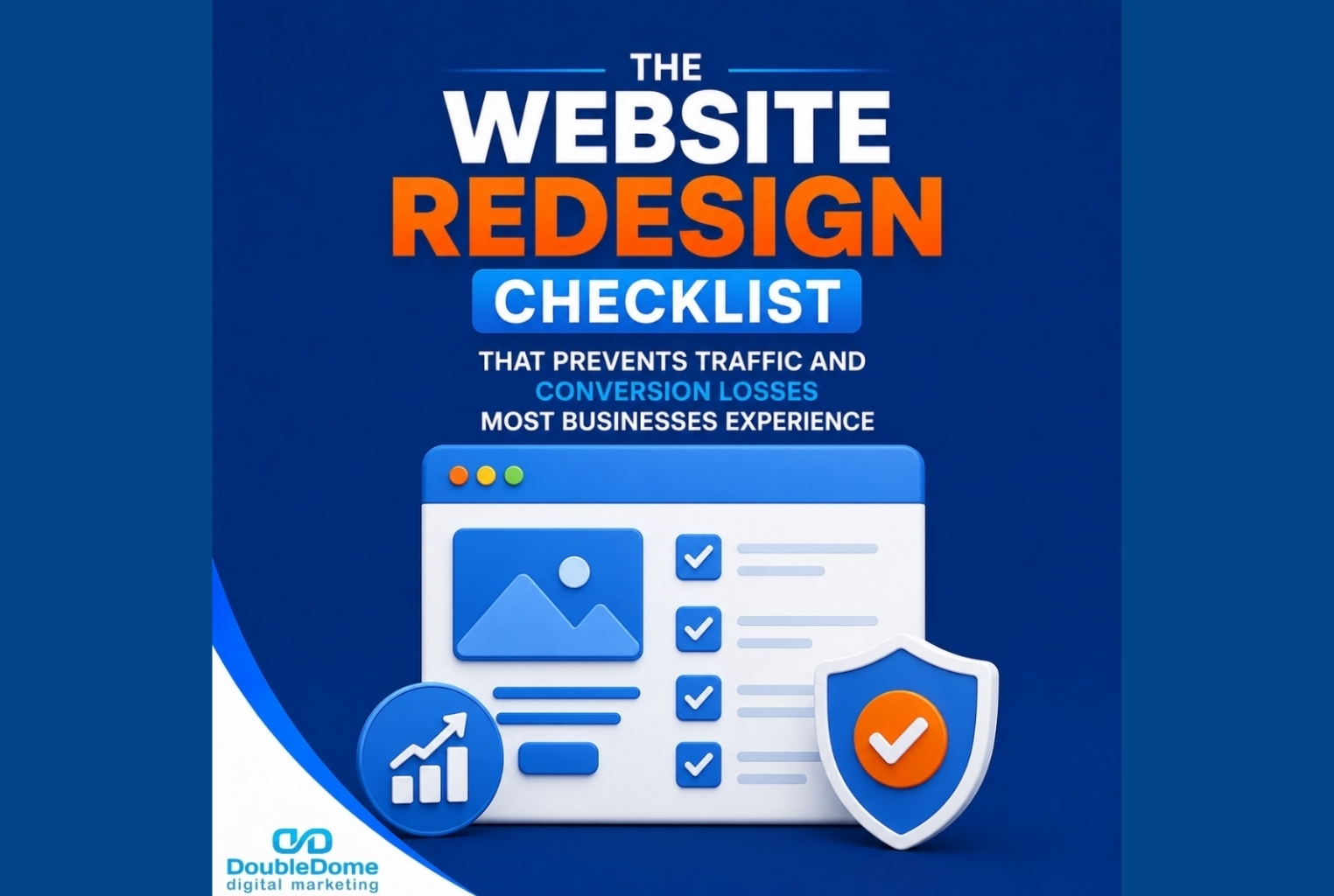
To ensure your new website build scales pipeline revenue instead of burning search authority, run your launch through these six technical protocols:
1. The 1-to-1 301 Redirect Architecture
Audit every legacy URL on your existing domain using a site crawler. Map each old URL path directly to its exact new equivalent. Never dump all old links onto the new homepage; generic redirects destroy keyword rankings.
2. Structured JSON-LD Data Migration
Copy and validate all existing schema blocks. AI assistants like ChatGPT and Gemini rely on structured data to verify your capabilities and cite your brand as the Preferred Answer.
3. High-Converting Page Element Preservation
Never alter the above-the-fold value messaging, trust badges, or form fields on pages that historically brought in qualified leads. Visual updates should enhance readability, not disrupt proven conversion elements.
4. Pre-Go-Live Server-Side Tracking Verification
Test all form inputs, phone click triggers, and CRM routing pipelines on a staging server. Verify that server-side offline conversion tracking (OCI) routes encrypted milestone data directly to your marketing dashboard.
5. Launch Day Google Search Console Resubmission
Submit your updated XML sitemap to Google Search Console and Bing Webmaster Tools within minutes of DNS propagation, accelerating crawler re-indexing.
6. The 30-Day Post-Launch Trigger Window
Monitor crawl error logs, server status codes, and keyword rank fluctuations daily for 30 days post-launch. Set automated alert triggers to patch broken links immediately.
Attribution can sometimes feel like a marketing game of Clue. Everyone has a theory, nobody is completely sure, and somehow Google Ads is always in the room.
Launch Strategy: Standard Design Agency vs. Risk-Protected Handoff
To see how technical handoffs protect your gross margins compared to creative-only agencies, examine how both approaches perform during site migrations:
Migration Performance Standards
| Technical Protocol | Standard Design Agency (High Loss) | Redesign Risk Protection Standard |
| URL Migration | Generic redirects or missing 404 error pages. | Complete 1-to-1 301 redirect mapping across all historical URLs. |
| Schema Preservation | Stripped out or forgotten in new design templates. | Migrated and updated JSON-LD schema blocks across all core hubs. |
| AI Recommendation Index | Drops dramatically as machine signals disappear. | Preferred Answer Status: preserved indexing inside ChatGPT & Gemini. |
| Reporting Standard | Abstract PDF decks explaining “temporary traffic drops.” | A simple, clear dashboard: “I spent $X, and our site made$Y.” |
SEO is more like planting an orchard than buying groceries. The payoff can be substantial, but nobody gets apples tomorrow.
Eliminating Fluff to Protect Your Pipeline
Stop chasing clicks and start owning your market. In 2026, you don’t need more traffic—you need more customers. We build the system that makes you the obvious choice for your leads, no matter how the tech changes. Just results, no jargon.
By embedding a rigorous Redesign Risk Protection framework into your launch strategy, you eliminate the hidden technical pitfalls that destroy search authority, ensuring your new site generates immediate revenue.
Outsourcing Technical Overhead to Scale Your Enterprise
Executing a flawless technical migration requires continuous precision—from managing server-side APIs to configuring complex redirect maps across expanding URL hierarchies. For an active CEO, playing web developer or sifting through server logs is an inefficient use of strategic time. You have zero patience for agency fluff about “algorithm updates.” You want a simple, transparent dashboard built around financial reality.
We act as the trusted technical backbone of your internal growth team. We remove the jargon, eliminate the fluff, and handle the backend technical handoffs that guarantee your site redesign scales lead volume from day one. We manage the technical infrastructure so you can maintain total focus on leading your company and expanding operations.
Claiming Complete Ownership of Your New Web Asset
The digital spaces where enterprise prospects evaluate solutions will continue to evolve, but the core math of business scale remains constant: technical systems eliminate waste and drive sustainable profitability. Committing your organization to systematic Redesign Risk Protection guarantees that your team stops renting temporary traffic loops and starts owning an unyielding corporate growth engine.
If you are planning a website refresh and want to protect your historical rankings, eliminate bad leads, and review an honest performance dashboard that directly connects your digital investments to gross profit margins, let’s audit your launch plan together. We will map your redirect strategy, preserve your conversion pathways, and build a growth engine focused entirely on revenue generation.
Book a Website Redesign Strategy Session with DoubleDome today.
Frequently Asked Questions
What is Redesign Risk Protection and why is it critical for website migrations?
Redesign Risk Protection is a technical migration framework—including 301 redirect mapping, schema preservation, and server-side tracking checks—that prevents the 20% to 40% organic traffic and conversion losses typical during site overhauls.
How does changing website URLs without 301 redirects impact my business?
Changing URLs without 1-to-1 301 redirects creates broken links (404 errors), erasing years of accumulated search engine authority and causing immediate drops in organic rankings and leads.
How does structured schema preservation keep my business recommended in ChatGPT and Gemini?
Conversational AI tools rely on structured JSON-LD schema markup to verify your company’s services, location, and authority. Preserving this code during a redesign ensures AI engines continue citing your brand as a preferred answer.