

By Sonny Day
The B2B buyer journey typically requires 3–5 interactions before a lead converts. Expecting cold traffic to buy on visit one is a recipe for wasted spend. A robust Website Conversion Strategy focuses on “multi-visit architecture”—using high-value information gain and lead magnets to capture, nurture, and re-engage visitors across their entire decision-making process.
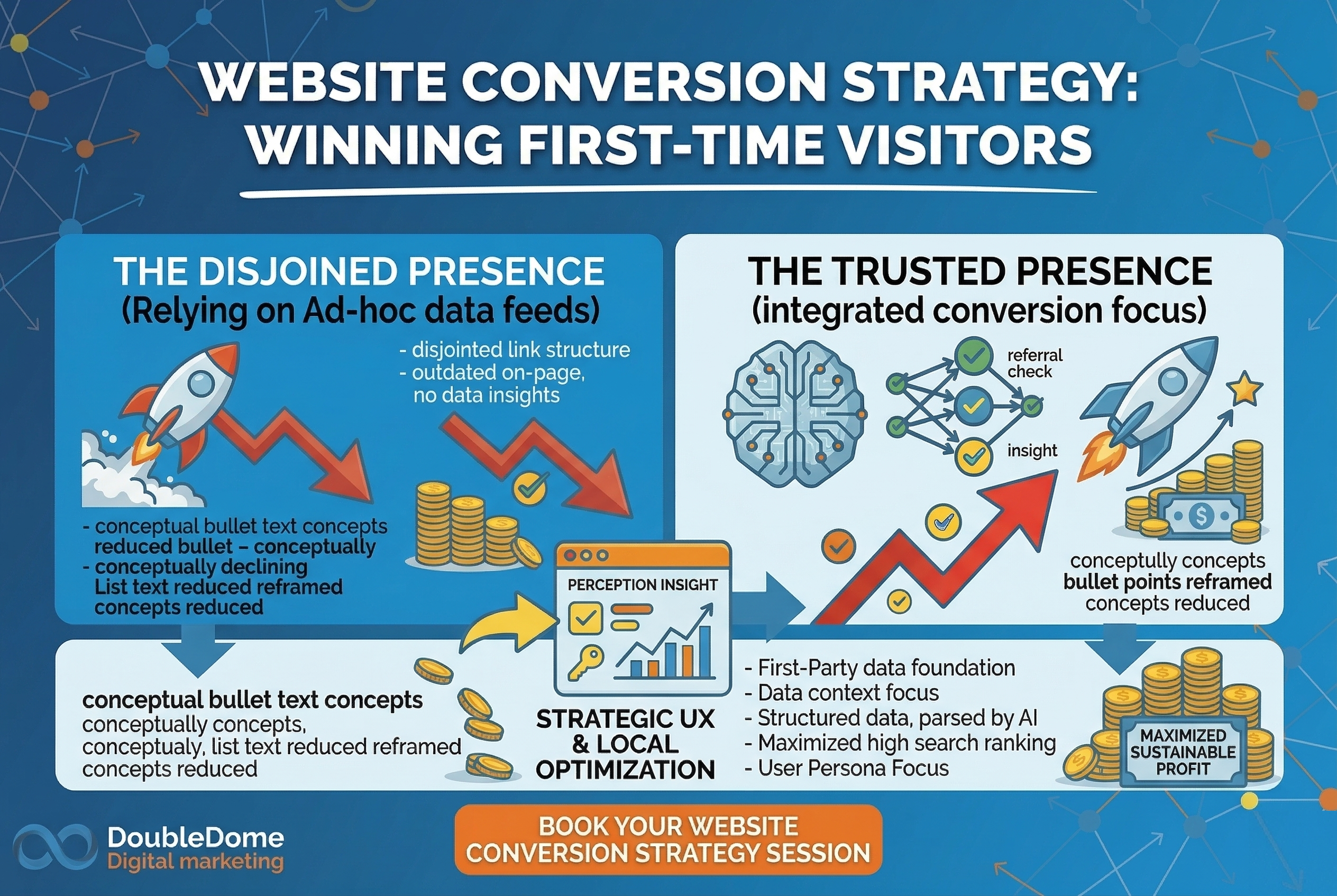
The Cold Traffic Fallacy: Why Your Website Isn’t a Vending Machine
It’s a common frustration for CEOs: you’re spending $15,000 a month to drive traffic to your site, but the phone isn’t ringing at the rate you expected. When this happens, the instinct is often to blame the traffic source—the Google Ads are “bad” or the SEO isn’t “ranking” high enough.
But as a leader focused on building a scalable growth engine, you have to look at the data through a 2026 lens. In a reality where AI bots like ChatGPT and Gemini often provide the “first answer,” a visitor who actually clicks through to your site is likely in a deep research phase, not a frantic buying phase. Expecting a cold visitor to convert immediately is like asking for a marriage proposal on a first date.
The “AI Slump” has taught us that traffic is a vanity metric. You don’t need more clicks; you need more customers. If your site is designed only for the “ready-to-buy-now” 3% of your market, you are ignoring the 97% who are currently vetting you against your competitors. To stop renting your growth and start owning your market, you need a Website Conversion Strategy that accounts for the human reality of the multi-visit journey.
The Guru Insight: Multi-Visit Conversion Architecture
The average B2B buyer visits a vendor’s website several times before making contact. They use visit one to verify your expertise, visit two to compare your methodology, and visit three to check your trust signals.
A high-performance website isn’t an expensive brochure; it is a technical backbone designed to capture intent at every stage. Instead of a “vending machine” approach, 2026 market leaders use Multi-Visit Conversion Architecture. This means providing “Information Gain”—proprietary insights or tools that give the visitor a reason to engage even if they aren’t ready for a sales call yet.
By capturing a visitor on visit one through a high-value asset, you move from “renting” their attention via expensive ad auctions to “owning” the relationship in your own lead-flow system.
Three Pillars of a 2026 Website Conversion Strategy
1. Low-Friction Intent Capture
Stop making “Contact Us” your only goal. Use a Website Conversion Strategy that offers specific, high-intent lead magnets—like an AI Readiness Audit or a Pricing Calculator. This captures the lead early and proves you are the “Preferred Answer” for their problem.
2. Verification of “Human-First” Authority
In an age where AI writes everything, buyers visit your “About” and “Case Study” pages to verify you are real. Ensure your site features first-party data and human stories that an AI bot cannot synthesize.
3. Technical Re-Engagement Infrastructure
If a visitor leaves, are they gone forever? A sophisticated growth engine uses server-side tracking (not just cookies) to re-engage high-intent visitors with targeted follow-up information that answers the specific questions they were researching.
Comparison: The “Vending Machine” vs. The Journey System
| Feature | The Vending Machine (Legacy) | The Multi-Visit System (2026) |
| Primary Goal | Instant “Contact Us” | Capture, Nurture, and Close |
| User Journey | Single-visit or bounce | 3–5 touchpoints to trust |
| Messaging | “Buy our service” | “Solve your problem” |
| Lead Quality | Mixed / High Noise | Pre-vetted / High Intent |
| CEO Dashboard | Clicks and Impressions | Spent $X, Made $Y |
Moving Beyond “Fluff” to Market Ownership
Lucas, you have zero patience for “algorithm update” talk or agencies that hide behind a proprietary “black box.” You want to know exactly what your marketing spend is buying you.
Designing your website for visit one, two, and three ensures that your $15k/month is actually building an asset you own. When your site is structured for the whole journey, you become the obvious choice for your leads. You stop chasing clicks and start building a system that makes you the authority in your market—no jargon, just results.
FAQ: Navigating the B2B Buyer Journey
Why don’t cold visitors convert immediately?
B2B purchases involve high risk and multiple stakeholders. Visitors use the first visit to vet your brand’s authority and “Information Gain” before committing to a conversation.
What is a Website Conversion Strategy?
It is a technical and psychological framework designed to guide visitors through various stages of intent—from initial research to final purchase—ensuring no lead is lost due to friction or lack of nurture.
How do I track revenue if buyers visit multiple times?
By using closed-loop attribution. Instead of looking at “last-click” data, we build a dashboard that tracks the entire journey from the first AI citation or ad click to the final signed contract.
Design Your Site for the Whole Journey
Your website needs to convert visitors on visit one, two, and three—not just the ones who were already ready to buy. Don’t leave your lead flow to chance. In 2026, you don’t need more traffic; you need a system that closes.
At DoubleDome Digital Marketing, we act as the technical backbone of your team. We build the systems that deliver high-quality leads and clear, honest data. We handle the 2026 tech shifts so you can focus on the big wins.
Ready to turn your website into a revenue-generating engine?
Book Your Website Conversion Strategy Session with DoubleDome Today.