

By Jo Medico
A successful Website Personalization Strategy in 2026 isn’t about expensive software; it’s about “strategic relevance.” By using industry-specific pathways, role-based messaging, and contextual social proof, you can turn a generic website into a high-converting growth engine that speaks directly to your ideal client’s specific pain points and goals.
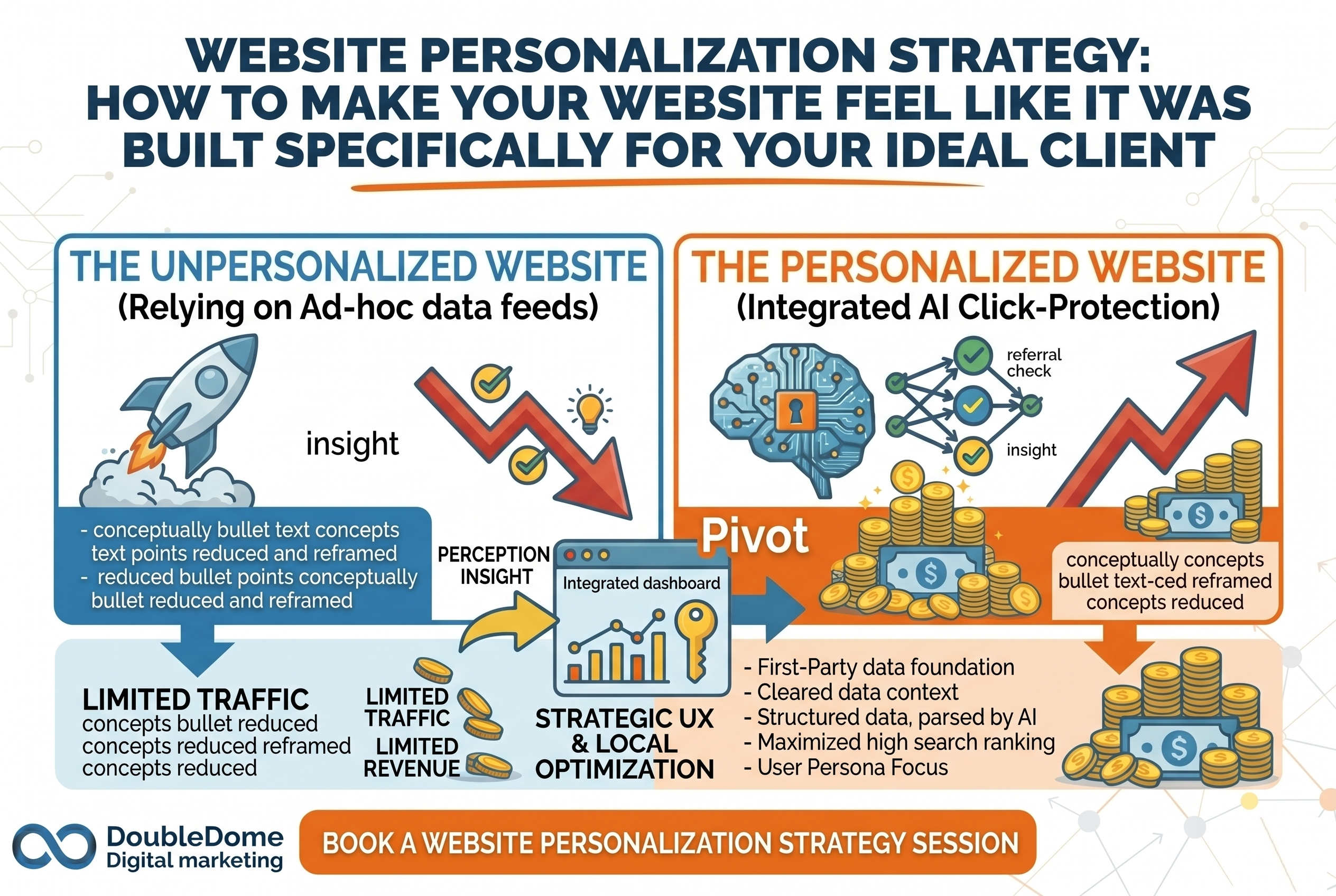
The Generic Trap: Why “Everyone” Means “No One”
You’ve invested heavily in your digital presence, but your conversion rates are stagnant. You’re looking at a dashboard that shows traffic is up, yet the pipeline feels thin. As a CEO focused on scaling systems, this is the ultimate frustration. In 2026, the reality is that the “AI Slump” has made generic content invisible. If your website speaks to “everyone,” it effectively speaks to no one.
When a high-value prospect lands on your site, they are looking for a mirror. They want to see their specific problems, their industry jargon, and their unique obstacles reflected back at them. If they don’t feel “seen” within the first five seconds, they bounce—and you’ve just wasted a high-cost click. You don’t need more “fluff” about algorithm updates; you need a system that makes you the obvious choice for your leads. You need a Website Personalization Strategy that makes your site feel bespoke without the cost of rebuilding it from scratch.
The Guru Insight: Personalization Without the Price Tag
Many CEOs avoid personalization because they assume it requires an enterprise-level tech stack and months of development. The truth? Effective personalization is a strategic layout choice, not a coding nightmare. In 2026, authority is built through “Information Gain”—unique insights that prove you understand the visitor’s world.
By layering simple, role-based pathways and industry-specific landing pages, you create a “Multi-Visit Conversion Architecture.” This makes the visitor feel understood. Furthermore, this clarity doesn’t just help humans; it helps AI. When Google Gemini or ChatGPT scans your site, a structured, specific architecture allows the AI to cite you as the definitive expert for a particular niche. To stop renting growth and start owning your market, you must transition to a Website Personalization Strategy that prioritizes precision over broad reach.
3 High-Impact Moves to Personalize Your Website
You can achieve “bespoke” levels of trust with three low-effort, high-impact moves that align with a modern Website Personalization Strategy:
1. The “Choose Your Own Adventure” Hero Section
Instead of a generic headline like “The Leader in B2B Solutions,” use your header to segment your audience immediately. Buttons like “I am a CEO looking to scale” vs. “I am a Marketing Director looking for data integrity” guide users to content that addresses their specific KPI.
2. Role-Based Messaging Variations
A CEO cares about ROAS and market ownership; an Operations Manager cares about efficiency and integration. By creating service pages tailored to the role of the person reading, you ensure the messaging hits the right pain points without the “fluff” that turns off executive buyers.
3. Contextual Social Proof Placement
Don’t just have a generic “Reviews” page. If a visitor is on your “Logistics Solutions” page, they should see case studies from logistics companies. Matching social proof to the visitor’s likely situation creates an immediate psychological bond of “they’ve done this for people exactly like me.”
Comparison: Generic Content vs. Personalized Strategy
| Feature | Generic Website (Legacy) | Personalized Strategy (2026) |
| User Experience | One-size-fits-all / High bounce | Role-based / High engagement |
| Search Position | Chasing keywords | Preferred AI Answer |
| Lead Quality | High Noise / Mixed Intent | High Precision / Pre-vetted |
| Conversion Rate | Industry average | 2x-3x higher than average |
| AI Citation | Often ignored as “Generalist” | Cited as “Niche Authority” |
| CEO Result | Renting Traffic / Guesswork | Spent $X, Made $Y Transparency |
Moving Beyond “Fluff” to Market Ownership
Lucas, you have zero patience for agencies that talk about “impressions” when you want to talk about revenue. You want a growth engine that works while you sleep. Implementing a Website Personalization Strategy is the technical backbone of that engine.
When a visitor feels like your website was written for them specifically, conversion rates change dramatically. This isn’t jargon; it’s results. We build that feeling into your site—without rebuilding it from scratch—ensuring every dollar of your $15k/month is aimed at a human who actually wants to buy. We handle the 2026 tech shifts so you can focus on the big-picture wins.
FAQ: Navigating Website Personalization
Does personalization require a new website?
No. Most personalization can be achieved through clever architectural changes, such as role-based landing pages and segmented navigation, rather than a full redesign.
How does a Website Personalization Strategy help with AI search?
AI models prioritize “E-E-A-T” (Experience, Expertise, Authoritativeness, and Trust). A specific, personalized site structure provides clearer entity signals, making you the “Preferred Answer” for niche queries.
Will this increase my wasted ad spend?
Actually, it decreases it. By pointing your ads to personalized landing pages rather than a generic home page, you ensure that the high-cost clicks you pay for are greeted with exactly what they were looking for.
Build the System That Makes You the Obvious Choice
Stop chasing clicks and start owning your market. In 2026, you don’t need more traffic—you need more customers. Your website should be your hardest-working salesperson, speaking directly to your ideal client’s needs every hour of the day.
At DoubleDome Digital Marketing, we act as the technical backbone of your team. We move past the jargon to deliver high-quality leads and clear, honest data. We’ll help you build a site that finally acts like the growth engine you need.
Ready to stop the guesswork and start scaling?
Book a Website Personalization Strategy Session with DoubleDome Today.