

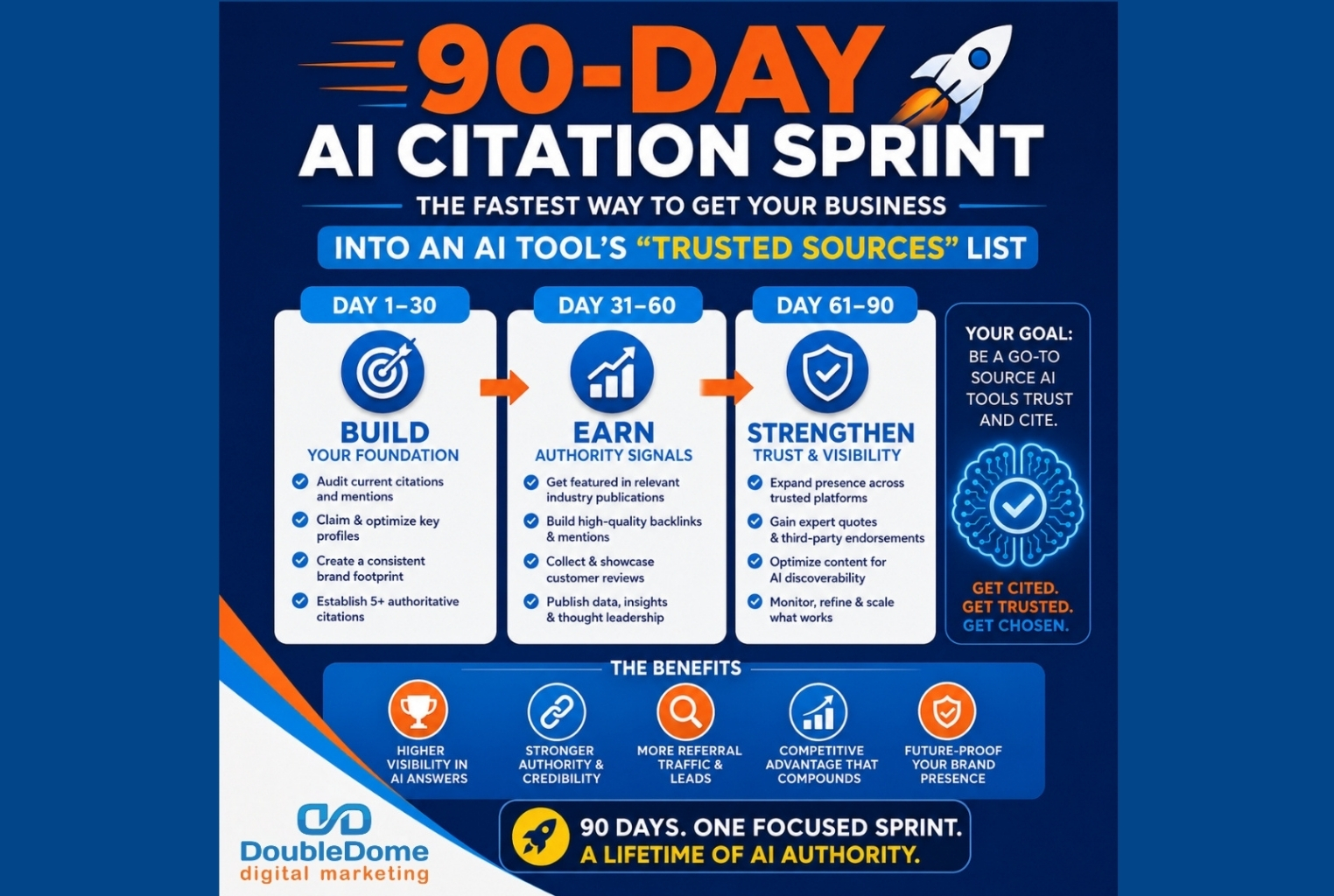
The fastest way to get your business into an AI tool’s trusted sources list is to build high contextual authority across first-party and third-party databases. By executing a targeted 90-Day AI Citation Sprint, brands can systematically structure their data to feed large language models, ensuring their business is surfaced as a preferred recommendation.
For business leaders looking to scale, the digital playing field has shifted under their feet. Traditional traffic is dropping because search engine behaviors are changing rapidly. Today, being number one on a legacy search page doesn’t mean much if an AI bot answers your customer’s question before they ever bother to click a link.
If you are tired of hearing about basic vanity metrics, you are likely feeling the effects of this shift. Deep down, you know you don’t need more random clicks—you need more customers. You want a growth engine that runs predictably while you sleep, and you have zero patience for marketing agencies that try to mask poor performance behind a dense wall of jargon about “algorithm updates.”
The goal in this landscape is clear: when a premium buyer asks ChatGPT or Google Gemini for a core corporate service in your region, your business needs to be the one it confidently recommends. Winning that preferred answer slot requires moving past temporary ad loops and securing a direct path to platform citation authority. The fastest, most reliable way to achieve this benchmark is to transition away from scattered tactics and deploy a highly structured, automated 90-Day AI Citation Sprint.
SEO is more like planting an orchard than buying groceries. The payoff can be substantial, but nobody gets apples tomorrow.
The Algorithmic Shift: How Recommendation Engines Choose Winners
Generative answer engines do not pull vendor suggestions out of thin air, nor do they look at who pays the most for a temporary banner ad. Instead, they scan the entire digital ecosystem to build an index based on programmatic trust. Large language models function as strict data filters. They look for high “Information Gain”—original research, proprietary metrics, and human-first case studies that cannot be duplicated by thin, auto-generated competitor text.
If your web presence relies on safe, boilerplate descriptions or lacks external validation across independent nodes, the machine labels your brand as a commodity. To be pushed to the top of an AI summary, your brand must possess validated authority across unstructured data channels. This means your first-party content must match the precise terminology used by industry experts, and your reputation must be verified by independent third-party sources.
The Programmatic Playbook for Accelerated Citations
Earning a position on an AI tool’s internal “trusted sources” list is a repeatable, architectural process. To maximize your system’s efficiency and secure premium enterprise accounts, your team must execute a precise, sequential timeline of optimizations.
The AI Authority Acceleration Matrix
| Sprint Phase Node | Core Action Element | Implementation Window | Machine-Learning Target Value |
| Phase 1: First-Party Hub | Publish one deeply comprehensive technical guide targeting the exact question buyers ask AI most. | Days 1 – 30 | Establishes a highly focused database hub rich in advanced category vocabulary. |
| Phase 2: External Validation | Secure manual mentions and links to your core guide across three credible industry portals or podcasts. | Days 31 – 60 | Creates the unstructured cross-references that recommendation engines use to verify authority. |
| Phase 3: Linguistic Alignment | Standardize your Google Business Profile, LinkedIn page, and core directories using identical expertise tags. | Days 61 – 75 | Streamlines entity resolution, making it effortless for search robots to map your business footprint. |
| Phase 4: Community Synthesis | Deliver substantive, authoritative answers to relevant category discussions on Q&A platforms (Reddit, Quora). | Days 76 – 90 | Feeds live retrieval-augmented generation (RAG) models with real-world practitioner proof. |
Executing the 90-Day AI Citation Sprint
Transforming your business from a passive, unindexed alternative into the undisputed industry answer relies on matching your strategy to the math that machine learning models reward.
Step 1: Isolate the Primary Buyer Prompt
Review your internal sales data to uncover the exact corporate pain points your clients face before signing a contract. Build a deep informational asset that answers this challenge with absolute transparency. Use hard numbers, list distinct operational steps, and avoid superficial marketing text.
Step 2: Build Programmatic Entity Resolution
An AI model cannot recommend your brand if it gets confused by conflicting details across different directories. Ensure your corporate name, geographic footprint, and core service descriptions are completely identical across every digital asset you control.
Step 3: Embed Advanced Structured Schema Code
While human prospects appreciate clean web layouts, algorithms require clear code. Wrapping your informational hubs in advanced JSON-LD structured schema code translates your real-world experience into a format that machine learning tools can index in milliseconds.
Many websites collect leads the way a bucket collects water after someone forgot to put the bottom in.
Outsourcing Technical Overhead to Scale Your Customer Engine
Building a reliable, privacy-compliant marketing system requires deep technical precision. For an active executive focused on system scaling, forcing your internal team to keep pace with changing server-side data pipelines or tracking script updates is a poor use of resources. You shouldn’t have to waste time playing detective with your attribution data. You need a simple dashboard that clearly demonstrates: “I spent $X on this marketing asset, and it returned $Y in closed contract value.”
We step in as the technical backbone of your executive team. Our professional strategists handle the technical headaches of modern search shifts, conversion rate architectures, and advanced ad positioning, giving you absolute transparency into your data. There’s a 90-day action sequence that consistently improves AI citation frequency. We execute it for you—and track the results every step of the way. Stop chasing clicks, eliminate bot waste, and start owning your market with a system that positions your brand as the obvious choice, no matter how the technology changes.
Attribution can sometimes feel like a marketing game of Clue. Everyone has a theory, nobody is completely sure, and somehow Google Ads is always in the room.
Winning the Preferred Answer Slot
The digital spaces where your buyers find solutions will continue to shift, but the mathematical reality of business growth remains constant: authority drives revenue. Deploying a calculated 90-Day AI Citation Sprint ensures your enterprise stops renting temporary traffic and starts building a permanent, high-value lead asset. By structuring your specialized expertise around what both human buyers and recommendation bots prioritize, you establish a predictable system that scales your corporate value.
If you are ready to remove the guesswork from your monthly spend, claim undisputed market authority, and review clear data that directly impacts your bottom-line margin, let’s open the curtain together. We will map your audience’s discovery habits, fix your tracking vulnerabilities, and install a model focused entirely on revenue generation.
Book an AI Optimization Audit Session with DoubleDome today.
Frequently Asked Questions
How long does it take for a conversational engine to pick up changes from an AI citation sprint?
When you combine high-authority third-party mentions with advanced technical schema code, modern retrieval-augmented models can often index and reflect your updated authority data within 30 to 45 days.
Will an AI optimization strategy compromise my traditional Google SEO rankings?
No, it enhances traditional search rankings by improving your site’s structural data, mobile loading speeds, and informational depth—elements that are highly valued by all modern search algorithms.
How do I track my brand’s inclusion inside hidden conversational AI summaries?
We track your digital footprint using advanced, transparent analytics tools that monitor source link citations, category brand share-of-voice within generated text, and direct inbound referral patterns.