

AI Brand Coherence measures how uniformly a business defines its core services, target audience, and operational footprint across every digital touchpoint. Executing an AI Brand Coherence Audit eliminates conflicting brand signals across websites, directories, and social platforms—allowing conversational AI tools like ChatGPT and Google Gemini to confidently cite your company as the preferred local answer.
For growth-focused executives, watching your organic website traffic decline while acquisition costs creep higher is an incredibly frustrating reality. You know your company delivers exceptional service, yet when a prospective high-value client asks ChatGPT or Google Gemini to recommend the top service provider in your market, an inferior competitor gets cited instead.
The issue often isn’t your ad spend or your website layout. It’s a hidden technical liability hiding in plain sight: a complete lack of brand coherence across the web.
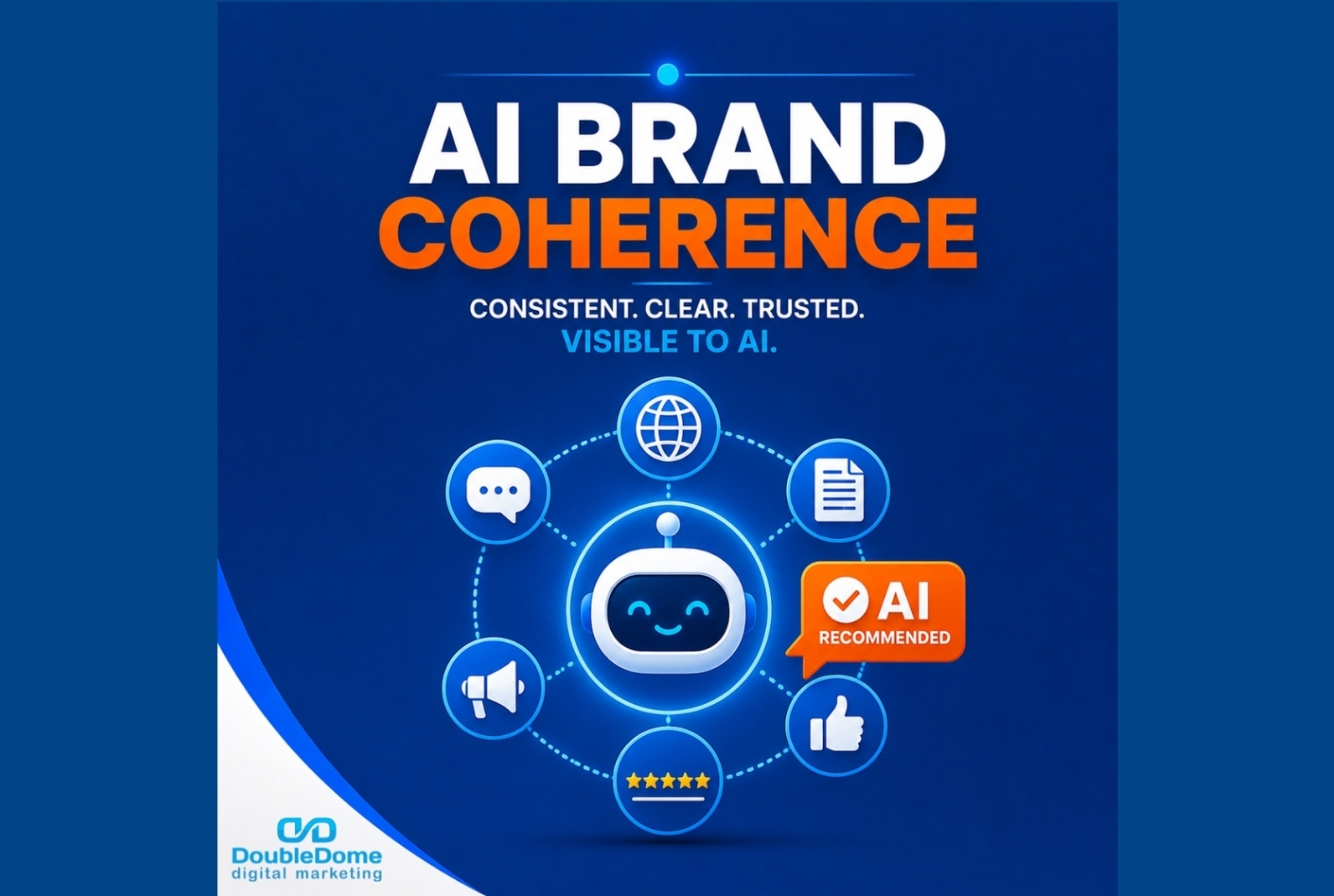
Over the years, your business has likely created digital assets in piece-by-piece fashion—a website written by one copywriter, a LinkedIn profile managed by an internal coordinator, directory listings submitted by a legacy agency, and press mentions using outdated messaging. While a human reader might look past subtle discrepancies in your service titles, artificial intelligence engines operate on mathematical entity confidence. When AI crawlers detect conflicting descriptions of what you do, who you serve, and where you operate, they view your business as ambiguous. Executing an AI Brand Coherence Audit systematically cleans up these conflicting signals, ensuring generative engines recommend your firm as the definitive answer.
Attribution can sometimes feel like a marketing game of Clue. Everyone has a theory, nobody is completely sure, and somehow Google Ads is always in the room.
How AI Recommendation Engines Evaluate Your Brand
Large language models (LLMs) do not guess which business is best. They scan millions of data points across websites, social platforms, B2B directories, and press releases to build a probabilistic knowledge graph of your company.
When an enterprise buyer prompts an AI assistant to find a vendor, the engine evaluates entity confidence:
- High Entity Confidence: Every digital source—from your website’s JSON-LD schema to your Bing Places profile—uses identical messaging, standardized service names, and aligned location parameters. Result: Preferred Answer Status.
- Low Entity Confidence: Your website calls you a “B2B Growth Consultancy,” your LinkedIn says “Marketing Agency,” an old press release calls you a “Digital Design Studio,” and directory listings list inconsistent addresses. Result: The AI drops your brand to avoid hallucinating inaccurate details.
AI brand coherence is the foundation of every other AI optimization strategy. Without it, other investments produce inconsistent results. We audit your coherence and build the consistency that makes everything else work.
The 4-Step AI Brand Coherence Audit Framework
To fix conflicting digital signals and build an unyielding competitive moat across AI search engines, run your company footprint through this four-step audit checklist:
1. Standardization of Core Entity Terminology
Define one canonical description of your business model, primary service offerings, and target customer profile. Eliminate outdated agency buzzwords and ensure your core messaging remains identical across your website, social headers, and corporate profiles.
2. Machine-Readable Schema Synchronization
Ensure your primary website hub features valid JSON-LD schema blocks. Matching backend code parameters directly with external directory descriptions gives machine algorithms explicit, structured proof of your capabilities.
3. Cross-Platform NAP and Service Perimeter Alignment
Verify that your Name, Address, and Phone (NAP) data—along with explicit service area zip codes—is perfectly mirrored across Google Business Profile, Apple Maps, Bing Places, and industry-vertical B2B databases.
4. Third-Party Citation and PR Alignment
Audit historical press releases, guest articles, and partner pages to ensure external web nodes describe your company using your standardized category terminology.
SEO is more like planting an orchard than buying groceries. The payoff can be substantial, but nobody gets apples tomorrow.
Brand Architecture: Disjointed Signals vs. Coherent Alignment
To understand why fragmented messaging quietly drains your acquisition efficiency, compare how traditional web setups perform against a coherent brand architecture in live AI search queries:
Digital Brand Signal Comparison
| Brand Evaluation Parameter | Fragmented Web Footprint (High Risk) | Coherent AI Brand Alignment |
| Service Category Signals | Conflicting titles across LinkedIn, website, and directories. | Single, standardized category naming across all digital assets. |
| Schema Data Integration | Non-existent or outdated HTML meta tags. | Validated JSON-LD schema code. |
| AI Recommendation Index | Low; LLMs filter out ambiguous or conflicting company profiles. | Preferred Answer Status: cited natively in ChatGPT and Gemini summaries. |
| Reporting Standard | Abstract PDF decks highlighting vanity impressions and clicks. | A simple, clear dashboard: “I spent $X, and our systems returned $Y.” |
Many websites collect leads the way a bucket collects water after someone forgot to put the bottom in.
Eliminating Fluff to Scale Your Net Pipeline
Stop chasing clicks and start owning your market. In 2026, you don’t need more traffic—you need more customers. We build the system that makes you the obvious choice for your leads, no matter how the tech changes. Just results, no jargon.
By conducting a comprehensive AI Brand Coherence Audit, you eliminate the hidden algorithmic friction that makes your business invisible to AI search engines, transforming your web presence into a predictable growth engine.
Outsourcing Technical Overhead to Scale Your Enterprise
Executing a complete brand coherence audit requires continuous technical precision—from updating machine-readable schema blocks to synchronizing server-side data feeds across external directories. For an active CEO, playing data detective or manually updating directory profiles is an inefficient use of strategic time. You have zero patience for agency fluff about “algorithm updates.” You want a simple, transparent dashboard built around financial reality: “I spent $X this month, and our systems returned$Y in closed contract revenue.”
We act as the trusted technical backbone of your internal leadership team. We remove the technical headaches, eliminate agency fluff, and build the automated systems that make your business the obvious choice for qualified buyers. We manage the complex backend technical integrations so you can maintain total focus on leading your company and closing major accounts.
Claiming Complete Ownership of Your AI Market Share
The digital interfaces where prospective clients locate enterprise solutions will continue to evolve, but the core math of business scale remains constant: clarity eliminates waste and drives sustainable profitability. Committing your organization to a systematic AI Brand Coherence Audit workflow guarantees that your team stops renting temporary traffic loops and starts building a permanent corporate growth engine.
If you are ready to eliminate bad leads, completely stop wasted ad spend, and review an honest performance dashboard that directly connects your digital investments to gross profit margins, let’s analyze your digital coherence together. We will locate your messaging gaps, repair your tracking vulnerabilities, and build an acquisition system focused entirely on revenue generation.
Book an AI Optimization Strategy Session with DoubleDome today.
Frequently Asked Questions
What is an AI Brand Coherence Audit and why is it necessary in 2026?
An AI Brand Coherence Audit is a comprehensive review that identifies and standardizes conflicting business descriptions, service names, addresses, and schema markup across the web, ensuring AI search models have high confidence when recommending your company.
How do conflicting digital descriptions hurt my visibility in ChatGPT and Google Gemini?
When AI tools detect inconsistent information across different websites, their entity confidence score drops. To avoid providing hallucinated or inaccurate data to users, the AI simply filters your business out of its recommendation answers.
Can server-side tracking measure revenue generated from AI search recommendations?
Yes, by deploying secure server-side offline conversion tracking (OCI) that routes encrypted CRM sales milestone data directly back to your marketing reporting dashboard, providing clear financial attribution for every lead.