

In 2026, Large Language Models (LLMs) and search bots don’t “read” your website like humans—they parse it as a data set. To be the “preferred answer” in ChatGPT or Google Gemini, you need an AI-friendly website built on structured schema, semantic headers, and explicit data connections that remove all guesswork for the machine.
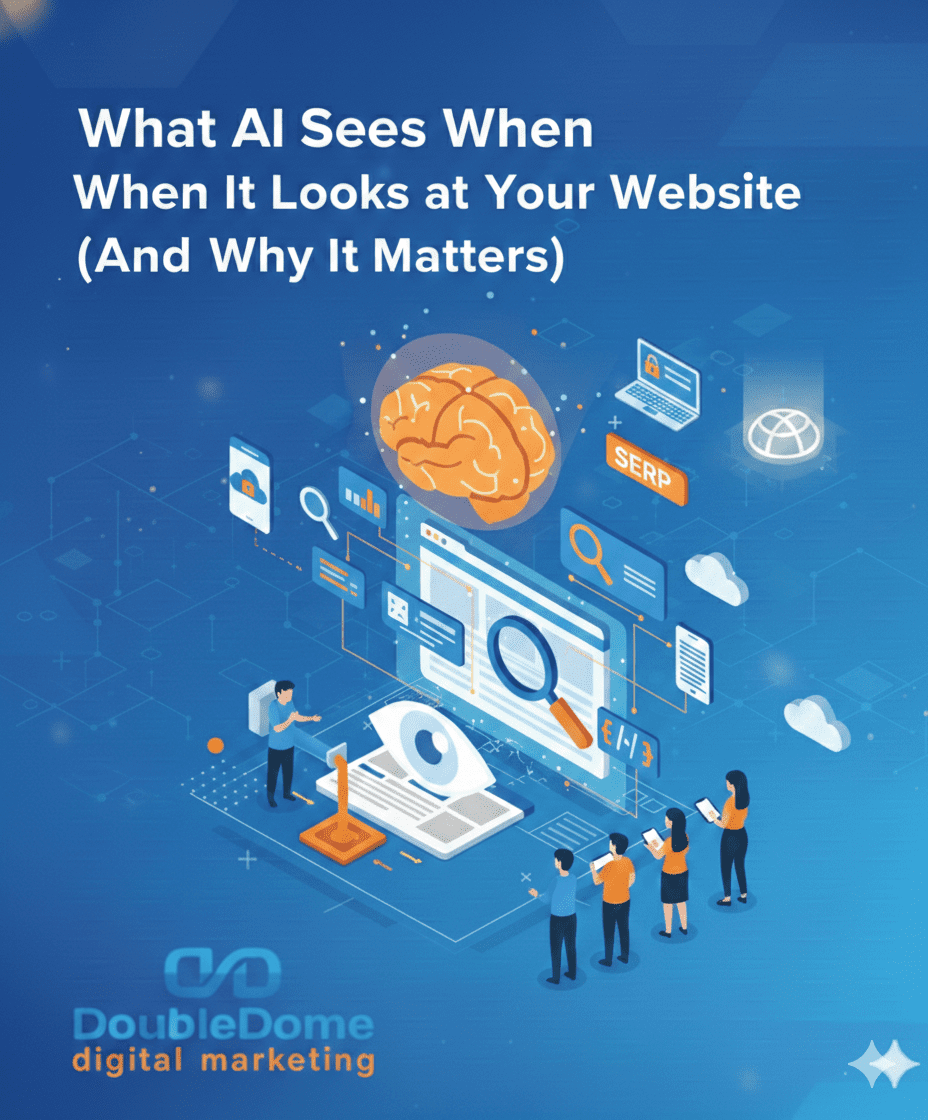
The Vision Gap: Why Your Best Content is Invisible
You’ve invested heavily in a high-end website. To a human prospect, the design is sleek, the copy is persuasive, and your authority is obvious. But when a sophisticated AI agent like Claude or a search-integrated LLM “looks” at that same page, it doesn’t see your brand’s prestige. It sees a chaotic sprawl of unstructured text and code.
If the AI cannot instantly categorize your service, verify your expertise, and map your location through your code, you simply do not exist in the “Answer Engine” era. This is why many CEOs are seeing an “AI Slump”—traditional traffic is dropping because the bots answering the questions don’t understand your site well enough to cite it as a source.
To own your market in 2026, you must stop building for eyes and start building for intelligence. You need an AI-friendly website that speaks the machine’s language without sacrificing the human experience.
How AI Interprets Your Digital Presence
AI tools use “semantic triples” (Subject-Predicate-Object) to build a knowledge graph of the world. When an AI crawls your site, it is looking for entities and relationships.
For example, a human sees: “Our team provides top-tier consulting in Atlanta.”
An AI looks for: Organization -> providesService -> Consulting -> areaServed -> Atlanta.
If those relationships aren’t explicitly defined in your site’s technical backbone, the AI has to “guess.” In a world where precision is the difference between a high-value lead and a wasted click, you cannot afford for an AI to guess what you do.
The Three Layers of AI Visibility
- The Structural Layer: Using H1-H4 tags not just for font size, but to create a logical hierarchy of information.
- The Schema Layer: Implementing JSON-LD markup to tell the AI exactly what your prices, reviews, and services are.
- The Semantic Layer: Using specific, authoritative terminology that links your brand to “Entity” nodes that AI models already recognize as trustworthy.
Why an AI-Friendly Website is Your Best Growth Engine
For the “System Scale” CEO, the goal isn’t just “more traffic”—it’s a predictable lead flow. When you optimize for AI, you are essentially training the world’s most powerful sales assistants (ChatGPT, Gemini, Perplexity) to recommend you.
An AI-friendly website acts as a 24/7 technical sales rep. It ensures that when a big client asks an AI, “Who is the best partner for [Your Service] in [Your City]?”, your business is the one with the most verified, easy-to-parse data. This is how you stop renting space from Google Ads and start owning the lead flow through your brand’s technical authority.
Comparison: Human Perception vs. AI Interpretation
| Feature | What a Human Sees | What an AI Needs to “See” |
| Trust/Authority | Professional photos and logos | Verified Schema Review and Author credentials |
| Services | Descriptions and bullet points | Service and Offer structured data types |
| Location | A map and a “Contact” page | LocalBusiness Geo-coordinates and NAP data |
| Expertise | Well-written articles | “Information Gain” and unique data citations |
| Navigation | A clean, clickable menu | A clear SiteNavigationElement and XML sitemap |
Eliminating the “Fluff” and Wasted Spend
Traditional agencies often hide behind “algorithm updates” and “brand awareness” metrics. In 2026, that’s just noise. If your website isn’t an AI-friendly website, you are likely suffering from wasted spend—paying for ads that bots click or traffic that never converts because the “Answer Engines” are steering high-intent users elsewhere.
The solution is a technical translation of your brand. By using structured data and semantic markup, we ensure AI tools correctly understand and cite your business. This isn’t just about SEO; it’s about building a system that delivers a measurable ROI: $X spent, $Y made.
FAQ: Making Your Website AI-Ready
What is an AI-friendly website?
An AI-friendly website is a site optimized for Large Language Models, featuring structured data (Schema), clear semantic hierarchies, and high “information gain” that allows AI to easily parse and cite the content.
Will making my site AI-friendly hurt my human user experience?
No. Most AI optimization happens in the code (the “technical backbone”) or through better content organization, which actually makes the site easier for humans to navigate and understand.
How do I know if AI can “read” my site correctly?
You can test your site using Schema validation tools and by prompting AI models to summarize your specific service offerings. If the AI misses key details, your site lacks the necessary structure.
Scale Your Lead Flow with an AI-Optimized System
Stop chasing clicks and start owning your market. In 2026, you don’t need more traffic—you need to be the definitive answer. We build the technical systems that make you the obvious choice for your leads, no matter how search technology changes.
At DoubleDome Digital Marketing, we translate your website into AI-readable formats. We handle the 2026 tech shifts so you can focus on the big wins. Just results, no jargon.