

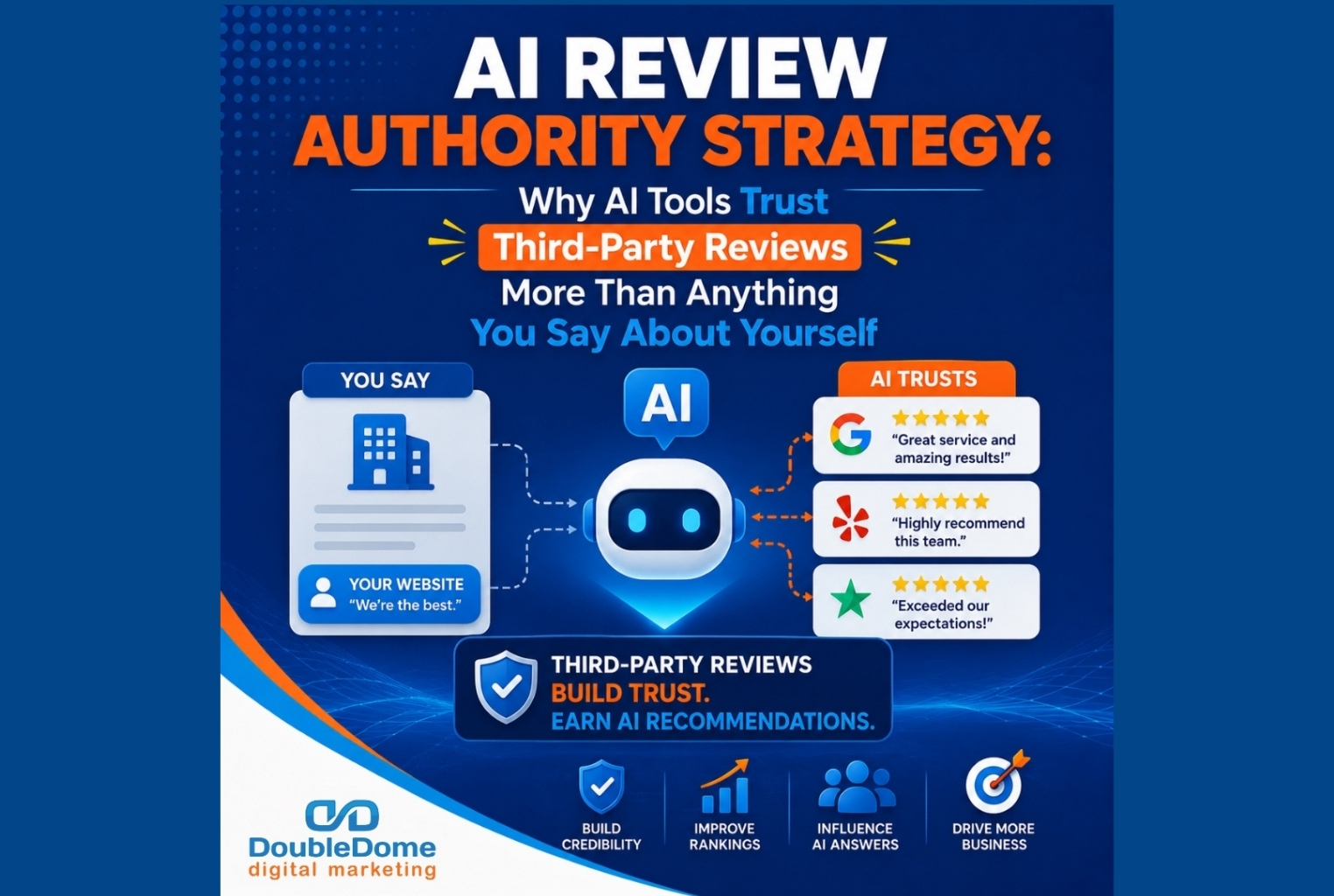
AI engines prioritize third-party reviews over first-party website content because algorithms view independent platforms as validated, unbiased social proof. To capitalize on this, businesses must implement a proactive AI Review Authority Strategy that feeds machine-learning models the external validation required to win the top recommended slot.
For years, scaling a business meant focusing heavily on what you controlled: your website, your content, and your ad campaigns. If you polished your homepage text to perfection and outspent the competition on standard keywords, you won’t have trouble winning your market.
But in 2026, the old playbook is showing its cracks. Traditional search engine traffic is shifting as users transition away from scrolling through blue links. Instead, high-value clients are asking tools like ChatGPT and Google Gemini to filter solutions for them directly. In this landscape, being number one on a generic directory doesn’t matter if an AI bot answers the user’s question before they ever look at a search results page.
If you are treating your online reviews as a passive corporate checklist or an administrative afterthought, you are missing the most critical algorithmic signal available. Moving from renting temporary clicks to owning your long-term lead flow requires a shift in perspective. To make conversational tools trust your brand, you need a proactive AI Review Authority Strategy built around how modern recommendation engines calculate credibility.
Many websites collect leads the way a bucket collects water after someone forgot to put the bottom in.
The Machine’s Bias: Self-Reported vs. External Verification
When an AI engine synthesizes an answer for an enterprise client looking for services, it scans your digital footprint through a highly skeptical lens. It treats your beautifully drafted website copy, your service definitions, and your blog posts as “self-reported claims.” The machine understands that you have a financial incentive to say you are the industry leader.
Third-party platforms like Google Business Profile, Clutch, G2, and industry-specific portals provide the algorithm with something entirely different: independent verification. AI systems cross-reference your site’s technical text with unstructured sentiment data across the web to see if your real-world outcomes match your marketing copy. A competitor with plain website content but fifty deeply detailed, scenario-specific external reviews will consistently be highlighted as the preferred answer over a company with flawless web copy and zero external proof points.
The Algorithmic Hierarchy of Trust
Recommendation engines evaluate digital trust signals using a strict, data-driven hierarchy. To turn your digital marketing into a predictable engine that generates high-quality customers while you sleep, you must understand how algorithms weight information across different sources:
The Trust-Signal Valuation Matrix
| Trust Metric Tier | Data Source Type | Algorithmic Weighting | Core Value to Recommendation Engines |
| Tier 1: High Trust | Independent Review Portals (Clutch, G2, Google Business Profile) | Critical Priority | Provides verified sentiment data, industry-specific vocabulary, and situational proof. |
| Tier 2: High Trust | Digital Citations & Factual Source Mentions | Strong Priority | Validates geographic presence, operational footprint, and market category association. |
| Tier 3: Moderate Trust | Case Studies & Native Portfolio Pages | Secondary Priority | Displays situational experience and industry expertise, but remains self-reported. |
| Tier 4: Baseline Trust | Standard Website Copy & Service Pages | Foundational Only | Sets up baseline categorization; viewed by models as a starting point rather than proof. |
Constructing an AI Review Authority Strategy That Wins Cites
Earning the top recommendation from conversational engines requires moving past reactive review monitoring and building a system that feeds machine-learning models the exact structural data they crave.
1. Optimize for Detailed, Contextual Sentiment
The days of chasing simple “Five stars, great service!” comments are over. AI models value descriptive keywords and industry-specific phrases. Encourage your partners to mention specific challenges, implementation timelines, and the exact software frameworks utilized. When an algorithm scans a review that says, “They migrated our legacy enterprise system in Dallas within 60 days under compliance parameters,” it can instantly pair your brand with high-intent corporate queries.
2. Diversify Across Relevant Category Nodes
Do not store your entire reputation asset in a single digital basket. If your review footprint is confined exclusively to one search portal, an AI engine analyzing alternative b2b data structures may overlook your brand. Maintain a steady, updated velocity of feedback across major general directories and vertical-specific platforms alike.
3. Implement Advanced Machine-Readable Schemas
To make it effortless for an engine to parse your external validation metrics, your website must utilize clean code. Integrating technical JSON-LD structured schema pulls your aggregate review scores, client case histories, and service perimeters into a format that search robots can index in milliseconds.
SEO is more like planting an orchard than buying groceries. The payoff can be substantial, but nobody gets apples tomorrow.
Eliminating Fluff Metrics for Predictable Revenue Scale
Investing heavily in complex digital media strategies can feel like a game of guesswork if your agency speaks only in vague terms like “algorithm updates” or “traffic impressions.” High-value business operations don’t need more random site visitors; they need more customers. True transparency means looking at an unambiguous dashboard that cleanly demonstrates: “I spent $X on this marketing system, and it returned $Y in real closed-contract revenue.”
Outsourcing the structural management of your search visibility, your conversion architecture, and your technical ad parameters protects your pipeline from automated bots and wasted click spend. We act as the technical backbone of your executive team, handling the daily algorithmic changes so you can maintain full focus on big-picture business growth. What others say about you carries more weight with AI than what you say about yourself. We help you build the review profile that makes AI tools trust—and recommend—your business.
Attribution can sometimes feel like a marketing game of Clue. Everyone has a theory, nobody is completely sure, and somehow Google Ads is always in the room.
Owning Your Market Position
The future of customer discovery is automated, objective, and deeply rooted in independent social proof. Transitioning your organization toward a continuous, intentional AI Review Authority Strategy ensures that your brand remains the top choice, regardless of how the search landscape shifts. By building an authoritative web presence supported by verified client success, you install a predictable growth engine that works around the clock.
If you are ready to eliminate the guesswork from your digital spend, claim the preferred answer slot in your category, and build an asset your company fully owns, we can show you the exact blueprint. Let us audat your current digital footprint, establish clear tracking frameworks, and implement a strategy focused entirely on revenue generation.
Book an AI Optimization Strategy Session with DoubleDome today.
Frequently Asked Questions
Why do ChatGPT and Gemini ignore my website content when making recommendations?
AI engines treat your own web copy as self-reported marketing material; they prioritize unstructured third-party review data and external citations to ensure their recommendations are objective and factually accurate.
How many reviews are required to establish authority with conversational engines?
Volume is important, but context and depth matter more; thirty comprehensive, technically descriptive reviews detailing specific industry solutions carry more weight than a hundred short, generic ratings.
Can an agency delete fake or malicious negative reviews that harm my AI profile?
While you cannot directly erase reviews, a structured data strategy relies on consistent review acquisition velocity and official dispute processes to ensure your overall sentiment score remains high and accurate.