
By admin
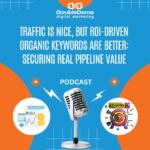

In this episode, we explore why organic traffic volume isn’t necessarily the best measure of SEO success.
Ranking first for a high-volume keyword can look impressive in a report, but if the people searching for that term have no intention of buying, the traffic may provide little business value. The better approach is to focus on search terms used by people who are actively evaluating solutions and are closer to becoming customers.
That’s the foundation of ROI-driven organic keywords. Instead of optimizing simply for more clicks, businesses can build their SEO strategy around commercial intent, qualified leads, and measurable pipeline value.
Why Traffic Volume Isn’t the Whole Story
A website can generate thousands of organic visitors and still struggle to produce meaningful revenue.
Consider the difference between 5,000 visitors who are casually researching a topic and 50 visitors who are specifically looking for a company that provides the service you sell.
The second audience may be far more valuable.
The goal of SEO shouldn’t simply be to maximize traffic. It should be to attract the right traffic—people who have a genuine need, understand what they’re looking for, and are actively evaluating potential providers.
What Are ROI-Driven Organic Keywords?
ROI-driven organic keywords are search terms selected based on their potential to generate qualified business opportunities rather than their search volume alone.
These keywords typically have stronger commercial or transactional intent and often include specific details about a service, industry, location, problem, or solution.
Instead of targeting broad phrases, an SEO strategy can focus on searches such as:
- Specific services
- Industry-specific solutions
- Regional service searches
- Problem-and-solution queries
- Buyer-focused comparisons
- High-intent long-tail searches
The objective is simple:
Generate fewer irrelevant clicks and more opportunities that can become revenue.
The Difference Between Traffic and Commercial Intent
Search intent determines the potential value of a keyword.
Someone searching for “what is SEO” may simply be researching.
Someone searching for “enterprise SEO agency Atlanta” has a much stronger commercial signal.
That distinction matters.
A successful ROI-driven organic keywords strategy prioritizes searches that indicate a prospect is moving closer to a purchasing decision.
How to Identify ROI-Driven Organic Keywords
Finding valuable keywords requires looking beyond search volume.
Start With Your Highest-Value Customers
Identify the services, products, and customer segments that generate the greatest revenue for your business.
Then determine what those customers would search for when they begin evaluating solutions.
Look for Specific Search Intent
Long-tail keywords often provide more information about what the searcher actually wants.
A highly specific query can reveal location, industry, problem, service type, or buying stage.
These details can make the keyword more commercially valuable even when its monthly search volume is relatively low.
Evaluate Existing Organic Traffic
Look at the pages already generating organic traffic.
Then ask an important question:
Are those visitors actually relevant to the business?
If a high-traffic page generates little engagement or few qualified leads, it may be less valuable than a lower-traffic page attracting decision-makers.
Connect SEO to Revenue
The ultimate test is what happens after the visitor arrives.
Connect organic traffic with lead generation, CRM milestones, sales opportunities, and closed revenue whenever possible. This creates a much clearer picture of which keywords are actually contributing to business growth.
Optimize Existing Content for Commercial Intent
You don’t necessarily need to publish hundreds of new articles to improve organic revenue.
Existing content can often be repositioned around more valuable search intent.
Review pages that already receive organic traffic and determine whether they:
- Match the searcher’s actual intent
- Provide authoritative information
- Include relevant calls-to-action
- Make the next step obvious
- Link to related commercial pages
- Contain useful first-party expertise
- Use appropriate structured data
This approach can turn existing organic visibility into stronger business opportunities.
Why Structured Data Supports ROI-Driven SEO
Search engines and AI-powered systems increasingly need to understand not just what a page says, but what the information represents.
Relevant structured data can help communicate important details about your organization, services, and frequently asked questions in a machine-readable format.
For an ROI-driven organic keywords strategy, this supports the broader goal of making commercially valuable content easier for automated systems to understand and interpret.
Why ROI-Driven Organic Keywords Matter in 2026
Search is changing.
Customers increasingly use conversational search and AI-powered platforms to research companies and solutions. Broad, generic content can struggle to differentiate itself in an environment where automated systems can summarize huge amounts of information.
Specific expertise, original information, and strong commercial relevance become increasingly important.
That means businesses should think beyond:
“How many people visited our website?”
And start asking:
“How many of the right people found us?”
A strategy built around ROI-driven organic keywords shifts SEO toward that second question.
Signs Your SEO Strategy Needs More Commercial Intent
You may need to rethink your keyword strategy if:
- Organic traffic is increasing but leads aren’t.
- Your highest-ranking pages attract irrelevant visitors.
- Your SEO reports focus heavily on traffic volume.
- Sales teams receive few qualified leads from organic search.
- Your content targets broad informational keywords without a clear business connection.
- You aren’t connecting organic performance to CRM revenue.
- Your competitors appear for highly specific buyer searches that you don’t target.
These are signs that traffic growth may be masking an underlying intent problem.
Key Takeaways
- More organic traffic doesn’t automatically mean more revenue.
- Search intent is often more important than search volume.
- Long-tail commercial searches can attract highly qualified prospects.
- Existing content can be optimized around stronger commercial intent.
- Calls-to-action and conversion paths should align with the visitor’s intent.
- Structured data can help communicate important information to search engines and AI systems.
- Connecting SEO data to CRM outcomes provides a clearer view of business value.
- ROI-driven organic keywords shift SEO from vanity traffic toward qualified pipeline and revenue.
Final Thoughts
You can’t deposit website clicks at the bank.
The real value of SEO comes from attracting people who have a genuine need for what your business provides.
A well-executed ROI-driven organic keywords strategy focuses your content, technical SEO, and conversion efforts on the searches most likely to produce meaningful business opportunities.
Instead of asking how much traffic you can generate, ask a better question:
Which searches bring the customers we actually want?
That’s where organic search starts becoming a revenue-generating asset rather than just another traffic channel.